



Vehicle Lift Manufacturers Help Inspectors Become Certified
To help accelerate the process and fill the need for Certified Lift Inspectors, ALI member manufacturers came together to hold a five-day “all-in-one” training, testing, and practical inspection event in Las Vegas Nov. 3-6, 2014.
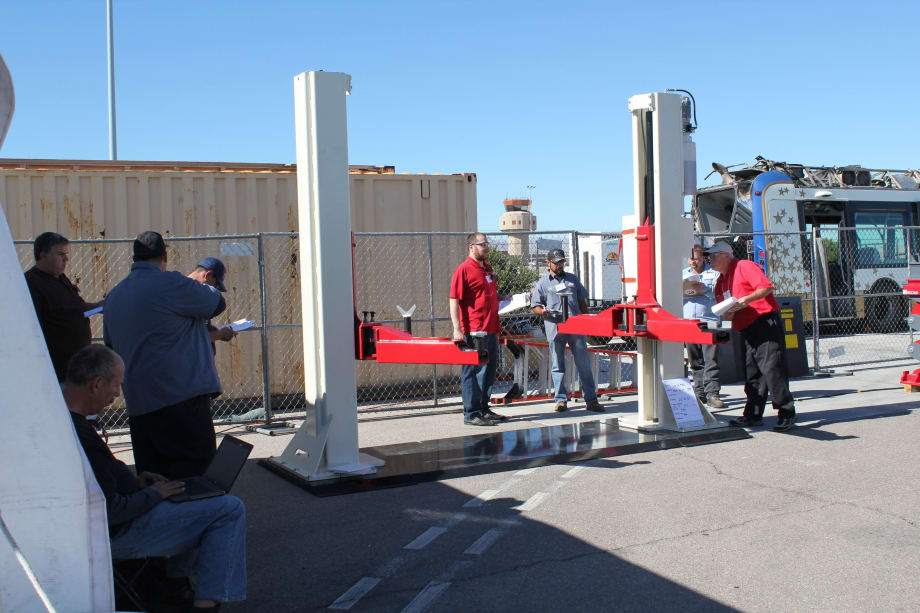
ALI Lift Inspector Certification program candidates inspect a heavy-duty two-post lift at the Regional Transportation Center in Las Vegas as part of the Five Days to Victory accelerated certification program organized by several ALI member manufacturers in November. Photo courtesy of ALI
ALI Lift Inspector Certification program candidates inspect a heavy-duty two-post lift at the Regional Transportation Center in Las Vegas as part of the Five Days to Victory accelerated certification program organized by several ALI member manufacturers in November. Photo courtesy of ALI
Since the Automotive Lift Institute (ALI) launched its Lift Inspector Certification Program in late 2012, demand for ALI Certified Lift Inspectors has continued to grow. Although some inspectors complete the certification requirements quickly, others may take six months to a year to achieve certification. To help accelerate the process and fill the need for Certified Lift Inspectors, ALI member manufacturers Rotary Lift, Forward Lift, Challenger Lifts, Mohawk Lifts, PKS, and Stertil-Koni USA came together to hold a five-day “all-in-one” training, testing, and practical inspection event in Las Vegas Nov. 3-6, 2014.
Called “Five Days to Victory,” the event offered candidate inspectors who had passed the pre-course exam the opportunity to complete all the other certification requirements: an orientation workshop, course examination, and 12 practical inspections. Additionally, participants could attend a full-day study group on Tuesday led by ALI Factory Designated Trainers to prepare for the next day’s exam. Although ALI has held previous “all-in-one” events, this manufacturer-led event was the first to include practical inspections. A total of 91 candidates participated over the week.
The ALI Lift Inspector Certification Program was created to provide third-party qualification of vehicle lift inspectors and to certify those who demonstrate that they are capable of properly inspecting any type of lift from any manufacturer in accordance with the ANSI standard governing vehicle lift inspection and in support of OSHA’s General Duty Clause, as well as provincial requirements in Canada. The program is open to anyone with a minimum of 12 months experience as a lift inspector. To obtain certification, participants must attend a six-hour orientation workshop, pass a written pre-course exam and final course exam, and properly complete 12 practical lift inspections on a range of vehicle lifts.
Annual lift inspections help protect technicians by ensuring that the lifts they work under are installed correctly, functioning properly, and adequately maintained. The inspections are required by ANSI/ALI ALOIM:2008 (R2013), the national standard covering vehicle lift operation, inspection, and maintenance. Companies with an ALI Certified Lift Inspector on staff are listed in a directory on the ALI website. The directory is searchable by ZIP code to make it easy for lift owners to find a local inspector. For more information about the program or to find a local ALI Certified Lift Inspector, visit www.autolift.org/inspection.
More Operations

Fleet Replacement Decisions, Waste Fleet Technology and the GFX Deadline
Is your next vehicle the right fit, can your records settle a missed pickup dispute, and what could your fleet teach others at GFX 2027?
Read More →
Is Delaying Fleet Replacement Really Saving Money?
Could delaying replacement cost your fleet more than it saves? This week’s recap takes a closer look, plus an update on GFX 2027.
Read More →
What Government Fleets Are Missing About Their True Costs
What are fleet budgets missing, and how can agencies use the data they already collect to make a stronger case for change?
Read More →
Rethinking Fleet Decisions From the Budget Office to the Shop
This October we looked back at how public fleets are reconsidering familiar processes and using what they learn to make better decisions.
Read More →
Who Owns the Message on a Refuse Truck?
Refuse trucks can carry public messages into neighborhoods, but keeping those messages current takes planning and clear responsibility.
Read More →
Who Deserves Fleet Recognition and What Could You Teach at GFX?
Who helped shape your fleet career, and what have you learned that could help someone else?
Read More →
What’s Haunting Public Sector Fleets?
Public sector fleet challenges rarely happen in isolation, and addressing one often means understanding how it connects to another.
Read More →
Is Keeping Older Fleet Vehicles Really Saving Money?
Is keeping vehicles longer saving money, and what happens when a diagnostic test points to the wrong fix?
Read More →
How Smart Fleet Strategy Can Help Local Government Agencies Do More with Less
Keeping a vehicle longer may ease this year’s budget, but what does it cost the next one? A closer look at fleet decisions can reveal opportunities to reduce spending while protecting essential services.
Read More →
Connect with Government Fleet on LinkedIn
From industry news and fleet management strategies to conversations with peers, Government Fleet's LinkedIn page offers public-sector fleet professionals another way to stay informed and connected.
Read More →