





Related: Survey Says: 80% of Fleet Managers Expect Budget Reductions Next Year
Survey Says: Return of Fleet Workers Varies
In a Government Fleet survey, 15% of respondents said more employees have come back to work in the past two weeks, while 13% said their workforce has decreased.
June 5, 2020
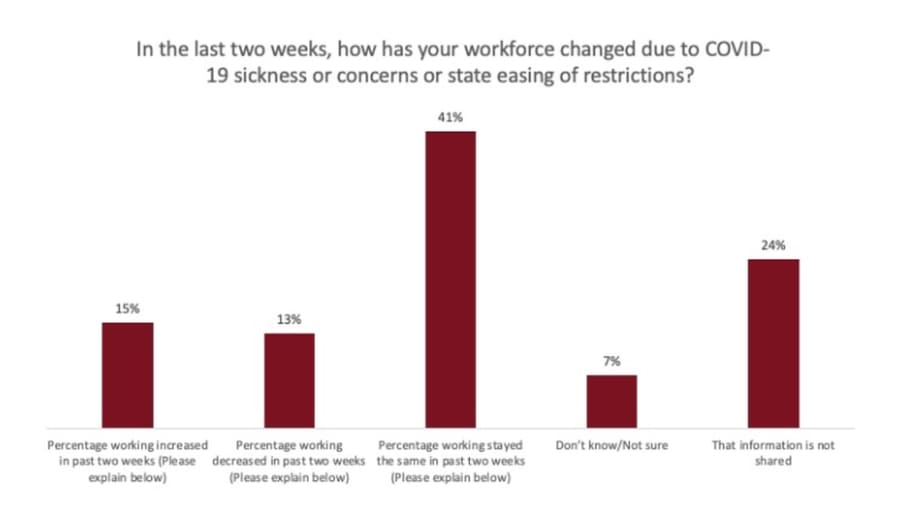
41% of respondents said their workforce has stayed the same in the past two weeks.
Data: Government Fleet
2 min to read
States are starting to open again after shelter-in-place orders to prevent the spread of the COVID-19 virus, and in response, government fleet managers are changing the way they do business. For some, that means more employees are back at work and for others, it’s the opposite. In a Government Fleet survey, 15% of respondents said more employees have come back to work in the past two weeks, while 13% said their workforce has decreased. Meanwhile, 41% said their workforce stayed the same in the past two weeks.
Those whose workforce increased said they started bringing technicians who had been working from home back to the shop, began opening up more shops, had fewer sick employees, and saw an increase in work as customers went back to work or used their vehicles more (such as more patrols for police). Those with a decreased workforce said they closed shops, employees took paid leave or were sent home on leave due to agency policy, employees tested positive for coronavirus, they saw a decrease in work, and they cut back on office staff.
Government Fleet conducted a survey of its readership on May 14, with results tabulated on May 26. The survey received 91 responses from public sector fleet professionals. This is the second COVID-19 survey — results of the first one can be found this page of the COVID-19 Data Center.
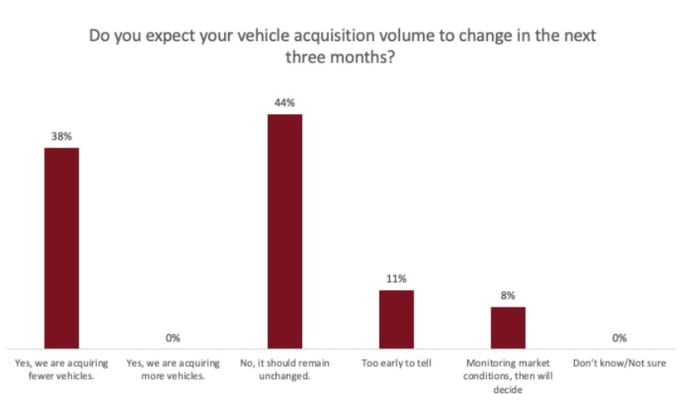
More than one-third of respondents said they expect to reduce purchases in the next three months.
Data: Government Fleet
Nearly three-fourths of respondents (71%) said they have taken steps to ensure that they have the parts needed to keep vehicles maintained and on the road. Still 27% said they anticipate being unable to obtain parts for their vehicles in the next month.
In the May survey, fewer respondents said they expect a decrease in operational budget next year, with 69% reporting this (versus 78% in April). However, about the same percentage said they expect decreases in next year’s capital/procurement budget (78% in May versus 81% in April).
As for short-term acquisition plans, 38% said they plan acquire fewer vehicles in the next three months, while none said they plan to acquire more vehicles during this time period.
Full survey results are available at the COVID-19 Data Center.
More Operations

Fleet Forward Conference Introduces One-Day Passes for 2026
New one-day registration lets fleet professionals attend Tuesday, Wednesday, or Thursday, with passes available for $249.
Read More →
ENC Unveils its ZAVIR Medium-Duty Shuttle
Two variants of the concept shuttles were revealed: a low-floor configuration and a high-floor configuration.
Read More →
Could Your Next Fleet Technician Start as an Intern?
What if your next technician hasn’t worked in a fleet shop yet? What fleets are doing to free up time.
Read More →
How Phoenix Is Building Its Next Generation of Fleet Technicians
With more than 8,000 vehicles and pieces of equipment to maintain, the City of Phoenix could not afford to wait for fully trained technicians to walk through the door. Instead, they revamped their entire workforce strategy and showed how public fleets can create their own talent pipeline while preparing existing employees for increasingly complex vehicles.
Read More →
What’s Slowing Your Fleet Down?
Could a change in how work gets done help your fleet return vehicles to service sooner?
Read More →
Can Public Fleets Trust the Data Driving Their Decisions?
Public fleets have more data than ever, but inconsistent records and missing information can still undermine maintenance, replacement, and cost decisions.
Read More →
John Deere Introduces 40 P-Tier Compact Excavator
John Deere is adding a compact excavator designed for crews that need to move equipment between jobsites and handle multiple types of work with one machine. The 40 P-Tier weighs less than 10,000 pounds and offers configurable hydraulics, attachment options, and connected fleet-management capabilities.
Read More →
How Leading Fleets Improve and Why Business Plans Matter
This week, we look at what past Leading Fleet winners can teach us about making progress, plus how to build a business plan your fleet will actually use.
Read More →
Nominate a Fleet Leader for the 2027 Public Fleet Hall of Fame
Do you know a fleet leader who has made a lasting impact on the industry? Nominate this fleet professional for the 2027 Public Fleet Hall of Fame.
Read More →
Why Fleet Business Plans Need Three Perspectives
A fleet business plan should help agency leaders understand the fleet’s value, give the organization a clear direction, and establish shared expectations with customer departments.
Read More →