





Similar Content: RUBICONSmartCity Launches on the Geotab Marketplace
Santa Fe's Smart Technology Benefits Highlighted in Docuseries
Santa Fe's trash and recycling workers use RUBICON's proprietary app for real-time updates on their routes.
January 27, 2022
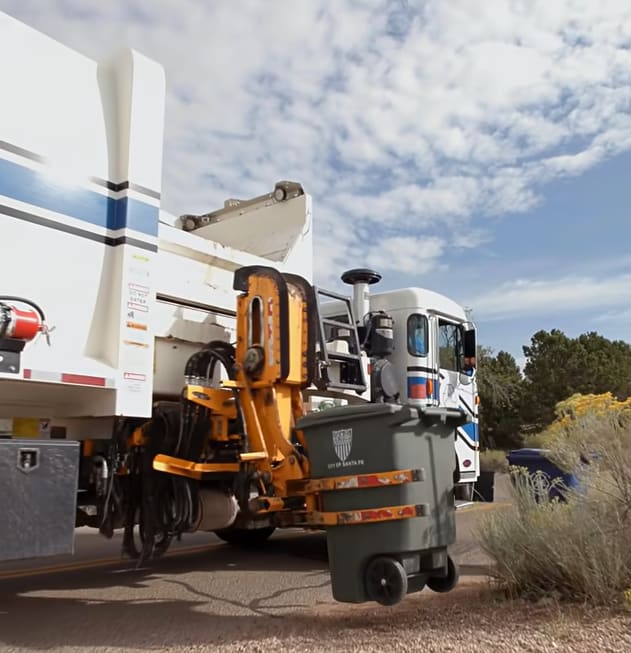
Santa Fe's trash and recycling workers use RUBICON's propreitary app for real-time updates on their routes.
Photo: Amazon
2 min to read
Using technology on its waste and recycling trucks, the City of Santa Fe, New Mexico, has improved customer service for city residents by reducing the number of missed pickups, optimizing collection routes, eliminating paper route sheets, and automating the tracking of customer issues. It has also saved taxpayer dollars by reducing fuel consumption and wear and tear on vehicles.
The city is featured in a four-part docuseries, called "Climate Next," focusing on a selection of Amazon Web Services (AWS) partners using the cloud technology to enable sustainability efforts. Santa Fe has been using Rubicion SmartCity for smart waste and recycling solutions.
Each of Santa Fe’s trash vehicles collects garbage and recycling from between 800 and 900 locations per day. Drivers carry a smartphone running Rubicon’s proprietary app, which provides optimized collection routes and live telematics information, and streams that data back to city headquarters via the cloud. Managers and supervisors can track the service status at every home in the city, monitor route progress, and address issues in the field. These are all essential insights for efficient program operations.
Before using the smart technology, recycling supervisor Abran Sanchez said crews missed up to 60 pickups per day, forcing them to return to those locations along their routes to complete the pickups. That led to higher labor costs and wasted fuel. This technology allows them to stay on track in real time, and provide updates on issues they face in the field.
Sanchez also said the number of residents who recycle has gone up since the department started using the technology.
“These efficiencies will reduce our carbon emissions associated with service delivery, moving us toward Santa Fe’s goal of carbon neutrality by 2040," said Shirlene Sitton, Environmental Services Division director for the city.
More Operations

How Smart Fleet Strategy Can Help Local Government Agencies Do More with Less
Keeping a vehicle longer may ease this year’s budget, but what does it cost the next one? A closer look at fleet decisions can reveal opportunities to reduce spending while protecting essential services.
Read More →
Connect with Government Fleet on LinkedIn
From industry news and fleet management strategies to conversations with peers, Government Fleet's LinkedIn page offers public-sector fleet professionals another way to stay informed and connected.
Read More →
Town of Queen Creek Named Most Successful Fleet Award Winner of Inaugural RTA Fleet Success Awards
Five fleets were honored at RTA Connect 2026 in Chicago for excellence across resource efficiency, intentional culture, risk management, and stakeholder satisfaction.
Read More →
Sponsored•October 14, 2026
A buyer's guide to fleet management software in 2027
Buying fleet management software in 2027 means looking beyond features and price. As fleet operations, technology and expectations evolve, this guide explores what today’s fleet professionals should consider when choosing a system that can deliver value now and adapt to what comes next.
Read More →
Hazard Alerts, Fleet Car Sales Rise and a New Shuttle Concept
Fleet car sales doubled, but the bigger picture tells a different story in this week’s roundup.
Read More →
How St. Johns County Turned Fleet Data Into Better Replacement Decisions
St. Johns County, Florida, had fleet data, but turning it into reliable decision guidance was another matter. Instead of starting over with a new fleet management system, the county connected existing tools and built a scoring system that gives managers an objective look at fleet health.
Read More →
Fleet Forward Conference Introduces One-Day Passes for 2026
New one-day registration lets fleet professionals attend Tuesday, Wednesday, or Thursday, with passes available for $249.
Read More →
ENC Unveils its ZAVIR Medium-Duty Shuttle
Two variants of the concept shuttles were revealed: a low-floor configuration and a high-floor configuration.
Read More →
Could Your Next Fleet Technician Start as an Intern?
What if your next technician hasn’t worked in a fleet shop yet? What fleets are doing to free up time.
Read More →
How Phoenix Is Building Its Next Generation of Fleet Technicians
With more than 8,000 vehicles and pieces of equipment to maintain, the City of Phoenix could not afford to wait for fully trained technicians to walk through the door. Instead, they revamped their entire workforce strategy and showed how public fleets can create their own talent pipeline while preparing existing employees for increasingly complex vehicles.
Read More →