




Public Fleet Hall of Fame 2017 Class Honored
Four public sector fleet professionals joined Public Fleet Hall of Fame this year, joining a group of fleet professionals who have made a significant impact to the industry.
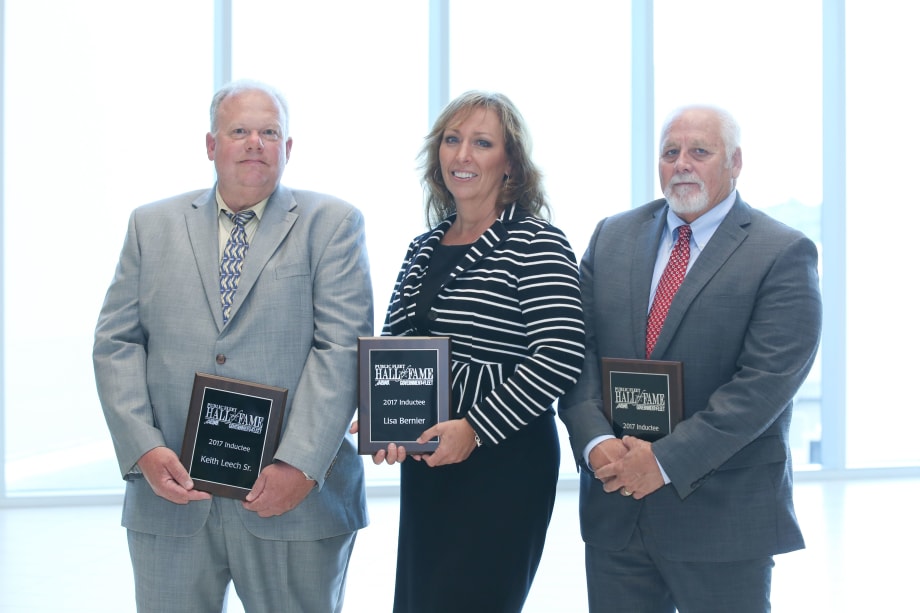
The three Hall of Fame inductees present at GFX were (l-r) Keith Leech, Sr., Lisa Bernier, and Steven Saltzgiver. Photo: Natalia King
The three Hall of Fame inductees present at GFX were (l-r) Keith Leech, Sr., Lisa Bernier, and Steven Saltzgiver. Photo: Natalia King
Four public sector fleet professionals joined Public Fleet Hall of Fame this year, joining a group of fleet professionals who have made a significant impact to the industry. The new inductees were recognized at The Honors Celebration at the Government Fleet Expo and Conference (GFX) on June 13.
Honorees are industry leaders and pioneers who have significantly contributed to the public fleet profession. The award is co-presented by the American Public Works Association (APWA) sponsored by the National Joint Powers Alliance (NJPA).
Each inductee who was present shared a nugget of industry knowledge or career advice with the audience.
The four inductees are:
Lisa Bernier, United States Navy
Approximate Years in Fleet: 34Keith Leech, Sr., County of Sacramento, CA
Approximate Years in Fleet: 26+Will Massey, CAFM, CFM (retired), City of Gainesville, FL
Approximate Years in Fleet: 42Steven Saltzgiver, CAFS, Mercury Associates
Approximate Years in Fleet: 40
Massey was unable to attend. Of all the Hall of Fame inductees, Steven Saltzgiver received the Legendary Lifetime Achievement Award.
Inductees are chosen by a combination of industry professionals via an online ballot and Government Fleet staff. To be eligible, they must have at least 20 years of experience in the industry, 10 of which must have been spent working for a public fleet or a private company contracted to manage a public fleet.
More Operations

Town of Queen Creek Named Most Successful Fleet Award Winner of Inaugural RTA Fleet Success Awards
Five fleets were honored at RTA Connect 2026 in Chicago for excellence across resource efficiency, intentional culture, risk management, and stakeholder satisfaction.
Read More →
A buyer's guide to fleet management software in 2027
Buying fleet management software in 2027 means looking beyond features and price. As fleet operations, technology and expectations evolve, this guide explores what today’s fleet professionals should consider when choosing a system that can deliver value now and adapt to what comes next.
Read More →
Hazard Alerts, Fleet Car Sales Rise and a New Shuttle Concept
Fleet car sales doubled, but the bigger picture tells a different story in this week’s roundup.
Read More →
How St. Johns County Turned Fleet Data Into Better Replacement Decisions
St. Johns County, Florida, had fleet data, but turning it into reliable decision guidance was another matter. Instead of starting over with a new fleet management system, the county connected existing tools and built a scoring system that gives managers an objective look at fleet health.
Read More →
Fleet Forward Conference Introduces One-Day Passes for 2026
New one-day registration lets fleet professionals attend Tuesday, Wednesday, or Thursday, with passes available for $249.
Read More →
ENC Unveils its ZAVIR Medium-Duty Shuttle
Two variants of the concept shuttles were revealed: a low-floor configuration and a high-floor configuration.
Read More →
Could Your Next Fleet Technician Start as an Intern?
What if your next technician hasn’t worked in a fleet shop yet? What fleets are doing to free up time.
Read More →
How Phoenix Is Building Its Next Generation of Fleet Technicians
With more than 8,000 vehicles and pieces of equipment to maintain, the City of Phoenix could not afford to wait for fully trained technicians to walk through the door. Instead, they revamped their entire workforce strategy and showed how public fleets can create their own talent pipeline while preparing existing employees for increasingly complex vehicles.
Read More →
What’s Slowing Your Fleet Down?
Could a change in how work gets done help your fleet return vehicles to service sooner?
Read More →
Can Public Fleets Trust the Data Driving Their Decisions?
Public fleets have more data than ever, but inconsistent records and missing information can still undermine maintenance, replacement, and cost decisions.
Read More →