




Postal Service Converts Mail-Delivery Van to Hybrid Technology
BOSTON — At a ceremony this week at the Boston General Mail facility, the Postal Service launched the first conversion of a mail-delivery van into a hybrid-electric vehicle.
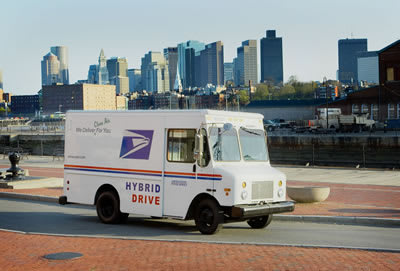
BOSTON — At a ceremony this week at the Boston General Mail facility, the Postal Service launched the first conversion of a mail-delivery van into a hybrid-electric vehicle. “As an agency that delivers mail to 145 million businesses and households six days a week, drives approximately 1.1 billion miles a year, and consumes more than 125 million gallons of motor fuel annually, we are in a unique position to demonstrate to the public and other businesses the growing viability and positive environmental and energy-savings benefits of alternate-fuel technologies,” said Walter O’Tormey, vice president, engineering, U.S. Postal Service. O’Tormey spoke to an audience of nearly 100 industry representatives, environmentalists, and Postal Service employees. The hybrid-electric mail-delivery van will be monitored in regular service — delivering mail to Boston-area homes and businesses — to determine its potential for emissions reduction and fuel-economy improvements. It was converted by Azure Dynamics Inc., Boston, a developer of electric and hybrid-electric powertrain systems. Based on the company’s other hybrid applications, and depending on the vehicle and its duty cycle, Azure officials expect fuel-economy improvements to be in the range of 30 to 50 percent. The Postal Service has been testing alternate-fuel vehicles for several years now. In fact, it operates the largest alternative-fuel fleet in the nation — 30,000 vehicles. The fleet includes compressed-natural gas, propane, ethanol, biodiesel, and electric vehicles.
More Operations

Town of Queen Creek Named Most Successful Fleet Award Winner of Inaugural RTA Fleet Success Awards
Five fleets were honored at RTA Connect 2026 in Chicago for excellence across resource efficiency, intentional culture, risk management, and stakeholder satisfaction.
Read More →
A buyer's guide to fleet management software in 2027
Buying fleet management software in 2027 means looking beyond features and price. As fleet operations, technology and expectations evolve, this guide explores what today’s fleet professionals should consider when choosing a system that can deliver value now and adapt to what comes next.
Read More →
Hazard Alerts, Fleet Car Sales Rise and a New Shuttle Concept
Fleet car sales doubled, but the bigger picture tells a different story in this week’s roundup.
Read More →
How St. Johns County Turned Fleet Data Into Better Replacement Decisions
St. Johns County, Florida, had fleet data, but turning it into reliable decision guidance was another matter. Instead of starting over with a new fleet management system, the county connected existing tools and built a scoring system that gives managers an objective look at fleet health.
Read More →
Fleet Forward Conference Introduces One-Day Passes for 2026
New one-day registration lets fleet professionals attend Tuesday, Wednesday, or Thursday, with passes available for $249.
Read More →
ENC Unveils its ZAVIR Medium-Duty Shuttle
Two variants of the concept shuttles were revealed: a low-floor configuration and a high-floor configuration.
Read More →
Could Your Next Fleet Technician Start as an Intern?
What if your next technician hasn’t worked in a fleet shop yet? What fleets are doing to free up time.
Read More →
How Phoenix Is Building Its Next Generation of Fleet Technicians
With more than 8,000 vehicles and pieces of equipment to maintain, the City of Phoenix could not afford to wait for fully trained technicians to walk through the door. Instead, they revamped their entire workforce strategy and showed how public fleets can create their own talent pipeline while preparing existing employees for increasingly complex vehicles.
Read More →
What’s Slowing Your Fleet Down?
Could a change in how work gets done help your fleet return vehicles to service sooner?
Read More →
Can Public Fleets Trust the Data Driving Their Decisions?
Public fleets have more data than ever, but inconsistent records and missing information can still undermine maintenance, replacement, and cost decisions.
Read More →