




Related: Renewable Diesel Reduces Ore. Utility's Maintenance Costs
Ore. Utility Outsources Parts Room to Reduce Costs
The Eugene Water & Electric Board (EWEB) in Oregon has outsourced its parts room to NAPA IBS to better comply with internal controls, allow technicians more time to work on vehicles, and reduce the true cost of parts.
by Staff
February 17, 2016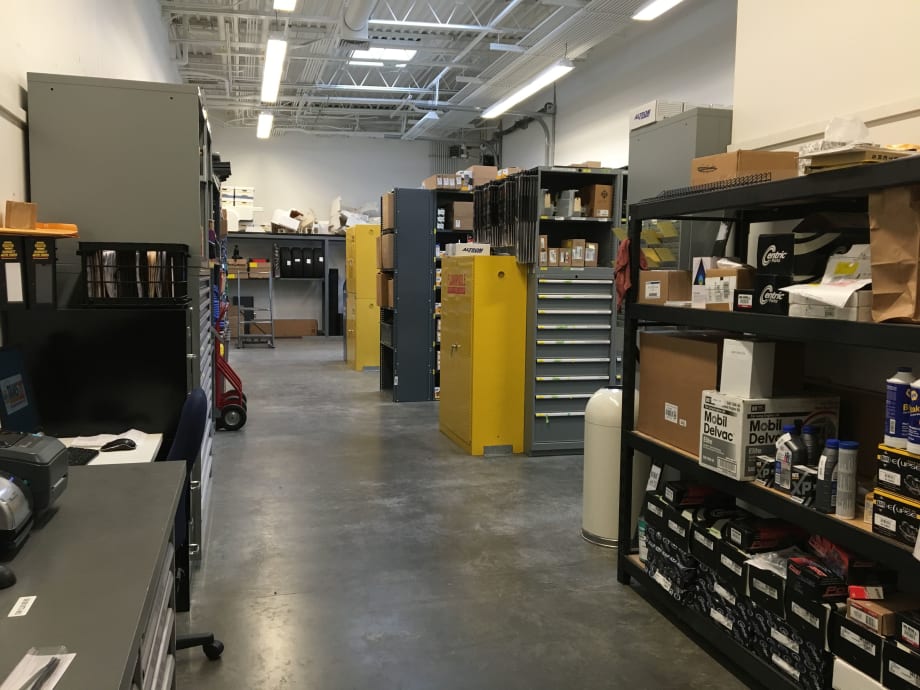
Photo courtesy of EWEB
2 min to read

The Eugene Water & Electric Board (EWEB) in Oregon has outsourced its parts room to NAPA IBS and in doing so, expects to better comply with internal controls, allow technicians more time to work on vehicles, and reduce the true cost of parts.
EWEB fleet previously managed its parts room without a parts person due to its relatively small size — maintaining about 320 units. However, after an internal review, the fleet decided it wasn’t the most efficient method, said Gary Lentsch, CAFM, fleet manager for EWEB. It needed to comply with the agency’s internal controls and solve some of its procurement problems: too much technician time spent on parts purchasing, and the complex and time-consuming process of buying parts over certain dollar thresholds.
Savings from the switch are expected to be significant.
“We are anticipating on reducing our entire fleet operation’s operation & maintenance budget by around 6%” in comparison to having an in-house parts person, Lentsch said.
To comply with its own internal controls, the fleet would have needed to add two parts staff members to the team.
“For the cost of just one full time employee, we were able to have NAPA staff our parts room for enough hours to cover both shifts (with two employees),” Lentsch said.
Secondly, crew leaders and technicians normally spent about an hour per day on researching, ordering, picking up parts, and doing paperwork, meaning they had less time to spend on vehicles.
“In order for us to meet our own needs…we added overtime and outsourced more work to balance the workload. With the NAPA IBS program we’ve been able to reduce that time to about 15 minutes day,” Lentsch said. “For us, it was like adding a technician to the shop floor.”
All this extra work also increased the true cost of parts, from technician time to accounting time to cut a check. With the IBS program, the fleet eliminated six of the nine steps needed to procure a part, and the fleet receives just one invoice per month.
The fleet will now also be able to recapture its warranties and core credits immediately, where in the past, staff was often behind in recovering credits.
NAPA purchased 70% of the fleet’s existing parts inventory. Lentsch said only about 40% of parts actually come from NAPA, with the rest being purchased from local businesses.
The utility contracted with NAPA IBS through the National Joint Powers Alliance (NJPA) after evaluating several options, including an in-house parts option. Lentsch expects full implementation to be completed in the next few months.
More Operations

Connect with Government Fleet on LinkedIn
From industry news and fleet management strategies to conversations with peers, Government Fleet's LinkedIn page offers public-sector fleet professionals another way to stay informed and connected.
Read More →
Town of Queen Creek Named Most Successful Fleet Award Winner of Inaugural RTA Fleet Success Awards
Five fleets were honored at RTA Connect 2026 in Chicago for excellence across resource efficiency, intentional culture, risk management, and stakeholder satisfaction.
Read More →
Sponsored•October 14, 2026
A buyer's guide to fleet management software in 2027
Buying fleet management software in 2027 means looking beyond features and price. As fleet operations, technology and expectations evolve, this guide explores what today’s fleet professionals should consider when choosing a system that can deliver value now and adapt to what comes next.
Read More →
Hazard Alerts, Fleet Car Sales Rise and a New Shuttle Concept
Fleet car sales doubled, but the bigger picture tells a different story in this week’s roundup.
Read More →
How St. Johns County Turned Fleet Data Into Better Replacement Decisions
St. Johns County, Florida, had fleet data, but turning it into reliable decision guidance was another matter. Instead of starting over with a new fleet management system, the county connected existing tools and built a scoring system that gives managers an objective look at fleet health.
Read More →
Fleet Forward Conference Introduces One-Day Passes for 2026
New one-day registration lets fleet professionals attend Tuesday, Wednesday, or Thursday, with passes available for $249.
Read More →
ENC Unveils its ZAVIR Medium-Duty Shuttle
Two variants of the concept shuttles were revealed: a low-floor configuration and a high-floor configuration.
Read More →
Could Your Next Fleet Technician Start as an Intern?
What if your next technician hasn’t worked in a fleet shop yet? What fleets are doing to free up time.
Read More →
How Phoenix Is Building Its Next Generation of Fleet Technicians
With more than 8,000 vehicles and pieces of equipment to maintain, the City of Phoenix could not afford to wait for fully trained technicians to walk through the door. Instead, they revamped their entire workforce strategy and showed how public fleets can create their own talent pipeline while preparing existing employees for increasingly complex vehicles.
Read More →
What’s Slowing Your Fleet Down?
Could a change in how work gets done help your fleet return vehicles to service sooner?
Read More →