




Linck to Retire from Town of Greenwich
GREENWICH, CT - Elizabeth "Betty" Linck, town fleet director for the Town of Greenwich for nearly 20 years, will retire effective September 30.
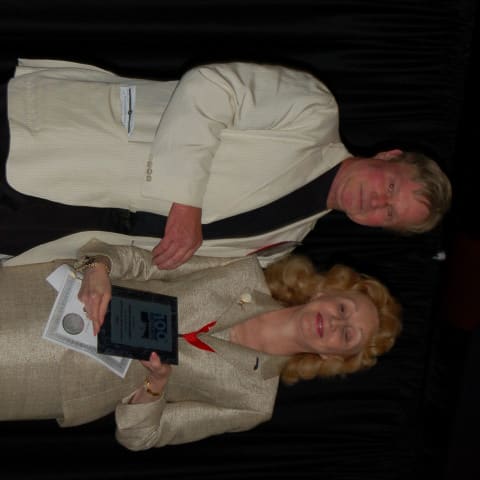
Linck accepted the 100 Best Fleets recognition from Tom Johnson at the 2009 Government Fleet & Expo in Denver.

GREENWICH, CT - Elizabeth "Betty" Linck, town fleet director, will retire from the Town of Greenwich, effective September 30. Linck has served in this role for 19 ½ years.
Linck's many accomplishments as fleet director includie achieving requirements for an ASE Blue Seal Facility since 2005, implementing pay grade increases and additional stipends for technicians; successfully outsourcing the parts room function; implementing an outcome-based budget; and recognition of her department as a 100 Best Fleet for four consecutive years (#15 in 2008 and #14 in 2009).
"Betty Linck has been an outstanding fleet director and made enormous contributions to the Town of Greenwich in attaining the highest industry recognition for our fleet department," said First Selectman Peter Tesei. "Betty will be missed and I wish her well in her future endeavors."
Linck has been involved in fleet management for the past 34 ½ years, starting her career in fleet in 1975 with a fortune 500 company and joining NAFA in 1980. Within a year, she became involved in her local Chapter, Inter-County's governing board, amount other positions, serving five terms as Chapter Chair. As Linck became more involved in NAFA, she served more than 25 years on the National Board of Governors in various capacities. Linck is an original Wharton CFM (Certified Fleet Manager) graduate.
The Town of Greenwich's fleet department is an independent chartered department reporting to the First Selectman and responsible for the maintenance and repairs of the Town's vehicles. Since 1990, the department went from mainly manual operations to computerization with the implementation of a fleet maintenance program (FleetMaint) and automated fueling system (TRAK), establishing a perpetual inventory, and a comprehensive preventive maintenance program. This computerization saved many hours of manual work by tracking fuel usage, repairs, parts data, and vehicle inventory. The PM program reduced unscheduled repairs and downtime, currently at 4.16 percent. A vehicle replacement program with specific criteria replacements at optimum intervals and specification focused on the unit's job function was successfully accomplished and has led to the 5-10 and 15-year replacement projections.
Staff positions were reclassified and reduced by two positions during the mid 1990's. In 2005, the fleet became an ASE Certified Blue Seal Facility, with pay grade increases for the participating Technicians. To insure established policies and procedures are followed with uniformity and the Department's diversified responsibilities were performed with conformity, a 23-chapter Department Operational Manual was developed and includes forms, data entry processes, building operations, and user department interaction. To measure customer service satisfaction, the TQM (Total Quality Management) program was developed with a repair/service satisfaction rate of 97.7 percent.
In 1999, operation of the parts room was successfully outsourced. With targeted labor hours saved, the average parts-on-demand objective exceeds the 90-percent target. The Town-owned inventory of more than 300,000 units was eliminated. A new fleet maintenance program (CCG FASTER) was purchased in 2002, and technician workstations were activated in 2006. In 2004, the automated fueling system was replaced with the E.J WARD system, which has reduced fuel site downtime. In FY 2004/2005 the outcome-based budget was implemented, measuring performance to project, statement and measurements, a useful tool for benchmarking. For the next two fiscal years, the department continued to compile data and generate this type of budget until it was discontinued in 2007.
Going forward is the installation of a truck washing facility at the VMC incorporating a reconfiguration of the work areas, going "green" with the acquisition of hybrid vehicles and proposed purchase of biodiesel, and implementing a stipend for the ASE certified technicians who obtained additional certifications.
More Operations
Who Deserves Fleet Recognition and What Could You Teach at GFX?
Who helped shape your fleet career, and what have you learned that could help someone else?
Read More →
What’s Haunting Public Sector Fleets?
Public sector fleet challenges rarely happen in isolation, and addressing one often means understanding how it connects to another.
Read More →
Is Keeping Older Fleet Vehicles Really Saving Money?
Is keeping vehicles longer saving money, and what happens when a diagnostic test points to the wrong fix?
Read More →
How Smart Fleet Strategy Can Help Local Government Agencies Do More with Less
Keeping a vehicle longer may ease this year’s budget, but what does it cost the next one? A closer look at fleet decisions can reveal opportunities to reduce spending while protecting essential services.
Read More →
Connect with Government Fleet on LinkedIn
From industry news and fleet management strategies to conversations with peers, Government Fleet's LinkedIn page offers public-sector fleet professionals another way to stay informed and connected.
Read More →
Town of Queen Creek Named Most Successful Fleet Award Winner of Inaugural RTA Fleet Success Awards
Five fleets were honored at RTA Connect 2026 in Chicago for excellence across resource efficiency, intentional culture, risk management, and stakeholder satisfaction.
Read More →
A buyer's guide to fleet management software in 2027
Buying fleet management software in 2027 means looking beyond features and price. As fleet operations, technology and expectations evolve, this guide explores what today’s fleet professionals should consider when choosing a system that can deliver value now and adapt to what comes next.
Read More →
Hazard Alerts, Fleet Car Sales Rise and a New Shuttle Concept
Fleet car sales doubled, but the bigger picture tells a different story in this week’s roundup.
Read More →
How St. Johns County Turned Fleet Data Into Better Replacement Decisions
St. Johns County, Florida, had fleet data, but turning it into reliable decision guidance was another matter. Instead of starting over with a new fleet management system, the county connected existing tools and built a scoring system that gives managers an objective look at fleet health.
Read More →
Fleet Forward Conference Introduces One-Day Passes for 2026
New one-day registration lets fleet professionals attend Tuesday, Wednesday, or Thursday, with passes available for $249.
Read More →