





Keep Reading: Hyzon, New Way Unveil Hydrogen Fuel Cell Refuse Truck
Hydrogen Fuel Cells and Grid Upgrades to Revamp EV Charging
IDTechEx researched several options for green on-site power generation with the hydrogen fuel cell generator standing out as a candidate for construction and temporary power generation.
June 14, 2024
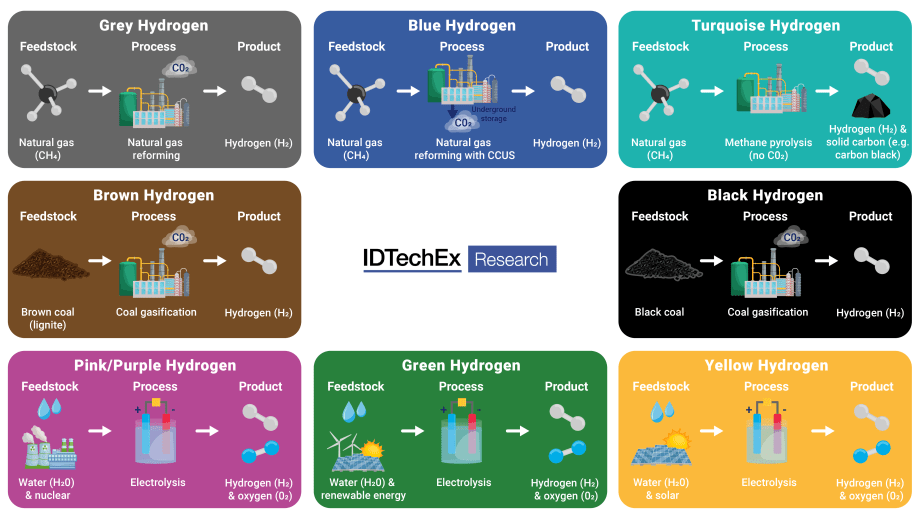
The colors of hydrogen refer to the method of production. Only green and yellow hydrogen are truly renewable.
Source: IDTechEx
3 min to read
In their market report, “Off-Grid Charging For Electric Vehicles 2024-2034: Technologies, Benchmarking, Players and Forecasts,” IDTechEx explored the challenges utility grids face amid vehicle electrification.
Restructuring aging utility grids that were primarily built to distribute energy from centralized coal power plants into systems that can cope with increasing renewable energy generation and electric vehicle adoption is a challenge that industry and policy are beginning to take steps to tackle.
However, some locations and situations will likely always exist beyond the reach of the grid and thus mains electricity. Temporary locations such as construction sites may never be economically or technically viable for expensive grid upgrades. Instead, they will have to resort to distributed generation for power.
The incumbent technology is diesel generators, which are increasingly viewed as polluting and may soon be banned from inner city construction sites due to air and noise pollution regulations.
IDTechEx researched several options for green on-site power generation with one technology standing out as a candidate for construction and temporary power generation: the hydrogen fuel cell generator.
Repurposing the Fuel Cell for Distributed Generation
There has been consistent interest in fuel cell electric vehicles (FCEVs) as a faster refueling and greater range alternative to battery electric vehicles (BEVs). Sales figures suggest that BEVs are significantly outperforming FCEVs, and IDTechEx expects fully battery electric to emerge as the dominant net-zero drivetrain.
However, there is growing momentum in the fuel cell generator space, which repurposes fuel cell generator technology and utilizes this to generate electricity from hydrogen. Fuel cell generators take in H2, combine it with oxygen from the air, and produce electricity and water with no carbon emissions and much-reduced noise compared with a diesel generator.
Compared with solar/wind integrated systems, which require an on-site battery, fuel cell generators can use stored energy in the form of on-site compressed hydrogen. Large power outputs can be generated by scaling up the fuel cell stack, which can then charge increasingly large electric construction vehicles or a large number of conventional vehicles.
These generators offer the promise of clean, non-intermittent, and scalable power. IDTechEx research has observed these being used in electric construction sites, festivals, remote multi-day electric vehicle races, and even public highway fast charging.
The challenge is affordable and green hydrogen
The entire supply chain must be considered for an accurate assessment of emissions and for hydrogen, which involves the method or ‘color’ of H2. If grey or black hydrogen is utilized, hydrogen generators displace the emissions from the point of use to the source of hydrogen production and represent no serious overall reductions in emissions.
If, on the other hand, green, renewable hydrogen is used, then the overall emissions are drastically reduced. The question then is will operators use green or grey hydrogen? This depends on the cost and availability.
Currently, green hydrogen is significantly more expensive, in part due to the overall energy inefficiency inherent in its production (around 3kWh input renewable energy creates 1kWh equivalent of H2).
As the end users are often commercial operators, OPEX considerations are likely to take priority, and if the price of green hydrogen remains too high, then it seems unlikely they will pay a significant premium.
Availability is another challenge, as current green H2 production remains small and regionally focused. IDTechEx research has found certain hydrogen fuel cell generator companies have had to make their own green hydrogen to supply their customers, as no one else can produce the quantities required.
More Operations

Is Keeping Older Fleet Vehicles Really Saving Money?
Is keeping vehicles longer saving money, and what happens when a diagnostic test points to the wrong fix?
Read More →
How Smart Fleet Strategy Can Help Local Government Agencies Do More with Less
Keeping a vehicle longer may ease this year’s budget, but what does it cost the next one? A closer look at fleet decisions can reveal opportunities to reduce spending while protecting essential services.
Read More →
Connect with Government Fleet on LinkedIn
From industry news and fleet management strategies to conversations with peers, Government Fleet's LinkedIn page offers public-sector fleet professionals another way to stay informed and connected.
Read More →
Town of Queen Creek Named Most Successful Fleet Award Winner of Inaugural RTA Fleet Success Awards
Five fleets were honored at RTA Connect 2026 in Chicago for excellence across resource efficiency, intentional culture, risk management, and stakeholder satisfaction.
Read More →
Sponsored•October 14, 2026
A buyer's guide to fleet management software in 2027
Buying fleet management software in 2027 means looking beyond features and price. As fleet operations, technology and expectations evolve, this guide explores what today’s fleet professionals should consider when choosing a system that can deliver value now and adapt to what comes next.
Read More →
Hazard Alerts, Fleet Car Sales Rise and a New Shuttle Concept
Fleet car sales doubled, but the bigger picture tells a different story in this week’s roundup.
Read More →
How St. Johns County Turned Fleet Data Into Better Replacement Decisions
St. Johns County, Florida, had fleet data, but turning it into reliable decision guidance was another matter. Instead of starting over with a new fleet management system, the county connected existing tools and built a scoring system that gives managers an objective look at fleet health.
Read More →
Fleet Forward Conference Introduces One-Day Passes for 2026
New one-day registration lets fleet professionals attend Tuesday, Wednesday, or Thursday, with passes available for $249.
Read More →
ENC Unveils its ZAVIR Medium-Duty Shuttle
Two variants of the concept shuttles were revealed: a low-floor configuration and a high-floor configuration.
Read More →
Could Your Next Fleet Technician Start as an Intern?
What if your next technician hasn’t worked in a fleet shop yet? What fleets are doing to free up time.
Read More →