




EPA Awards 5 Calif. Fleets for Eliminating Lead Wheel Weights
LIVERMORE, CA - The City of Tracy, the City and County of San Francisco, Monterey County, Contra Costa County, and the U.S. Postal Service (USPS), were honored for eliminating lead wheel weights from fleet vehicles.
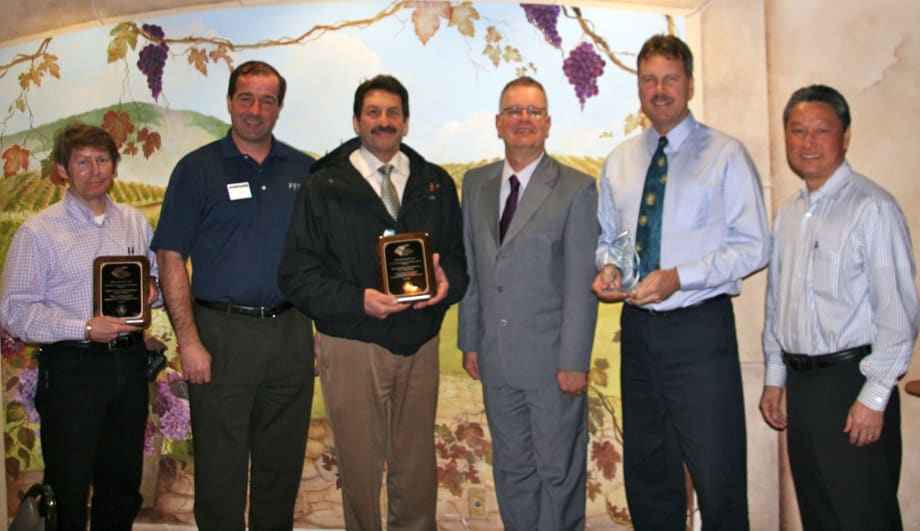
Pictured from left to right at the Public Fleet Supervisors Association (PFSA) are: Thomas Abear, fleet manager of Monterey County; Doug Bond, transportation services manager of Alameda County; David Del Grande, operations director of central shops of the City and County of San Francisco; Olof Hansen, U.S. EPA; Patrick Langsjoen, environmental specialist with USPS; and Tom Fung, fleet director for the City and County of San Francisco.
Pictured from left to right at the Public Fleet Supervisors Association (PFSA) are: Thomas Abear, fleet manager of Monterey County; Doug Bond, transportation services manager of Alameda County; David Del Grande, operations director of central shops of the City and County of San Francisco; Olof Hansen, U.S. EPA; Patrick Langsjoen, environmental specialist with USPS; and Tom Fung, fleet director for the City and County of San Francisco.
LIVERMORE, CA - At a Jan. 19 Public Fleet Supervisors Association (PFSA) meeting in Livermore, Calif., five California fleets were honored by the U.S. Environmental Protection Agency (EPA) for their sustainable practices - the City of Tracy, the City and County of San Francisco, Monterey County, Contra Costa County, and the U.S. Postal Service (USPS).
Each fleet received a National Partnership for Environmental Priorities (NPEP) plaque commending their efforts to eliminate lead wheel weights from fleet vehicles. Lead has become a key concern for the EPA due to its environmental and human health hazards. The NPEP was a voluntary program developed to encourage private and public facilities to reduce the use or release of millions of pounds of toxic chemicals into the environment. While the NPEP formally ended in Oct. 2011, the EPA is still continuing to partner with fleets to "green" their business practices, according to Olof Hansen of the EPA.
Fleet Manager of Monterey County Thomas Abear accepted the award for eliminating 150 lbs. of lead wheel weight. Annually, their department also spends $300,000 in lead-free tire replacements.
David Del Grande, operations director of central shops for the City and County of San Francisco, accepted the award for eliminating more than 1,000 lbs. of lead wheel weight, surpassing the original goal by 650 lbs. Del Grande said the fleet first considered stick-on alloy weights but decided to go with standard clip-on steel weights due to the volume of tires the fleet maintains.
Frank Desousa from the City of Tracy Central Garage collected the award for recycling 208.8 lbs. of lead, bringing the city's larger Sustainability Action Plan up to speed.
Fleet Manager of Contra Costa County Rick Ranger accepted the award for successfully eliminating 1,250 lbs. of lead weights. All new weights installed are now coated in steel.
Finally, Patrick Langsjoen, Pacific Area Environmental specialist with USPS in San Francisco was awarded for launching a lead-free wheel weight pilot for the company's 31,000 delivery vehicles in California and Hawaii and for preventing 34 pounds of lead from entering the environment annually.
Additionally, USPS received the EPA NPEP "Outstanding Partner" award for its national leadership in transitioning its delivery fleet to the use of lead-free wheel weights. A video explaining the hazards of lead wheel weights as well as the USPS's reduction of its use can be found here.
The PFSA was founded in 1959 and meets six times a year to discuss pertinent fleet issues. It is a means for building relationships between fleet managers in the San Francisco Bay Area and the California central valley.
The Jan 19 meeting also included presentations from Mark Wing of Enterprise Fleet Management; John Glann and Kelley Smith from Alameda County Purchasing; and Greg Haglin of the National Joint Powers Alliance (NJPA).
By Brittni Rubin
More Operations
Who Deserves Fleet Recognition and What Could You Teach at GFX?
Who helped shape your fleet career, and what have you learned that could help someone else?
Read More →
What’s Haunting Public Sector Fleets?
Public sector fleet challenges rarely happen in isolation, and addressing one often means understanding how it connects to another.
Read More →
Is Keeping Older Fleet Vehicles Really Saving Money?
Is keeping vehicles longer saving money, and what happens when a diagnostic test points to the wrong fix?
Read More →
How Smart Fleet Strategy Can Help Local Government Agencies Do More with Less
Keeping a vehicle longer may ease this year’s budget, but what does it cost the next one? A closer look at fleet decisions can reveal opportunities to reduce spending while protecting essential services.
Read More →
Connect with Government Fleet on LinkedIn
From industry news and fleet management strategies to conversations with peers, Government Fleet's LinkedIn page offers public-sector fleet professionals another way to stay informed and connected.
Read More →
Town of Queen Creek Named Most Successful Fleet Award Winner of Inaugural RTA Fleet Success Awards
Five fleets were honored at RTA Connect 2026 in Chicago for excellence across resource efficiency, intentional culture, risk management, and stakeholder satisfaction.
Read More →
A buyer's guide to fleet management software in 2027
Buying fleet management software in 2027 means looking beyond features and price. As fleet operations, technology and expectations evolve, this guide explores what today’s fleet professionals should consider when choosing a system that can deliver value now and adapt to what comes next.
Read More →
Hazard Alerts, Fleet Car Sales Rise and a New Shuttle Concept
Fleet car sales doubled, but the bigger picture tells a different story in this week’s roundup.
Read More →
How St. Johns County Turned Fleet Data Into Better Replacement Decisions
St. Johns County, Florida, had fleet data, but turning it into reliable decision guidance was another matter. Instead of starting over with a new fleet management system, the county connected existing tools and built a scoring system that gives managers an objective look at fleet health.
Read More →
Fleet Forward Conference Introduces One-Day Passes for 2026
New one-day registration lets fleet professionals attend Tuesday, Wednesday, or Thursday, with passes available for $249.
Read More →