




10 Feats This Fleet Manager and His Team Accomplished In 10 Years
John Manring, fleet chief for San Diego County, Calif., leaves behind an impactful legacy before his retirement.
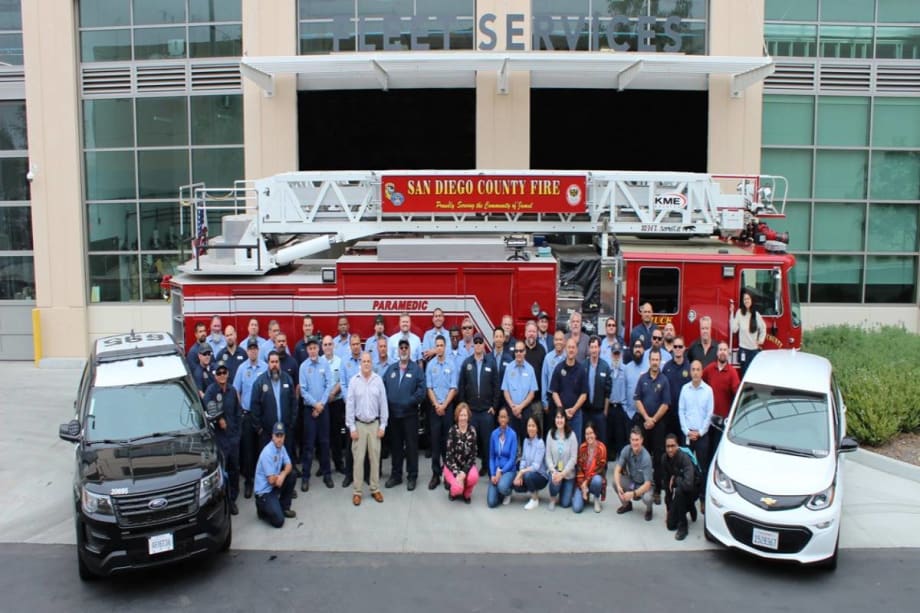
Manring (wearing khaki slacks) with the County of San Diego Fleet Services Department.
When John Manring, fleet chief for San Diego County, Calif., looks back and reflects on what ten years of county service has meant to him, he realizes just how much hard works goes into keeping a government fleet running.
“Before I started at the county, I, like most others from the private sector, thought government employees did not work as hard as the private sector and that the job I was applying for would be easy. I quickly learned this was not the case; in fact, government employees work harder than most private sector jobs…and not only harder, but with more meaning and responsibility,” he explains.
Serving the public in this capacity is no easy task, and he quickly learned that within government comes a great support structure. It fosters a family atmosphere and most everyone is willing to work toward a common goal, he believes.
“There is security in knowing you will have a job each and every day, and that should not be taken lightly as it’s not the way of the private sector.”
So what have he and his team accomplished in the past ten years?
1. Update and Improve Technician Tools
When he first started at the county, the tools issued to the technicians were old and outdated. There was no system in place that provided tools by classification, so there were disparities. New staff got the oldest tools regardless of classification. Some master technicians had less tools than the fleet technicians.
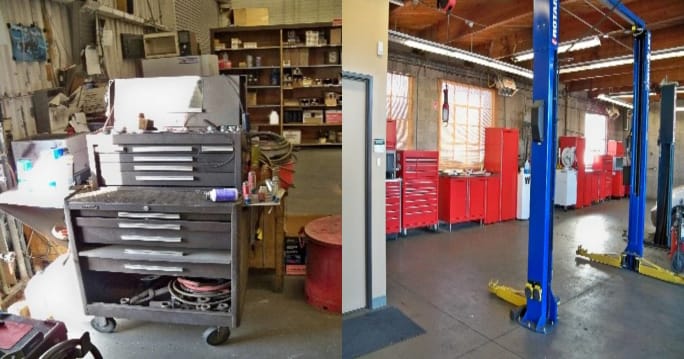
(l to r) a typical old tool box versus new tool boxes with work station
Now, there’s a standardized tool program that allows for all technicians to receive tool sets based on classification and duties. There is also a tool replacement program that ensures tools stay current with the needs of the technicians.
When Manring first joined, vehicle lifts were outdated and lacked standardization, which created safety issues regarding staff familiarity with lift operating procedures when relocating to another garage.
A large tool replacement program was developed that allowed for all vehicle lifts to be replaced over a three-year period. Now, fleet has a depreciation program in place that provides for replacements when the service life of the lifts has expired. This ensures fleet will always have vehicle lifts that are standardized and safe to operate.
Technicians also have standardized workstations with individual computers that gives access to internet manuals for all makes and models of vehicles and equipment the county owns.
2. Overhaul and Modernize Training
Over the past ten years, training opportunities for staff have expanded from paper to electronic manuals. ASE manuals are now offered to the technicians in electronic versions, paperback books, and DVDs.
A state-of-the-art training room was built at the County Operations Center (COC) campus and is available for all technicians. The county also holds co-agency trainings with partner agencies when appropriate and available.
Rates were developed to allow 40-hours of annual training for all technicians. NAPA Auto Tech online training is now available to all fleet employees offering over 200 different web-based training courses available 24/7. Fleet provides fire mechanics certification training annually, as well as Ford factory certification training.
3. Prioritize Technology
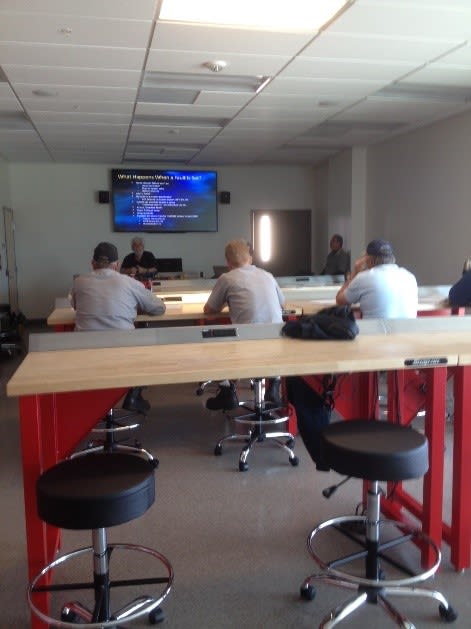
Training is now more accessible than ever.
Over the past ten years, the pace of technology has changed rapidly. Luckily, fleet has been able to keep up.
All fleet staff have their own computers and no longer share a common computer. Cell phones are now issued to all supervising staff which increases communication. Online training is available 24/7 and available at the click of a mouse. Diagnostic tools are current and available for all technicians, even when working in the field. Laptops are being used to allow increased mobility.
4. Build New Garages and Remodel
During his time at the county, Manring experienced several remodels and the construction of the new main garage at the COC.
“Most agencies would be excited just to receive a remodel of their current garage, and yet we at the county have had the pleasure of building a state-of-the-art garage that is the envy of all other agencies,” he explains.
5. Climb Government Fleet Rankings
When Manring first arrived at the county as a fleet coordinator, the fleet did not participate in the 100 Best Fleets/Leading Fleets program as there was too much to improve on before considering applying for a ranking. After several years and some improvements, they sent in an application. The first year, they ranked #78, and the following year were ranked #43. Year three saw them at #17 and #14 their fourth time around.
They finally hit the top five by ranking #5 in 2015 and 2019, and in 2020 they were ranked at the #4 spot. This continued improvement shows the effort their fleet has made over the past 10 years to become better at what they do each day.
“Someday we may just reach the #1 spot as I feel like we deserve it.”
6. Evolve the Fleet
Over the past ten years, Manring has seen the fleet evolve and progress, from the major model and design change of the Ford Crown-Vic to the Interceptor, to the development and growth of the fire authority (from ten pieces of apparatus to over 80 pieces currently), to the evolution and beginning transformation from internal combustion engines to electric vehicles and plug-in hybrid vehicles.
The fleet’s development of a Green Fleet Action Plan that saw success in the first five years is being updated to incorporate the next ten years. Under Manring’s leadership, the fleet has grown from 3,200 vehicles to a current count of almost 4,500 active vehicles.
“We continue to work on right sizing through constant monitoring of vehicle utilization while working with the departments to ensure they have the necessary vehicles to complete their missions.”
7. Develop and Grow the Mobile Maintenance Program
As the fire program began to grow, so did the need to service fire apparatus in the field. In addition to this, the need to service client departments in the field for departments such as Park and Recreation, the Sheriff’s Office, and DPW also grew.
A business process reengineering took place with participation from department representatives. Over the past ten years, the mobile maintenance program evolved and became one of fleet’s premier services. It has expanded due to demand from four to six trucks and will quite possibly continue to expand over the next ten years.
8. Expand Fuel Program
Fleet incorporated the fuel program from DPW into fleet’s existing program and became the sole owner of all fuel for the County of San Diego. Manring experienced the transition from non-compliant single wall underground tanks to the most current double wall 30-year life expectancy tanks. Fuel sites doubled and are currently at 27 sites throughout the county. Fuel is also sold to numerous outside agencies.
9. Make Fiscal Improvements
Historically, fleet borrowed money from the acquisition fund for years to be able to pay various costs. Over the past ten years, fleet has been able to repay the acquisition fund and is now fiscally stable and able to pay its own way while making budget.
“All of this has been done while still being able to improve on everything previously mentioned due to the excellent five-year budget forecast and two-year operational plan budget. This is also due to having excellent fiscal staff and support from upper management oversight,” he says.
10. Foster Leadership at the Director and Assistant Director Level
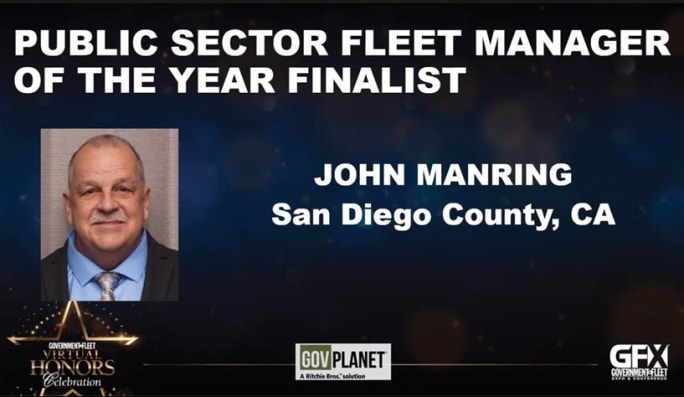
Manring was selected as a Public Sector Fleet Manager of the Year Finalist for 2020.
Since the time of his hire, there has been excellent support from the leadership level at the Department of General Services. Manring credits April Heinze, Marko Medved, and Nicole Alejandre as leaders who have supported fleet.
“They all have had a great vision and provided the required experience necessary to run a successful program with fleet,” he says. “They have allowed me the freedom to use my talents and experience within the management structure to guide and direct fleet in a positive direction and have been there to support me during challenging times as well. They allowed me to use my experience from the private sector to help bring competitiveness to fleet and its government setting. They also nurtured my growth as a manager.”
This allowed Manring to expand his talents to the point where he was named as a 2020 finalist for Fleet Manager of the Year in the Public Sector. “I could not have risen to this level without the support and encouragement to improve by those mentioned above. Many thanks to the three of you for seeing and believing in my talents.”
“I cannot express in words how much I will miss working with this fine group of talented individuals. All I can say is thank you for the opportunity to serve under your guidance. It has been one hell of a ride I will not forget!”
More Operations
Who Deserves Fleet Recognition and What Could You Teach at GFX?
Who helped shape your fleet career, and what have you learned that could help someone else?
Read More →
What’s Haunting Public Sector Fleets?
Public sector fleet challenges rarely happen in isolation, and addressing one often means understanding how it connects to another.
Read More →
Is Keeping Older Fleet Vehicles Really Saving Money?
Is keeping vehicles longer saving money, and what happens when a diagnostic test points to the wrong fix?
Read More →
How Smart Fleet Strategy Can Help Local Government Agencies Do More with Less
Keeping a vehicle longer may ease this year’s budget, but what does it cost the next one? A closer look at fleet decisions can reveal opportunities to reduce spending while protecting essential services.
Read More →
Connect with Government Fleet on LinkedIn
From industry news and fleet management strategies to conversations with peers, Government Fleet's LinkedIn page offers public-sector fleet professionals another way to stay informed and connected.
Read More →
Town of Queen Creek Named Most Successful Fleet Award Winner of Inaugural RTA Fleet Success Awards
Five fleets were honored at RTA Connect 2026 in Chicago for excellence across resource efficiency, intentional culture, risk management, and stakeholder satisfaction.
Read More →
A buyer's guide to fleet management software in 2027
Buying fleet management software in 2027 means looking beyond features and price. As fleet operations, technology and expectations evolve, this guide explores what today’s fleet professionals should consider when choosing a system that can deliver value now and adapt to what comes next.
Read More →
Hazard Alerts, Fleet Car Sales Rise and a New Shuttle Concept
Fleet car sales doubled, but the bigger picture tells a different story in this week’s roundup.
Read More →
How St. Johns County Turned Fleet Data Into Better Replacement Decisions
St. Johns County, Florida, had fleet data, but turning it into reliable decision guidance was another matter. Instead of starting over with a new fleet management system, the county connected existing tools and built a scoring system that gives managers an objective look at fleet health.
Read More →
Fleet Forward Conference Introduces One-Day Passes for 2026
New one-day registration lets fleet professionals attend Tuesday, Wednesday, or Thursday, with passes available for $249.
Read More →