




Preparation and Cooperation are Key in Emergencies
Preparing for emergency situations helps a business or agency recover quickly to resume normal activities. John Clements, fleet manager, San Diego County, Calif., discusses how lessons learned in the past helped shape the county’s response to last fall’s devastating wild fires.

GF: What type of emergency plan did San Diego County’s fleet operation have in place before the fire?
Clements: Fleet Management has an emergency operations plan that is an integral part of our department’s and overall County emergency operations plan. Last fiscal year, we also completed a COOP, a Continuity of Operations Plan. The COOP plan is a little different than the first responder process. It details how we’re to recover as a business. We did pretty well during the most recent fires. From a big-picture perspective also, we went through a similar fire emergency in 2003. We had all that practical experience to draw upon. We did a lot of advanced planning based on that.
GF: What changed in the plan between this fire and the one in 2003?
Clements: From a county perspective, our Board of Supervisors had invested a substantial amount of money and resources into planning a better response to fires and disasters in general. Some of the more notable items included funding and purchasing two firefighting helicopters that were additional resources to the region. They also purchased approximately 13 additional fire fighting apparatus with 15 more units on order, trained more County employees as emergency shelter workers, and improved our communications system’s infrastructure.
Let me back up half a step and explain the County’s fire fighting environment. The County does not have a County Fire Department; it is a combination of the U. S. Forest Service, CalFire (formerly CDF), local fire districts and departments, as well as volunteer fire departments. An advisory vote was taken with the citizens of San Diego County after the 2003 fires, and they approved the concept of a more coordinated fire fighting effort, primarily in the rural areas.
Responding to that, a study is underway to determine how to address fire fighting resources in the unincorporated areas of the County. The study hasn’t been finalized yet, but it’s close. In lieu of that, our Board of Supervisors have been investing millions of general fund dollars and grants into purchasing additional fire apparatus, training, and some general coordination efforts. The results are that we had 13 additional pieces of fire apparatus during the recent fires, not counting other local fire agencies resources. Additionally, we have 15 more apparatus on order with an expected delivery date before April 1, 2008.
Other improvements were the addition of a GIS mapping system for fire resources and two training officers for rural fire agencies. All and all, a lot of money and effort was put into improving our response to fire and other disasters.
I think the real hero of this fire — second, of course, to the fire fighters and police officers — was the reverse 911 system. A total of 515,000 evacuation notices were sent out during the seven separate fires. There were many people in transition. We had about 40 shelters going at one time, including the City of San Diego’s football stadium that was taking in evacuees. The stadium effort received a lot of press, but it was just one of many shelters.
In this type of disaster, shelters must be set up and running quickly, so the County proactively trained hundreds of workers from the Health and Human Services Agency as disaster shelter workers. As the disaster continues, those shelters are then transitioned over to the Red Cross or National Guard. This process involves a great deal of preparation and training.
Another key factor that distinguishes San Diego (and California) was that we handled the disaster as it was supposed to be handled. First you exhaust your local resources, and then you go to the State level. When the State resources are exhausted, you ask for help at the Federal level. That went just like clockwork. It’s still a disaster and you’re dealing with a lot of loss, but the call for help and the way the resources were requested and used were much better than you see in other areas.
GF: What toll did the fires take on your fleet and fleet maintenance operations?
Clements: Let me be very honest and tell you what I credit this to. In regards to the fire storms in 2003 and 2007, vehicle maintenance really wasn’t a problem for us. Our fleet probably had failure rate of less than 1 percent. We did open our shops 24 hours a day throughout the disaster, and we opened all our fuel sites to serve all fire and police organizations. Obviously, fuel support is huge when you start bringing in out-of-county resources. Additionally, in Fire Storm 2003, we sent two of our mechanics to CalFire for a month, to help them out because we didn’t need them.
I honestly took a deep breath after the first fire storm in 2003 and then took the same deep breath after this one. I attribute our maintenance record to two things. One, we have a very sound vehicle replacement program so we’re not operating a lot of old vehicles, and secondly, our preventive maintenance (PM) program. We have a very solid PM program. It is truly what I deem a “preventive maintenance” program; it’s not just an oil change.
Some of the numbers are still rolling in. However, I’ve spoken with the Sheriff’s staff as they coordinated their fleet assignments internally during the fires. The bottom line was the Sheriff deployed 27 platoons of deputies with 22 marked vehicles per platoon just for fire-related activities. That equates to approximately 600 Sheriff’s vehicles continually assigned to fire support, not counting routine patrol that needed to continue. These types of numbers are only for one department, not counting Fire departments and other County operations.
GF: How did this fire impact fleet personnel?
Clements: The 2007 Firestorms took a little different spin than the 2003 fires. First, let me clarify my role to better explain. I serve two roles in a disaster. One, I’m still the fleet manager for County vehicles and support services such as fuel resources. However, in a disaster I’m also assigned to the County’s Emergency Operations Center as the transportation coordinator. The latter position is responsible for overall County transportation needs, including public and private vehicles and not just County of San Diego assets.
What that means is that many of my fleet employees — mechanics and other staff — became delivery drivers to support emergency shelters and our local assistance centers for fire recovery. Once you identify needed supplies both purchased and donated, you must have a way to move those items around to where they’re needed. We used our own large trucks and vans and much of our staff to move supplies within the County. Obviously, fuel and maintenance take priority, but other functions such as vehicle acquisition and administration slows down during a disaster and you can use those people for other tasks. The fleet effort largely became more logistical support for the whole County.
I heard of one fleet many years ago on the East Coast that experienced a hurricane during which 80 percent of their fleet was down. The situation was just the opposite for us. As I said, I doubt that even 1 percent of our fleet was down during the fires. We had some maintenance issues — flat tires and things — but nothing of any catastrophic nature. The vehicles were in the field and working. In fact, at one point a few of our larger shops were used as command posts for the Sheriff’s department, and our staff was able to do PM-type work on the Sheriffs’ vehicles literally “mid-crisis.” We were also able to deploy several “mini- PM” crews to change air filters and things of that nature. It was truly a PM effort, and again, we have a really solid vehicle replacement program.
GF: Do you consider the emergency plan successful?
Clements: Yes, I think it was. There is general agreement that any plan can get better and it will. However, because we’ve experienced back-to-back disasters of the same type, everybody agreed this one went much smoother than the last.
The reverse 911 system, the additional resources, the improved general coordination, and calling for additional resources in a timely manner were key. We conduct disaster drills in our emergency operations center routinely, where we run realistic exercises, including actual phone calls to other emergency centers and vendors. An actual call might be “This is a drill; however, we need 50 buses sent to wherever.” You practice and stress-test the systems and processes.
We also had a new software program called Web EOC, which tracks the entire disaster, and we had to be trained in that. It’s training, preparation, and those types of things that really help us. An actual example from the last disaster illustrates our cooperation with other agencies. A friend of mine is the fleet manager for the City of San Diego and he called me at 5 a.m. the second day of the fires and our conversation was something like: “Are you guys OK?” “We’re OK.” “If you need help (either direction) let us know” There’s a formal reporting structure, and then there’s getting the job done, the boots-on-the-ground thing. The City’s fleet manager and I had the same conversation during our recent fires.
Finally, the City and County of San Diego cooperated a great deal. There were joint news conferences where City and County leaders provided information and answered question as regional government, not two separate agencies. In other words, we’re all talking to each other, helping each other out.
GF: After the fires, what’s still to be done?
Clements: A lot of PM work. We have to change air filters and other maintenance issues impacted by the fire. The vehicles kept running when needed, although we have a little physical damage to repair which can be expected.
We did lose one 10-yard dump truck that was parked at a closed landfill site. The fire went through so fast, there was no time to move the truck. It was deemed to be in a safe position, but obviously that was not the case. That was our only real loss.
Cooperation is the name of the game. In fact, we’re working with CalFire to help them with maintenance, whatever we can do to get their equipment back up and running again. Our County-owned fire apparatus was brand new, which contributed to reliability, but we have a very solid replacement program. From here out, we’ll always have newer, working equipment. Not an old-old-old-fleet.
If you can establish a solid vehicle replacement program and give your PM program the importance it deserves, you’re going to save yourself a disaster within a disaster. One of my favorite quotes from Desert Storm was a general commenting on the enemy’s vehicles. He said it is hard to change the oil in your tank with an F-14 breathing down your neck. Hence, during a firestorm is not the time to get your act together.
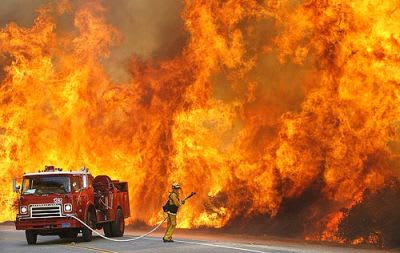
As far as lessons learned, it’ll be more polish than creating new programs. The programs we have in place are pretty solid. We had seven fires burning out of control at one time with the largest being the Witch Creek fire. At one point, the fire experts were saying the only thing that is going to put these fires out is a change in weather or when the fires hit the ocean. That’s a pretty bleak forecast.
The final count was approximately 1,600 homes and a lot of outbuildings destroyed, numerous private vehicles destroyed, 370,000 acres burned, and 10 deaths. That’s a tremendous loss. Although the predictions for the future are more fires, we cannot be lulled into thinking our next experience will be fire-related. We have to be ready for whatever form of disaster, and preparation is the name of the game.
More Operations

What’s Haunting Public Sector Fleets?
Public sector fleet challenges rarely happen in isolation, and addressing one often means understanding how it connects to another.
Read More →
Is Keeping Older Fleet Vehicles Really Saving Money?
Is keeping vehicles longer saving money, and what happens when a diagnostic test points to the wrong fix?
Read More →
How Smart Fleet Strategy Can Help Local Government Agencies Do More with Less
Keeping a vehicle longer may ease this year’s budget, but what does it cost the next one? A closer look at fleet decisions can reveal opportunities to reduce spending while protecting essential services.
Read More →
Connect with Government Fleet on LinkedIn
From industry news and fleet management strategies to conversations with peers, Government Fleet's LinkedIn page offers public-sector fleet professionals another way to stay informed and connected.
Read More →
Town of Queen Creek Named Most Successful Fleet Award Winner of Inaugural RTA Fleet Success Awards
Five fleets were honored at RTA Connect 2026 in Chicago for excellence across resource efficiency, intentional culture, risk management, and stakeholder satisfaction.
Read More →
A buyer's guide to fleet management software in 2027
Buying fleet management software in 2027 means looking beyond features and price. As fleet operations, technology and expectations evolve, this guide explores what today’s fleet professionals should consider when choosing a system that can deliver value now and adapt to what comes next.
Read More →
Hazard Alerts, Fleet Car Sales Rise and a New Shuttle Concept
Fleet car sales doubled, but the bigger picture tells a different story in this week’s roundup.
Read More →
How St. Johns County Turned Fleet Data Into Better Replacement Decisions
St. Johns County, Florida, had fleet data, but turning it into reliable decision guidance was another matter. Instead of starting over with a new fleet management system, the county connected existing tools and built a scoring system that gives managers an objective look at fleet health.
Read More →
Fleet Forward Conference Introduces One-Day Passes for 2026
New one-day registration lets fleet professionals attend Tuesday, Wednesday, or Thursday, with passes available for $249.
Read More →
ENC Unveils its ZAVIR Medium-Duty Shuttle
Two variants of the concept shuttles were revealed: a low-floor configuration and a high-floor configuration.
Read More →