Two years after Detroit’s Chapter 9 bankruptcy filing, the city fleet has come out stronger, with a fleet that’s leaner, more data-driven, and striving for further improvements.
by Jon White
November 5, 2015
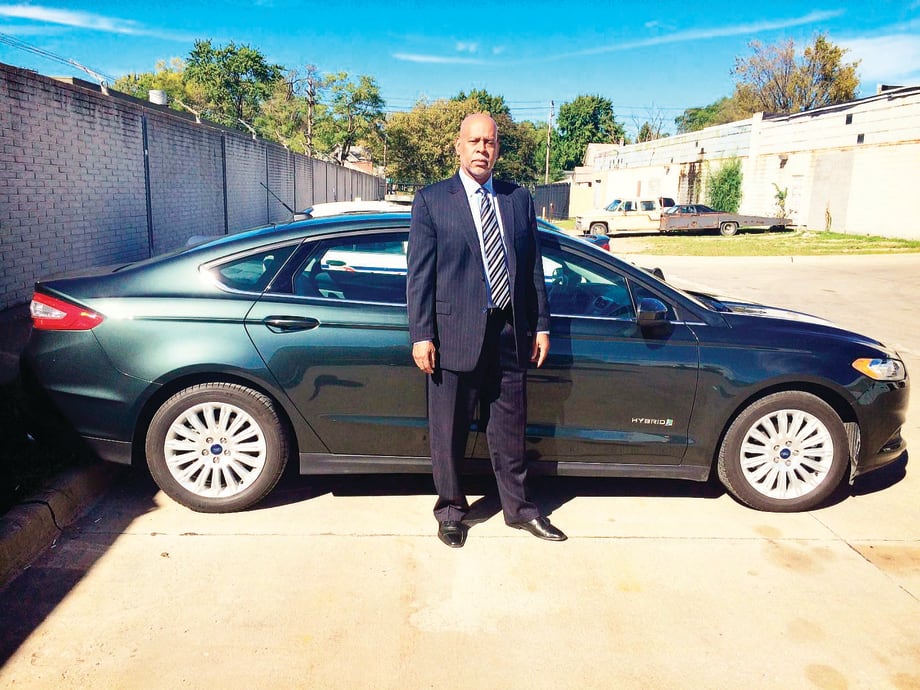
Detroit Executive Fleet Manager Craig Rice is pictured here with one of the new 2015 Ford Fusion hybrids, which get twice the fuel economy of the vehicles they replace. Photo courtesy of City of Detroit
6 min to read
Detroit Executive Fleet Manager Craig Rice is pictured here with one of the new 2015 Ford Fusion hybrids, which get twice the fuel economy of the vehicles they replace. Photo courtesy of City of Detroit
The decline of Detroit has been decades in the making and has probably bottomed out. The recovery of Detroit is now underway and full of potential and vitality. Despite the city’s ultimate Chapter 9 bankruptcy filing of July 2013, the city vehicle fleet has remained robust, well managed, and balanced. Fleet management, in spite of several administration changes, has consistently brought forward excellent leadership and vision, before, during, and after bankruptcy, and the fleet continues striving to improve in its services to user departments.
At a Glance
Since Detroit’s bankruptcy filing in 2013, the fleet has:
Further reduced fleet size, fuel sites, and number of shops
Created a new vehicle replacement plan
Invested in its first hybrid vehicles
Begun implementation of vehicle telematics and fuel site interface technology.
Heading Toward Bankruptcy
The City of Detroit population increased to a high point of about 2 million residents by the middle of the 20th century. Then from 1950 to 1980, Detroit lost 90% of its economic base and two-thirds of its population. In the opinion of Janet Anderson, current deputy director of General Services and a city employee for 25 years, by the 1980s, the corporate manufacturing exodus to suburban Detroit combined with the decline of the city led to a “predominant stigma of living in fear of crime and financial loss.”
Ad Loading...
By 2009, the Detroit Residential Parcel Survey revealed that 90,000 parcels were vacant; of the 220,000 standing homes, 34,000 were unoccupied.
Excessive debt and its reduced tax base led the City of Detroit to enter into a consent agreement with the State of Michigan in 2012, specifying 26 reform projects. In March 2013, the state appointed an emergency city manager, and the city filed Chapter 9 bankruptcy that July. The resulting post-bankruptcy plan of adjustment called for debt reduction to fund reinvestment in city services.
Turning Fleet Around
Before this, the fleet had been working to make positive changes.
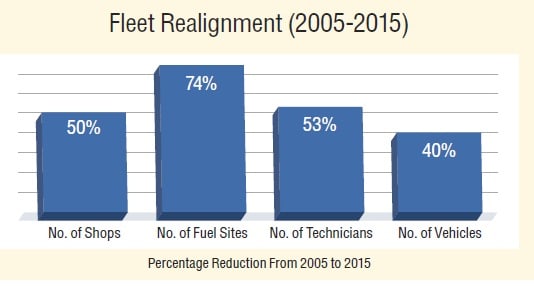
In 2005, the general fund fleet had a profile of approximately 4,000 vehicles, eight shops, 23 fuel sites, and approximately 150 technicians. The fleet at that time had many problems: It was fragmented, with seven key independent department fleets, and vehicle acquisition and disposal was splintered across the city. Record keeping was circa the 1950s, with no fleet management system, and fuel sites were unmanned and not automated.
That year, the city hired CST Fleet Services to identify fleet improvements, and in 2006, it promoted Craig Rice to the position of fleet manager. From 2006 through 2010, Rice initiated two strategic projects: fleet consolidation and automation.
Ad Loading...
The consolidation project brought all vehicles under management of the General Services fleet, excluding the transit fleet and the Water & Sewage Department vehicles. The general fund fleet had a city-wide fleet steering committee that managed all vehicle acquisitions, specifications, assignments, and remarketing.
Consolidation allowed the city to close down two maintenance facilities and 10 fuel sites — the fuel sites that weren’t automated. It also reduced fleet size by approximately 20%, to 3,200 vehicles. To do this, fleet staff used the new automated fuel sites to determine which vehicles weren’t being fueled. Any vehicle that didn’t get fuel for 90 days was targeted for disposal. Fleet reduction allowed the city to reduce the number of technicians to approximately 100.
During this period, fleet implemented the AssetWorks FleetFocus and FuelFocus systems at all active shops and fuel sites with real-time data. Technicians logged work order activity as maintenance and repairs occurred. The city also got out of the parts business and implemented a strategic vehicle parts partnership agreement.
Progress Stalls
In 2011 and 2012 the City of Detroit decline came to a critical level, and the city infrastructure began to flounder and suffer.
This, coupled with Rice’s retirement in 2011, severely affected the fleet. Mechanic and staff cutbacks were prevalent, leading to excessive vehicle downtime. Customer departments became dissatisfied. Information systems data became unreliable, and annual capital funding for vehicle asset replacement dropped to near $0.
Ad Loading...
Fortunately, during this period, General Services Director Brad Dick and Deputy Director Anderson recognized the decline. They worked to hold the vision of continued fleet sustainability, which helped keep the fleet intact and ensured the positive fleet initiatives that had been started survived during this challenging time.
Reviving Fleet Efforts
In 2013 the city finalized the bankruptcy and initiated recovery programs. One of these was in the fleet management arena. Dick re-engaged CST Fleet Services to develop models for fleet operations and vehicle assets. The resulting scenario profile options, analysis, and forecasts helped him justify rehiring Rice as executive fleet manager. In addition, city staff negotiated with eight corporations for the donation of $8 million in new vehicle assets for the Police and Fire departments.
In the two years since, Rice and his team have been able to make more positive changes. The team analyzed utilization, right-sizing, and vehicle sharing, and re-initiated the motor pool. With a smaller employee base, the fleet was able to identify more underutilized vehicles to reduce fleet size. It shut down additional fuel sites and consolidated more facilities. The fleet profile in 2015 is 2,400 vehicles, four shops, six fuel sites, and 70 technicians.
In addition, the fleet initiated several projects in 2015. Fleet is reviewing policies and procedures for maintenance personnel and operators, developing work standards for all shops, and implementing a new vehicle parts partnership agreement. It is re-establishing the Fleet Steering Committee with the goal of updating new customer department service level agreements. Fleet is finalizing a new forecasted capital plan that sets realistic levels, keeping the fleet within a good life cycle.
In 2015 and projected into next year, Rice and the staff are extensively adding new technology to the fleet. All vehicles are getting GPS systems and will also have AssetWorks RFID systems for fuel site updates and diagnostic information.
Ad Loading...
In addition, the city has begun greening efforts, with the addition of 55 Ford Fusion hybrids to replace 11-year-old Chevrolet Impalas, which are aged out. The 2015 Fusions are the first hybrids to be introduced to this fleet. These vehicles have a smaller carbon footprint and get double the fuel economy of the vehicles they replace.
Surviving Through Arduous Times
Managing a fleet in accordance with consistent basic industry best practices is a challenge. Doing so in a changing government and economic climate is even more challenging. The city fleet management for Detroit obtained and maintained best practices through very arduous times and through some of the worst possible economic challenges.
Bob Degnan, former commissioner of fleet management for the City of Chicago, who worked with CST and with Rice as a consultant during this transition and has consulted for other public agencies, said, “Other than being the fleet commissioner in Chicago, this was the greatest fleet story I was involved with.”
With its ongoing improvements, the Detroit fleet is now postured to become a best fleet among peers.
As Rice stated to Mayor Michael Duggan, “Detroit’s fleet should proudly represent the Motor City, and my goal is to get it there.”
Ad Loading...
Editor's note: Jon White II of Jon White, Inc., is an associate of CST Fleet Services and has served in various capacities as a consultant and fleet adviser to the City of Detroit since late 2004.
Keeping a vehicle longer may ease this year’s budget, but what does it cost the next one? A closer look at fleet decisions can reveal opportunities to reduce spending while protecting essential services.
From industry news and fleet management strategies to conversations with peers, Government Fleet's LinkedIn page offers public-sector fleet professionals another way to stay informed and connected.
Five fleets were honored at RTA Connect 2026 in Chicago for excellence across resource efficiency, intentional culture, risk management, and stakeholder satisfaction.
Buying fleet management software in 2027 means looking beyond features and price. As fleet operations, technology and expectations evolve, this guide explores what today’s fleet professionals should consider when choosing a system that can deliver value now and adapt to what comes next.
St. Johns County, Florida, had fleet data, but turning it into reliable decision guidance was another matter. Instead of starting over with a new fleet management system, the county connected existing tools and built a scoring system that gives managers an objective look at fleet health.