




Gainesville Fleet Manager ‘Out-Tasks’ Accident Management
Running your department like a business means always looking for efficiencies. To operate more efficiently, Milton Reid, director of fleet management for the city of Gainesville, Fla., outsourced accident management.
Milton Reid, director of fleet management for the city of Gainesville, Fla., acknowledges that outsourcing isn’t a popular concept among government fleet administrators. Yet he predicts that as they face mounting pressure to operate more efficiently, more and more government fleets will follow his example.
Late last year, Gainesville turned over its fleet accident management functions to The CEI Group Inc. (CEI), based in Trevose, Pa. By the spring, the Gainesville Regional Transit System followed suit. The city’s fleet includes more than 1,400 vehicles, while the regional transit system operates about 130 units, including 100 buses.
Few Public Fleets ‘Out-Task’
“Outsourcing is a dirty word in the government fleet business, so I’d rather say out-task,” says Reid. “I would estimate that fewer than one percent of government fleets out-task accident management. But I think you will see more of my colleagues going in this direction as they learn about our experience. And so far, it has been great.”
Reid doesn’t believe out-tasking is a panacea. When he joined Gainesville’s fleet department, it was already outsourcing routine vehicle maintenance and repairs.
“Gainesville was the first municipal fleet in the country to go outside for routine maintenance and repair,” Reid recalls. “But after I reviewed the operations, I was convinced that we could do the job better, faster, and cheaper if we took it back inside. So that’s what we did.”
Since then, his maintenance department has never given him reason to rethink that decision. “We still go outside for major work, like transmissions, but I’m satisfied that routine maintenance is something we handle more cost-effectively ourselves,” he says.
Nevertheless, Reid remained open to the idea that some aspects of his operation would be more efficient with outside help.
“One of the big reasons government fleet administrators don’t out-task accident management services is that they just aren’t aware it’s available,” says Reid. “I know that for some time I wasn’t.”
Reid, who holds a degree in mechanical engineering from Howard University in Washington, D.C., is a well-known public service fleet manager. He joined Gainesville’s fleet department in 1984 and has been its director for the last 21 years. In that time, he has served as president of the Florida Association of Government Fleet Administrators (FLAGFA) and, most recently, the National Association of Fleet Administrators (NAFA).
Before he came to Gainesville, Reid worked as an engineer and manager in the private sector for General Electric, Ford, and Occidental Petroleum. It was both his education and his experience at these companies that ingrained in him a drive to achieve the greatest possible efficiency in management.
{+PAGEBREAK+}
Finding Hidden Costs
Reid says fleet administrators often view accident management as just another line-item expense. What they don’t see, however, are the hidden costs of accidents - numbers that don’t appear in fleet managers’ budget books, but are really costing the government and, ultimately, the taxpayer.
Reid had long been dissatisfied with one aspect of his department’s method of handling vehicle accidents - downtime, meaning not just the time city vehicles are off the road, but the time that city employees whose jobs depend on their vehicles are out of action. “Up until we began working with CEI, our average downtime, just to get the vehicles to the repair facility, was 21 days,” Reid recounts. “But it could take 30 days, quite easily.”
It wasn’t his people or the repair shops that caused the delay, he explains. It was the system. All accident repairs over a certain dollar amount were required to go out for bid, and it was the bidding process itself that created the downtime.
“First, it would take five days to notify every body shop that we had a damaged vehicle they could inspect,” Reid recounts. “Then we would allow them 10 days to prepare and submit their bids. Then there was a waiting period of another three days to allow for potential bid protests.
“Then we could have another three to four days for my people to review and research the bids, because they weren’t always comparable. Some shops would bid on damage that others didn’t see. Some might be using OEM parts and others using substitute parts. And then, even after we’d award the job, every so often a body shop thought we were being unfair and would take their complaint all the way to the city commission.”
Instinctively, Reid realized that all this delay was costing Gainesville a lot of money. This is how he figured it. Between the police, fire, public works, utilities, and other departments, the city’s vehicles carry, on average, a crew of two. Without their vehicles, Reid estimates that a significant percentage of workers’ productivity is lost. Last year, the city’s fleet - minus the transit system - had 76 accidents. So by this analysis, downtime to the organization could have cost up to $255,000, depending on his department’s ability to secure loaner vehicles. That figure towers over the city’s total body shop repair bills of $87,500 last year.
Today, how many days does it take to get vehicles from the road to a repair facility? “Two,” says Reid. Using his method of analyzing the cost of downtime, the city could have saved between $170,000 and $230,000 with CEI’s services last year.
The key, he explains, is that CEI has a pre-approved network of auto body repair shops around the country, so the bidding process for each repair job isn’t necessary. In Gainesville’s case, the network includes some of the same shops Reid had worked with over the years. CEI’s process of auditing and monitoring these shops and the repairs they do is designed to ensure proper workmanship and to control downtime and costs. As a result, Reid says, “We are completely satisfied with the turnaround time, quality, and cost of repairs.”
Other Benefits
Reid is aware of two other benefits of this outsourcing program. One is that information about this aspect of his operations is now readily available to staff, through Internet access to CEI’s claims management system. “Now, all the data that used to take an analyst on my staff hours to retrieve - the number of accidents, total and average repair costs, and repair time - are all available, any time, at the touch of a finger,” he says.
And then there’s the extra time for his staff, created by eliminating the labor-intensive steps formerly involved with the bidding process. “Now my staff has more time to devote to all the other tasks we have to accomplish,” he says.
“We run our department like a business, and we are always looking for efficiencies,” Reid observes.
More Operations
How Leading Fleets Improve and Why Business Plans Matter
This week, we look at what past Leading Fleet winners can teach us about making progress, plus how to build a business plan your fleet will actually use.
Read More →
Nominate a Fleet Leader for the 2027 Public Fleet Hall of Fame
Do you know a fleet leader who has made a lasting impact on the industry? Nominate this fleet professional for the 2027 Public Fleet Hall of Fame.
Read More →
Why Fleet Business Plans Need Three Perspectives
A fleet business plan should help agency leaders understand the fleet’s value, give the organization a clear direction, and establish shared expectations with customer departments.
Read More →
How Oil Analysis, Safety Technology, and Fleet Awards Drive Improvement
What happens when fleets let measured results guide their next decision?
Read More →
Emergency Response, Fleet Sales and New Technology
This week’s fleet news covers emergency preparedness, shifting vehicle sales, electric truck investments, and new tools for monitoring road conditions.
Read More →
NCDOT Adds Dash Cam Imagery to Statewide Traffic Monitoring
North Carolina transportation officials are adding another set of eyes to roads that aren't covered by fixed traffic cameras. A statewide deployment gives NCDOT access to on-vehicle imagery to verify conditions during work zones, severe weather, emergencies, and other traffic events.
Read More →
Turning a Bottleneck Into a Blueprint: How Tallahassee Rethought Police Fleet Readiness
For Tallahassee, finally receiving 87 delayed police cruisers created a new problem: how to get them on the road without creating a massive backlog. The solution would change more than the upfit process.
Read More →
AI, Police Fleet Readiness and Fire Apparatus News
See how AI, a reworked police-vehicle upfitting process, and a fire apparatus acquisition could affect public fleet operations.
Read More →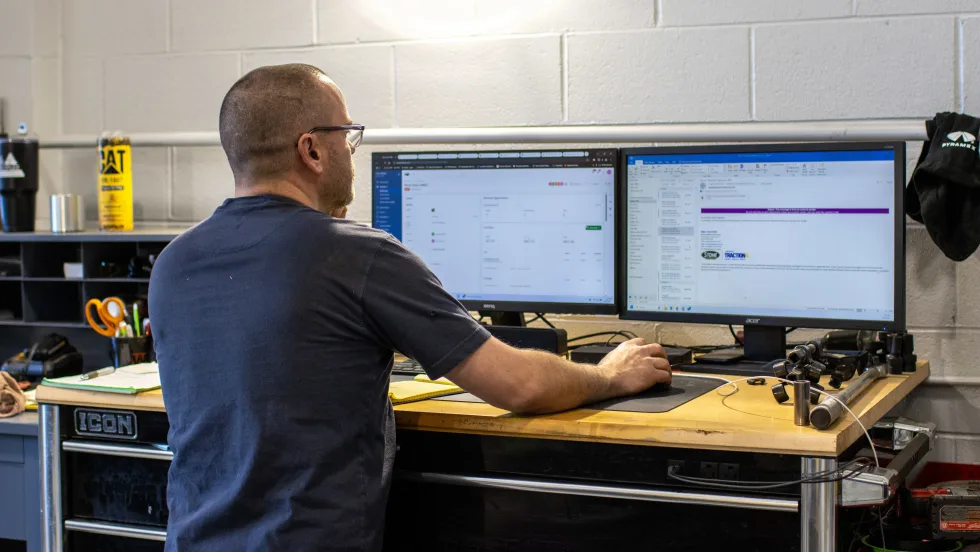
How AI and Automation Work Together to Reduce Government Fleet Downtime
As their assets age and their budgets’ purchasing power shrinks, government fleet managers are facing growing pressure to do more with less.
Read More →
Police Fleet Innovation, EV Strategy and AI
See how public fleets are rethinking police vehicle readiness, electrification, workplace culture, and driver workflows.
Read More →