




Federal vs. State & Local Fleets
The largest U.S. fleets are in the federal government. How do they compare with state and local government fleets?
Public sector fleet management includes federal, state, and local government fleet programs. Despite falling under that common designation, key differences exist in fundamental management processes and practices. A review of some of these differences highlights both strengths and weaknesses.
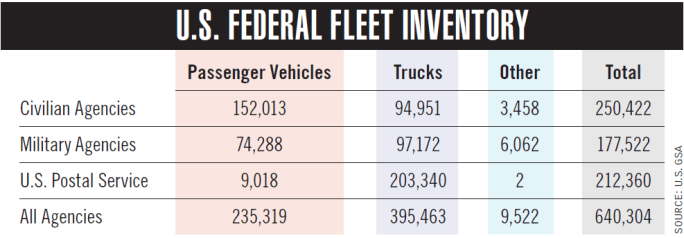
The U.S. government operates the largest civilian fleet in the world with more than 640,000 vehicles as reported in the most recent Federal Fleet Report (2015). The largest single agency fleet is the U.S. Postal Service (USPS) with well over 200,000 vehicles. Other civilian agencies operate around 250,000 vehicles, and the military has around 177,000.
At a glance
Areas where the federal fleet differs from state and local fleets include:
Centralized leasing
More variety in asset management software
More regulations that take time, effort, and funding
The exclusion of off-road equipment from fleet management.
Centralized Acquisition
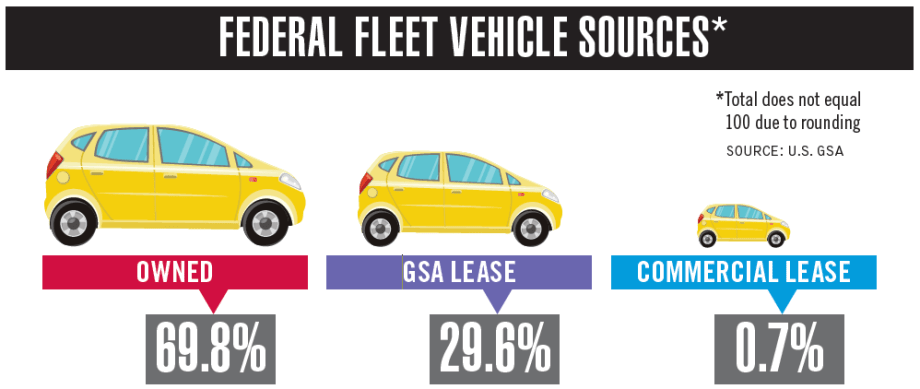
With the exception of the USPS, all federal agencies must acquire their vehicles using the services provided by the U.S. General Services Administration (GSA). Although agencies commercially lease a few vehicles, these account for less than 1% of the total fleet and are usually specialty vehicles not available through GSA.
As established by law, agencies may acquire vehicles in two ways from GSA.
First, GSA offers a purchasing service that helps agencies use their own funding to buy vehicles with substantial volume pricing discounts. Most states offer a similar arrangement for local governments by establishing a “state bid list” of vehicles with discounted pricing.
Second, GSA offers a leasing program whereby GSA owns the vehicle and leases it to the agency using a fixed monthly charge combined with a “cents-per-mile” charge. The leasing program usually includes fuel, maintenance, and some administrative services, although a “dry lease” is possible that excludes fuel and maintenance. In general, most state and local government fleets lack such a centralized internal leasing arrangement, although some have a working capital fund to facilitate vehicle replacements.
Similar Fueling and Maintenance Operations
Fueling and maintenance for federal agency-owned vehicles is handled much the same as in state and local government fleets. These functions for federal fleets (excluding GSA-leased vehicles) are usually decentralized, with maintenance performed by local commercial shops or by federal fleet shops, the latter being widely used in more remote locations such as parks within the Department of the Interior’s National Park Service or the Department of Homeland Security’s Customs and Border Protection’s Border Patrol.
State and local governments frequently rely on their own maintenance shops, which are usually staffed and managed by government employees.
The federal government often turns to private contractors to staff and manage its own maintenance shops. Non-tactical (i.e. non-battlefield) vehicles operated by the branches of the military are usually operated and managed in a more centralized manner by government civilian workers.
GSA-Provided Remarketing
Vehicle disposal for both agency-owned (civilian) and agency GSA-leased vehicles is nearly always handled by GSA, which operates auctions for sales to the public. By regulation, GSA offers an “exchange sale” program whereby proceeds from the sale of agency-owned vehicles are applied to offset some of the purchase cost of new replacement vehicles. Disposal of owned military vehicles is usually handled by the Defense Logistics Agency within the Department of Defense.
Disposal of state and local government vehicles is mostly decentralized with each state, county, and city choosing and managing its own disposal process, usually by auction.
Various Fleet Software in Use
Fleet information collection and management has been especially challenging in the federal government.
Most state and local governments have wisely opted for fleet management information systems specifically designed for vehicle management. Some federal agencies have implemented this approach too, but many others have struggled to modify and use property or asset management software or general enterprise resource planning software, an approach that is less than optimal.
The branches of the military have been more successful in this area. Steps are underway to require all military and civilian agencies to annually report line-by-line vehicle level data with a requirement for more than 70 data elements.
GSA is now providing software at no charge to agencies to manage their owned vehicles. The GSA-leased vehicles are managed using an internal GSA software system and typically have more complete and accurate data.
Telematics is gradually being introduced into some federal agency fleets. This has the potential to improve data collection and accuracy but poses security concerns for some agencies. The same holds true for state and local government fleets.
Exploring Other Factors
One factor that impacts federal fleet management more than most state and local government fleets is the requirement for environmental and management actions in the areas of greenhouse gas emission reduction, acquisition of battery-electric and plug-in hybrid vehicles, optimizing vehicle inventories in terms of the right number and right types of vehicles, and deploying telematics. These requirements stem from an Obama-era Executive Order (a presidential order having the force of law). Other federal regulations abound that occupy a considerable amount of time, effort, and funding.
State and local fleets must adhere to federal laws such as the Energy Policy Act, but generally face fewer regulations. One exception is the State of California, which is also very active in the area of vehicle environmental issues.
Perhaps the most glaring inconsistency between state and local government fleets and federal fleets is the management of motorized off-road equipment. State and local government fleets manage off-road equipment and highway vehicles collectively as a single fleet, recognizing that they all have similar requirements for acquisition, fuel, maintenance, management, disposal, and data collection.
The definition of “fleet” for the federal government (regulation FMR 102-34.35) narrows the reportable fleet to cars, trucks, and buses, and excludes motorized off-road equipment. In fact, in many cases, off-road equipment is tracked by people in property management and is often disconnected from car and truck fleet management. This inefficiency will likely continue until the regulation defining fleet is modified.
Finally, training and certification in the area of fleet management is offered by several organizations including the NAFA Fleet Management Association, the American Public Works Association, and the Association of Equipment Management Professionals. Recognizing the many differences between federal fleet management and state and local fleet management, the National Property Management Association created a training and certification program specifically designed for people in the business of federal fleet management.
All these organizations have valuable programs for fleet managers and staff, but each individual should examine the various programs to determine the best fit.
More Operations

Is Keeping Older Fleet Vehicles Really Saving Money?
Is keeping vehicles longer saving money, and what happens when a diagnostic test points to the wrong fix?
Read More →
How Smart Fleet Strategy Can Help Local Government Agencies Do More with Less
Keeping a vehicle longer may ease this year’s budget, but what does it cost the next one? A closer look at fleet decisions can reveal opportunities to reduce spending while protecting essential services.
Read More →
Connect with Government Fleet on LinkedIn
From industry news and fleet management strategies to conversations with peers, Government Fleet's LinkedIn page offers public-sector fleet professionals another way to stay informed and connected.
Read More →
Town of Queen Creek Named Most Successful Fleet Award Winner of Inaugural RTA Fleet Success Awards
Five fleets were honored at RTA Connect 2026 in Chicago for excellence across resource efficiency, intentional culture, risk management, and stakeholder satisfaction.
Read More →
A buyer's guide to fleet management software in 2027
Buying fleet management software in 2027 means looking beyond features and price. As fleet operations, technology and expectations evolve, this guide explores what today’s fleet professionals should consider when choosing a system that can deliver value now and adapt to what comes next.
Read More →
Hazard Alerts, Fleet Car Sales Rise and a New Shuttle Concept
Fleet car sales doubled, but the bigger picture tells a different story in this week’s roundup.
Read More →
How St. Johns County Turned Fleet Data Into Better Replacement Decisions
St. Johns County, Florida, had fleet data, but turning it into reliable decision guidance was another matter. Instead of starting over with a new fleet management system, the county connected existing tools and built a scoring system that gives managers an objective look at fleet health.
Read More →
Fleet Forward Conference Introduces One-Day Passes for 2026
New one-day registration lets fleet professionals attend Tuesday, Wednesday, or Thursday, with passes available for $249.
Read More →
ENC Unveils its ZAVIR Medium-Duty Shuttle
Two variants of the concept shuttles were revealed: a low-floor configuration and a high-floor configuration.
Read More →
Could Your Next Fleet Technician Start as an Intern?
What if your next technician hasn’t worked in a fleet shop yet? What fleets are doing to free up time.
Read More →