




Related: Freightliner Shows Detroit DD8 Engine in a Heavy Vocational Truck
Freightliner EconicSD Waste Collection Truck Unveiled
Freightliner Trucks introduced the new EconicSD, a low-entry cab-over-engine waste collection truck. It will be available in 6x4, high cab and low cab, and rear and side loader configurations.
by Staff
April 24, 20183 min to read
Freightliner Trucks introduced the new EconicSD waste collection truck at WasteExpo. The Freightliner EconicSD is a modern, low-entry cab-over-engine (COE) waste collection truck for the North American market.
The truck will be available to start ordering in the summer of 2018. Cab configurations for the EconicSD in 6x4, high cab and low cab, and rear and side loader configurations will be available.
The Freightliner EconicSD was adapted from the Mercedes-Benz Econic, a low-entry COE chassis that is popular with waste collection customers in Europe, Australia, and Asia.
“By working closely with our North American waste collection customers and analyzing how we could provide a solution that best benefits their businesses, we recognized the opportunity to adapt the Freightliner EconicSD for this market,” said Roger Nielsen, president and CEO for Daimler Trucks North America. “Our customers continually seek to elevate the safety and performance of their waste collection vehicles, and the Freightliner EconicSD is the right solution for the distinct needs of this segment.”
The cab and chassis are designed and manufactured in Woerth, Germany – Daimler’s largest truck plant. Final assembly of the cab and chassis will be completed in Gaffney, S.C., at the Freightliner Custom Chassis Corporation (FCCC) manufacturing facility.
Freightliner Trucks also partnered with Heil Environmental and McNeilus Truck & Manufacturing, two truck equipment manufacturers (TEMs) in the waste collection industry.
Equipped with the new Detroit DD8 mid-range engine, the Freightliner EconicSD achieves a rating of 350 hp and 1,050 lb.-ft. torque. Ideal for the waste collection market, the DD8’s variable exhaust cam phasing optimizes exhaust temperatures during low-load operations for more efficient aftertreatment performance, according to the manufacturer. The DD8 also features Detroit Connect Virtual Technician remote diagnostic service.
The new waste collection truck is engineered to enhance the safety of not only the driver and crew but also pedestrians and drivers of other vehicles. Its panoramic windshield and low seating position provide increased visibility, while the mirror system offers an expanded field of vision for work areas and potential blind spots. Finally, the short wheelbase and aggressive wheel cut deliver enhanced maneuverability.
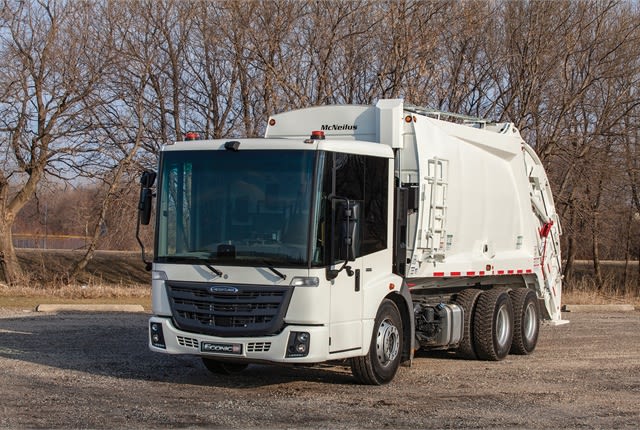
Freightliner Trucks also partnered with Heil Environmental and McNeilus Truck & Manufacturing (pictured), two truck equipment manufacturers (TEMs) in the waste collection industry. (Photo courtesy of Freightliner)
In addition, the Freightliner EconicSD comes standard with active brake assist, adaptive cruise control, and lane departure warning to mitigate potential collisions. Optional safety features include side guard assist and a built-in camera system with 360-degree views displayed on a flat screen dash monitor.
The Freightliner EconicSD’s low entry means only one step is needed to enter the cab, with just one more step to the driver’s platform. The first step is only 19 inches, half the first-step height of many conventional waste collection trucks. A kneeling feature further reduces step-in height, while a lifting feature improves clearance over objects.
The cab has an air-suspended driver’s seat, with additional single seating to accommodate up to three passengers in the high cab model. The Freightliner EconicSD comes standard with a digitized instrument cluster that displays key information on an LCD screen on the dash and is operated by intuitive steering wheel controls.
More Operations
Is Keeping Older Fleet Vehicles Really Saving Money?
Is keeping vehicles longer saving money, and what happens when a diagnostic test points to the wrong fix?
Read More →
How Smart Fleet Strategy Can Help Local Government Agencies Do More with Less
Keeping a vehicle longer may ease this year’s budget, but what does it cost the next one? A closer look at fleet decisions can reveal opportunities to reduce spending while protecting essential services.
Read More →
Connect with Government Fleet on LinkedIn
From industry news and fleet management strategies to conversations with peers, Government Fleet's LinkedIn page offers public-sector fleet professionals another way to stay informed and connected.
Read More →
Town of Queen Creek Named Most Successful Fleet Award Winner of Inaugural RTA Fleet Success Awards
Five fleets were honored at RTA Connect 2026 in Chicago for excellence across resource efficiency, intentional culture, risk management, and stakeholder satisfaction.
Read More →
Sponsored•October 14, 2026
A buyer's guide to fleet management software in 2027
Buying fleet management software in 2027 means looking beyond features and price. As fleet operations, technology and expectations evolve, this guide explores what today’s fleet professionals should consider when choosing a system that can deliver value now and adapt to what comes next.
Read More →
Hazard Alerts, Fleet Car Sales Rise and a New Shuttle Concept
Fleet car sales doubled, but the bigger picture tells a different story in this week’s roundup.
Read More →
How St. Johns County Turned Fleet Data Into Better Replacement Decisions
St. Johns County, Florida, had fleet data, but turning it into reliable decision guidance was another matter. Instead of starting over with a new fleet management system, the county connected existing tools and built a scoring system that gives managers an objective look at fleet health.
Read More →
Fleet Forward Conference Introduces One-Day Passes for 2026
New one-day registration lets fleet professionals attend Tuesday, Wednesday, or Thursday, with passes available for $249.
Read More →
ENC Unveils its ZAVIR Medium-Duty Shuttle
Two variants of the concept shuttles were revealed: a low-floor configuration and a high-floor configuration.
Read More →
Could Your Next Fleet Technician Start as an Intern?
What if your next technician hasn’t worked in a fleet shop yet? What fleets are doing to free up time.
Read More →