




Scooting to the Future on Segways
Impressed by environmental advantages, potential productivity benefits, and low operating costs, public sector fleets across the country are testing the novel 'human transporters' for a variety of functions.

In the resort town of Delray Beach, Fla., police officers patrol special events perched atop a Segway Human Transporter (HT), gaining an eight-inch height advantage that provides greater visibility both of and from the crowd. They easily maneuver through the pedestrians, drawing startled reactions, stares, and excited questions.
So has the Segway been capturing attention in public sector applications across the country.
The electric scooters, which resemble oversized, push-style lawn mowers, have been employed in fleets at the U.S. Army, Navy, and Air Force, the National Highway Traffic Safety Administration, postal service, airport and transit authorities, utilities, police departments, emergency medical teams, and several universities.
Introduced to the nation in 2001 as a revolution in personal mobility, the Segway HT is a self-balancing, electric-powered transportation device designed as an alternative to short-distance car trips. According to company materials, the scooter is “ideally suited for situations that require covering long distances or maneuvering through densely populated areas,” including applications such as delivery/utility routes, large-scale manufacturing plants and warehousing operations, campus transportation, and public safety functions.
The transporter is the brainchild of inventor and entrepreneur Dean Kamen, who also created the first portable drug infusion pump and a self-propelled wheelchair that can maneuver up stairs or curbs.
HTs Use ‘Dynamic Stabilization’
The essence of the Segway is a technology called Dynamic Stabilization, which enables the transporter to work seamlessly with the body’s movements.
Gyroscopes, tilt sensors, high-speed microprocessors, and powerful electric motors work together to sense the user’s center of gravity, instantaneously assessing the information and making minute adjustments 100 times per second. To operate, the user merely leans forward or backward, and the Segway responds to the slight shift in body position by moving forward or reversing. Straightening up stops the transporter, and rotating a steering grip will turn it in either direction.
With a top speed of 12.5 mph, slightly faster than a 5-minute mile, the Segway can navigate most walkable areas, including paved surfaces, grass, dirt roads, and inclines. The size of an average person, the scooter measures about shoulder-width and lifts the user 6-8 inches off the ground. Balancing on a single axle with wheels capable of rotating in opposite directions, the Segway can turn in place, a maneuver few other vehicles can manage.
Available in three models designed for specific functions — carrying cargo, traveling over variable terrain, or navigating in congested pedestrian environments — the transporter is powered by a twin NiMH battery pack with a usual range of 8-12 miles on a single charge. Users undergo a brief orientation session to master the vehicle’s operation.
The Segway HTs are priced about $5,000 each with operating costs as low as $3 a year. The scooters are manufactured a few miles from company headquarters in Manchester, N.H.
{+PAGEBREAK+}
Performing a Variety of Roles
Among public sector fleets, the attention-grabbing Segways perform in a variety of roles. In California, the Los Angeles County Metropolitan Transit Authority, sheriff, and police departments use a dozen HTs in patrolling rail stations and a downtown bus maintenance facility — large complexes where quick movement from one location to another is required.
Environmental management experts at Tinker Air Force Base in Oklahoma recently began a pilot test of 10 leased Segways, employing them to help transport people and deliveries throughout the base’s cavernous buildings.
In addition to special event coverage, the Delray Beach police department uses its two Segway HTs for specialized patrol functions, reported Jeff Messer, department spokesman. “We can quickly patrol business complexes and parking lots, covering three times the area of a foot officer. They’re silent, so would-be burglars can’t hear a patrol officer approach,” said Messer. “The community loves them.”
Seattle Conducts Pilot Program
The city of Seattle is conducting an 18-month pilot program analyzing the Segways in a variety of environments. The test run is part of the city’s “green fleet” initiative, which set a long-term goal of a 100 percent “clean and green fleet.”
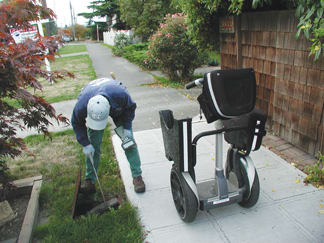
Seattle’s Public Utilities water meter readers were the first to employ the self-balancing scooters. “We were looking at the impact the Segways could have on productivity as well as financial factors, the cost/benefit ratio,” said Matt Rathke, fleet services division.
On foot or in vehicles, the meter readers cover 175,000 commercial and residential customers in Seattle and surrounding King County, according to Rathke. With the Segways, initial results indicate productivity doubled for readers who usually drive their routes and increased by 20 percent for those who normally walk routes.
“An unexpected benefit was an increased level in accuracy,” said Rathke.
The utilities department is now considering redesigning its routes to use additional Segways. The city’s parking meter coin-collection operation, Seattle’s downtown fleet motor pool, and the parks and recreation departments are also investigating how the transporter can improve operations.
“We are trying to be careful. We only want to use the Segways where we know there are productivity benefits in addition to environmental benefits,” Fleets and Facilities Director John Franklin told the Seattle Post-Intelligencer.
More Operations

Is Keeping Older Fleet Vehicles Really Saving Money?
Is keeping vehicles longer saving money, and what happens when a diagnostic test points to the wrong fix?
Read More →
How Smart Fleet Strategy Can Help Local Government Agencies Do More with Less
Keeping a vehicle longer may ease this year’s budget, but what does it cost the next one? A closer look at fleet decisions can reveal opportunities to reduce spending while protecting essential services.
Read More →
Connect with Government Fleet on LinkedIn
From industry news and fleet management strategies to conversations with peers, Government Fleet's LinkedIn page offers public-sector fleet professionals another way to stay informed and connected.
Read More →
Town of Queen Creek Named Most Successful Fleet Award Winner of Inaugural RTA Fleet Success Awards
Five fleets were honored at RTA Connect 2026 in Chicago for excellence across resource efficiency, intentional culture, risk management, and stakeholder satisfaction.
Read More →
A buyer's guide to fleet management software in 2027
Buying fleet management software in 2027 means looking beyond features and price. As fleet operations, technology and expectations evolve, this guide explores what today’s fleet professionals should consider when choosing a system that can deliver value now and adapt to what comes next.
Read More →
Hazard Alerts, Fleet Car Sales Rise and a New Shuttle Concept
Fleet car sales doubled, but the bigger picture tells a different story in this week’s roundup.
Read More →
How St. Johns County Turned Fleet Data Into Better Replacement Decisions
St. Johns County, Florida, had fleet data, but turning it into reliable decision guidance was another matter. Instead of starting over with a new fleet management system, the county connected existing tools and built a scoring system that gives managers an objective look at fleet health.
Read More →
Fleet Forward Conference Introduces One-Day Passes for 2026
New one-day registration lets fleet professionals attend Tuesday, Wednesday, or Thursday, with passes available for $249.
Read More →
ENC Unveils its ZAVIR Medium-Duty Shuttle
Two variants of the concept shuttles were revealed: a low-floor configuration and a high-floor configuration.
Read More →
Could Your Next Fleet Technician Start as an Intern?
What if your next technician hasn’t worked in a fleet shop yet? What fleets are doing to free up time.
Read More →