




Paving the Way to Asphalt Equipment Management
In-house asphalt projects can save considerable time and money if the equipment is used appropriately and is carefully maintained to ensure optimal performance.
Large asphalt projects, such as major roads and highways, are often contracted out to private companies, but many municipal, city, and state governments take responsibility for small and medium paving projects. This can include parking lots, bike and golf cart paths, residential streets, road resurfacing, and pothole repair.
Like all specialized construction equipment, the tools used to remove and spread asphalt have varying specifications depending on need.
The first step in purchasing the best asphalt equipment is identifying how it will be used.
Commercial pavers are generally 4 to 15 feet in width with a 5- to 10-ton hopper capacity and weigh less than 19,000 lbs.
In 2003, LeeBoy of Denver, N.C., expanded into the highway heavy market with a 25,000-lb. paver.
Asphalt compaction is usually achieved using a static drum roller, a vibratory roller, or a pneumatic tire roller.
Bomag Americas, Inc. in Kewanee, Ill., has directed its technological advances primarily to the vibratory roller category, says Doug Zoerb, administrator of marketing communications.
These rollers contain a spinning weight that lifts and drops in the drum, creating evenly-spaced small dents in the asphalt.
To prevent bumpy roads with obvious ripples, the vibrations are set to create dents no more than one inch apart. According to Zoerb, this is the optimum number of dents per inch: more is unnecessary.
Benefits of In-House Projects
Don Boynton, assistant street superintendent for the City of Costa Mesa, Calif., oversees the city's asphalt equipment, which includes a LeeBoy paver, backhoe, and two rollers.
Costa Mesa averages eight residential street overlays each year, with each taking approximately two weeks to complete. The city's overlay program has been operational for nearly 20 years.
Boynton says the city decided on its current paver about 12 years ago after identifying how it would be used.
While the pavers are primarily used for the overlay projects, the city's rollers are used nearly every day for routine patches and maintenance.
The Town of Lisbon, N.Y., began removing old or damaged asphalt itself in 2001, rather than contracting out the work.
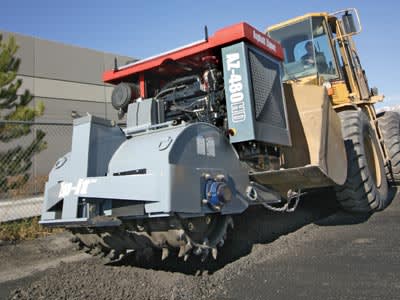
Tim Dow, highway superintendent, says the time required for reconstruction projects was cut in half after the town purchased an Asphalt Zipper.
Using the machine, old black top is milled up and able to be reused. "It gives us a uniform product that we can use again in the same place," says Dow.
He adds that the machine's ease of mobility was one of its main selling points. Transported on its own trailer, Dow says the Asphalt Zipper can be set up in just minutes.
Dow has two crews trained to operate the equipment, which has its own motor and is attached to a CAT loader when in use.
The Town of Lisbon lease-purchased the machine over a five-year period for a cost of $18,000 each year. "If I had jobbed this out, it would have cost $36,000 this year alone," says Dow.
The town also supports the cost of the equipment by bidding on jobs in nearby cities and towns. This usually allows Lisbon to make a profit while still providing the service at a lower cost than would a private contractor.
When working with asphalt projects, operators must understand how to use the equipment as well as how to work with the asphalt. Temperature, consistency, and amount are crucial to the success of the final product.
Carl Bonson, of Nixon-Egli Equipment Company, a dealer of LeeBoy and Rosco asphalt equipment, says some people think laying down more asphalt is always better, but this is not necessarily the case.
He says innumerable problems can result from incorrect asphalt temperature and from hitting the asphalt too soon with the compactor.
In Costa Mesa, the same people generally operate the same equipment, which Boynton says creates more efficiency and a better finished product.
{+PAGEBREAK+}
Preventive Maintenance Saves Money
Although construction time is often decreased, more time must be allotted for preventive maintenance and repairs on the machinery in a fleet.
Dow says he expects about two hours of maintenance for every seven hours of use. This mainly involves replacing the carbide-tipped steel teeth that have broken off during the asphalt milling process. Also, holes can be torn in the tooth holders that must be fixed.
"We go through about 400 teeth in 10 miles of road," says Dow. "We try to be careful because it's almost $4 per tooth and that adds up, but they just wear out over time."
The Zipper has about 122 teeth on the 48-inch cutter head and proportionately fewer on the 36-inch and 30-inch cutter heads. Asphalt Zipper's Keller says normal operation requires the replacement of approximately five teeth for each hour of use, but this varies depending on the thickness of the asphalt.
Keller adds, "If the operator uses water during the grinding operation, the teeth will last a whole lot longer."
A common mistake Dow has experienced is requests to dig too deep while working in other jurisdictions.
"Some want you to get all the way to the sub-base and there's no need to go that deep," he says. "You only need to go about one inch into the base. You're taking a chance when you get to that rocky layer below."
Paver cleaning and maintenance involves cleaning out excess asphalt and lubricating all the moving parts. "A problem with larger contractors is that they don't leave time for proper maintenance and then the big equipment breaks," says Costa Mesa's Boynton.
Because asphalt equipment is often used on a daily basis, many operators do not have time to perform all necessary maintenance when it should be done.
"We've taken the maintenance out of the lubrication and water systems, which used to be done on a daily basis," explains Bomag's Zoerb.
The engine and hydraulic system still require regular service intervals, but the lengthy daily work has been reduced, he adds.
More Operations
Who Deserves Fleet Recognition and What Could You Teach at GFX?
Who helped shape your fleet career, and what have you learned that could help someone else?
Read More →
What’s Haunting Public Sector Fleets?
Public sector fleet challenges rarely happen in isolation, and addressing one often means understanding how it connects to another.
Read More →
Is Keeping Older Fleet Vehicles Really Saving Money?
Is keeping vehicles longer saving money, and what happens when a diagnostic test points to the wrong fix?
Read More →
How Smart Fleet Strategy Can Help Local Government Agencies Do More with Less
Keeping a vehicle longer may ease this year’s budget, but what does it cost the next one? A closer look at fleet decisions can reveal opportunities to reduce spending while protecting essential services.
Read More →
Connect with Government Fleet on LinkedIn
From industry news and fleet management strategies to conversations with peers, Government Fleet's LinkedIn page offers public-sector fleet professionals another way to stay informed and connected.
Read More →
Town of Queen Creek Named Most Successful Fleet Award Winner of Inaugural RTA Fleet Success Awards
Five fleets were honored at RTA Connect 2026 in Chicago for excellence across resource efficiency, intentional culture, risk management, and stakeholder satisfaction.
Read More →
A buyer's guide to fleet management software in 2027
Buying fleet management software in 2027 means looking beyond features and price. As fleet operations, technology and expectations evolve, this guide explores what today’s fleet professionals should consider when choosing a system that can deliver value now and adapt to what comes next.
Read More →
Hazard Alerts, Fleet Car Sales Rise and a New Shuttle Concept
Fleet car sales doubled, but the bigger picture tells a different story in this week’s roundup.
Read More →
How St. Johns County Turned Fleet Data Into Better Replacement Decisions
St. Johns County, Florida, had fleet data, but turning it into reliable decision guidance was another matter. Instead of starting over with a new fleet management system, the county connected existing tools and built a scoring system that gives managers an objective look at fleet health.
Read More →
Fleet Forward Conference Introduces One-Day Passes for 2026
New one-day registration lets fleet professionals attend Tuesday, Wednesday, or Thursday, with passes available for $249.
Read More →