




LEDs Light the Way for Fleets
LEDs offer numerous benefits over halogen and incandescent lights, including a low-amperage electrical draw and less required maintenance.

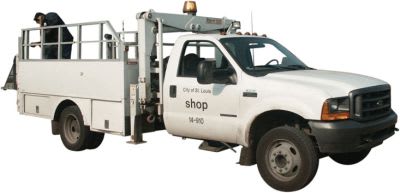
With many cost and safety benefits, LEDs are fast becoming the standard in various service-vehicle lighting applications. LEDs are increasingly used for running/clearance lights and are rapidly becoming the “standard” in stop, turn, and back-up lights on both trucks and bodies.
The light emitting diode (LED) is a semiconductor device that emits light when electrical current passes through it. It has neither the high voltage requirement of a strobe nor the filament of bulbs in halogen/incandescent lights. As such, it offers numerous benefits over both.
“We’ve purposely put LED lighting on everything we spec for the past four years,” said Chris Amos, CAFM, commissioner of equipment services for the City of St. Louis.
The city’s fleet of 2,400 vehicles includes a wide variety of public works service trucks, such as utility body, aerial (bucket), animal control, mosquito spray, dump, and water trucks used to fix water mains and fire hydrants.
The city also uses LED lighting on the “arrow boards” (pop-up directional indicators for traffic) of its roadside construction vehicles, on service trucks used for on-road calls, and for quick response/ emergency vehicles.
The City uses LEDs for tail marker, side marker, top cab lighting, and even the top bed marker lights installed in the fronts and backs of certain raised-bed vehicles.
“To me, LED versus incandescent is a no-brainer,” said Amos. LED lights “illuminate better. They require less maintenance and draw less power. On arrow boards, it’s to the point now where you don’t even have to idle the vehicle when running the lights.”
The idling benefit involves more than saving fuel costs and reducing pollution.
“Following the 9/11 terrorist attacks, the Los Angeles County Department of Public Works, in Alhambra, Calif., became more wary of perpetrators stealing gas company or other public works trucks and getting into places other vehicles would have difficulty being admitted,” said Frank X. Madrid, county power equipment specifications writer.
“Often, a crew might be working 50 yards away, making it easy for someone to jump in and drive away before they can be stopped,” Madrid added.
For the past few years, the City of Macomb Department of Public Works in Macomb, Ill., has been buying LEDs for its trucks “whenever they’re available as an OEM product,” said Walter J. Burnett, CAFM, public works director for Macomb.
The city’s municipal fleet includes a wide variety of light- and medium-duty trucks and road maintenance vehicles.
In similar fashion, the majority of the County of Henrico, Va., fleet departments, with a 3,000-vehicle fleet, also “routinely specify” LED lighting, said Charles A. Gibbens, county fleet manager in Glen Allen, Va. “It’s picked up considerably, especially in service vehicles and dump trucks,” he added.
Given his departments’ growing preference for LEDs, Gibbens thinks coordinating and standardizing their use is the most cost-effective approach.
“It saves problems in parts supply and keeps down the overhead in the parts room,” said Gibbens. “You’re also buying in quantity, so you can get a good price on [LEDs].”
With nearly 3,000 vehicles, Los Angeles County’s Department of Public Works uses LED rear-face lighting and clearance lights for “anything we specify and have built, except the back-up lights, which are incandescent,” said Madrid.
Until recently, the cost differential for using LED back-up lights had been too great. “Now that costs have come down a lot, we might start adding them,” Madrid concluded.
Brightness, Low Energy Prompt Appeal
LEDs first established themselves in emergency vehicles, such as fire apparatus and EMS trucks, because of the safety provided by their superior brightness, allowing greater distance visibility, and their low-amperage electrical draw.
With a vehicle’s air conditioner running and its typically large light bar pulling so many amps, the electrical draw “would literally suck down the battery, if you weren’t in high idle in the summertime,” said Gibbens. “We used previous-generation Street Hawk bars that drew 53 amps, and some LED bars barely draw 10. That’s a fantastic savings in drain on batteries and charging systems. Alternators are quite expensive; everything you can do to cut down on electrical draw, you’re doing yourself a favor.”
Lifecycle vs. Initial Cost Benefits
LEDs are more expensive than strobe lights and halogen/incandescent lighting, but, over the long run, pay for themselves.
Costs range widely, depending on variables such as size and configuration, according to Greg Parman, an independent manufacturer’s representative with Clark Sales, in Tustin, Calif. His customers include a number of truck upfitters.
Older “first-generation” 5mm T1-3/4 LEDs, for example, are “very affordable, but don’t provide as much illumination or as wide a viewing angle” as newer designs, said Parman.
“Second-generation” 8mm LEDs offer an upgrade. They’re typically used for stop and clearance lights, incorporating 6-10 diodes versus 40-50 in the past.
The latest “third-generation” LED light bars are bigger, brighter, and high-powered yet, using 10mm LEDs, referred to as “1-watt” or “3- watt,” for their lighting.
Overall, manufacturers reduced costs using technological improvements, such as more efficient diodes and sophisticated lens optics (requiring fewer diodes to meet requirements).
“For a few hundred dollars more, you can upgrade from a strobe to an LED light bar,” Parman noted.
For example, at Pacific Truck Equipment in Whittier, Calif., LED lighting adds about $240 to the $800 price of a standard cab-mounted light bar on service vehicles, according to Joe Ramirez, a company purchasing agent. The labor time required is the same for both halogen and LED lighting, Ramirez added.
Reduced Service & Maintenance
LEDs are designed to last 100,000 hours. That equates to 11 years service life on a 24/7 basis, compared to 1,000 hours for a long-life halogen bulb and 2,000-4,000 hours for the average strobe light.
LEDs also have no bulbs to replace. “We used to have to pop off the covers (of halogen lights) to change the bulbs,” Amos said. “The backs weren’t wellsealed either, so in the winter you’d get corrosion from snow, salt, and ice on the wire ends in the back.”
Amos noted that the LEDs’ smaller, flatter design also makes them less susceptible to damage from tree limbs.
Even with his fleet’s rather moderate $53 hourly labor rate, “It doesn’t take much to pay off the extra (initial) cost of the LEDs,” Amos concluded.
Additional Safety Benefits
LEDs also provide distinct safety advantages. With anywhere from six to 50 diodes, they are virtually incapable of burning out, unlike halogen or strobe lights. If one diode goes, the remainder continue functioning. This feature safeguards an operator from the potential
risk of suddenly having the warning lights go out, for example.
From a safety standpoint, LEDs also light up faster than incandescent bulbs, according to a study by University of Michigan Transportation Research Institute, Ann Arbor,Mich.
Although the difference in response time may be small, it equates to about 20 additional feet of stopping distance for a vehicle traveling at freeway speeds.
Until recently, one drawback to LEDs used in taillights/running lights and turn signals was their low currency draw. They typically flash about three times faster than a normal turn signal, for example. Flash units now have been engineered for LEDs, “so the problem has gone away,”Madrid noted..
More Operations

What’s Haunting Public Sector Fleets?
Public sector fleet challenges rarely happen in isolation, and addressing one often means understanding how it connects to another.
Read More →
Is Keeping Older Fleet Vehicles Really Saving Money?
Is keeping vehicles longer saving money, and what happens when a diagnostic test points to the wrong fix?
Read More →
How Smart Fleet Strategy Can Help Local Government Agencies Do More with Less
Keeping a vehicle longer may ease this year’s budget, but what does it cost the next one? A closer look at fleet decisions can reveal opportunities to reduce spending while protecting essential services.
Read More →
Connect with Government Fleet on LinkedIn
From industry news and fleet management strategies to conversations with peers, Government Fleet's LinkedIn page offers public-sector fleet professionals another way to stay informed and connected.
Read More →
Town of Queen Creek Named Most Successful Fleet Award Winner of Inaugural RTA Fleet Success Awards
Five fleets were honored at RTA Connect 2026 in Chicago for excellence across resource efficiency, intentional culture, risk management, and stakeholder satisfaction.
Read More →
A buyer's guide to fleet management software in 2027
Buying fleet management software in 2027 means looking beyond features and price. As fleet operations, technology and expectations evolve, this guide explores what today’s fleet professionals should consider when choosing a system that can deliver value now and adapt to what comes next.
Read More →
Hazard Alerts, Fleet Car Sales Rise and a New Shuttle Concept
Fleet car sales doubled, but the bigger picture tells a different story in this week’s roundup.
Read More →
How St. Johns County Turned Fleet Data Into Better Replacement Decisions
St. Johns County, Florida, had fleet data, but turning it into reliable decision guidance was another matter. Instead of starting over with a new fleet management system, the county connected existing tools and built a scoring system that gives managers an objective look at fleet health.
Read More →
Fleet Forward Conference Introduces One-Day Passes for 2026
New one-day registration lets fleet professionals attend Tuesday, Wednesday, or Thursday, with passes available for $249.
Read More →
ENC Unveils its ZAVIR Medium-Duty Shuttle
Two variants of the concept shuttles were revealed: a low-floor configuration and a high-floor configuration.
Read More →