




Ford F-150 Wins AF's 2006 Fleet Truck of the Year Award
TORRANCE, CA — Known for its ruggedness, durability, gritty performance, and dependability, the 2006 Ford F-150 upheld its reputation among fleet industry professionals as it brought home Fleet Truck of the Year honors. Sponsored by Automotive Fleet and Business Fleet magazines, this year's annual Fleet Truck of the Year competition featured 25 domestic and imported 2006-MY light trucks.
TORRANCE, CA — Known for its ruggedness, durability, gritty performance, and dependability, the 2006 Ford F-150 upheld its reputation among fleet industry professionals as it brought home Fleet Truck of the Year honors. Sponsored by Automotive Fleet and Business Fleet magazines, this year’s annual Fleet Truck of the Year competition featured 25 domestic and imported 2006-MY light trucks. Qualified fleet buyers voted online via the magazines’ shared Web site, www.fleet-central.com. The F-150 has been the best-selling pickup for 28 years, and since the introduction of the new 2004-MY truck, the F-150 has won numerous accolades, including North American, Texas, and Motor Trend Truck of the Year. Just recently, J.D. Power and Associates recognized the F-150 as the highest-ranked light-duty, full-sized pickup in initial quality. Available in five series — XL, XLT, STX, FX4, and Lariat — the F-150 offers a variety of body configurations, including three cab choices (Regular, SuperCab, and SuperCrew), three box lengths (5, 6, and 8 feet), and two box styles. A new feature for the SuperCrew is the 6.5-foot bed. All ver-sions are standard-equipped with tailgate assist. The SuperCab and SuperCrew feature two rows of seating and four doors. The 2006 F-150 is powered by either a 4.2L V-6 202-horsepower or 4.6L Triton V-8 231-horsepower engine in both 4x2 and 4x4 capacities. The F-150 also offers a 5.4L three-valve Triton V-8 300 horsepower engine with variable cam timing and electronic throttle control, also available as an E-85 option. The V-6 is offered in a five-speed manual or four-speed automatic, while the V-8 is equipped with a four-speed automatic overdrive transmission. The F-150 maintains a competitive fuel economy, achieving up to 15/20 mpg city/highway, depending on engine and drivetrain. Known for its durability and ability to handle diverse road conditions, the F-150 has always been a popular fleet truck. For improved performance, a coil-on-shock, long-spindle, double-wishbone front suspension with cast aluminum lower control arms provides a better ride and more stability. Outboard-mounted rear shocks increase maneuverability. Ford’s rack-and-pinion steering system enhances steering response. Inside, the F-150 features 40/20/40-split-front-bench seating, except in the Lariat. A modular over-head rail system allows more storage options. Built in Norfolk, Virginia, Kansas City, Mo., and the Rouge Center in Dearborn, Mich., the F-150 provides best-in-class towing at up to 9,900 lbs., with a maximum payload capacity of 3,060 lbs. Hydrofoamed front frame rails designed to collapse on impact helped the F-150 earn the National Highway Traffic Safety Administration’s (NHTSA) Five-Star rating for driver and right-front passenger frontal crash rating. Other safety features include Ford’s Personal Safety System and occupant-sensing technology for front-row passengers. The frontal airbag offers multiple deployment levels based on seat position, seatbelt use, and severity of the crash. Four-wheel vented-disc anti-lock brakes are offered standard, while Traction Assist can be ordered on 4x2 V-8 models. Ed Bobit, chairman, Bobit Business Media (left), presents the 2006 Fleet Truck of the Year Award for the new Ford F-150 to Hal Feder, executive director, Ford Motor Company North American Fleet, Lease & Remarketing Operations.
More Operations
What Can Disappear After a Fleet Crash?
This week, we look at drone footage, what fleets should document before repairs begin, and share a quick poll.

Does Your Government Fleet Handle Refuse and Waste Operations? Take Our Poll
Government Fleet wants to hear from public-sector fleet professionals about their responsibilities for refuse collection and waste management equipment.
Fleet Replacement Decisions, Waste Fleet Technology and the GFX Deadline
Is your next vehicle the right fit, can your records settle a missed pickup dispute, and what could your fleet teach others at GFX 2027?
Is Delaying Fleet Replacement Really Saving Money?
Could delaying replacement cost your fleet more than it saves? This week’s recap takes a closer look, plus an update on GFX 2027.

What Government Fleets Are Missing About Their True Costs
What are fleet budgets missing, and how can agencies use the data they already collect to make a stronger case for change?
Rethinking Fleet Decisions From the Budget Office to the Shop
This October we looked back at how public fleets are reconsidering familiar processes and using what they learn to make better decisions.
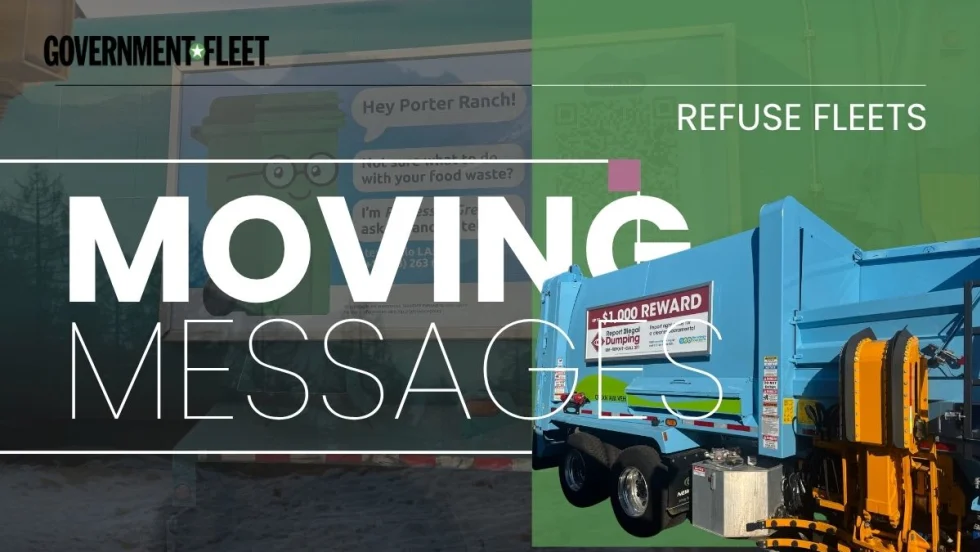
Who Owns the Message on a Refuse Truck?
Refuse trucks can carry public messages into neighborhoods, but keeping those messages current takes planning and clear responsibility.

Who Deserves Fleet Recognition and What Could You Teach at GFX?
Who helped shape your fleet career, and what have you learned that could help someone else?

What’s Haunting Public Sector Fleets?
Public sector fleet challenges rarely happen in isolation, and addressing one often means understanding how it connects to another.

Is Keeping Older Fleet Vehicles Really Saving Money?
Is keeping vehicles longer saving money, and what happens when a diagnostic test points to the wrong fix?