




Virginia Expands E-85 Network with Award-Winning Initiative
The Commonwealth of Virginia partners with both the public and private sectors to build E-85 fueling stations and promote the use of this clean-burning ethanol and gasoline blend.
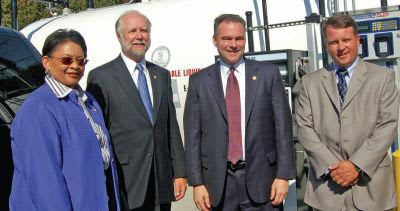
Virginia government officials (l-r): Viola Baskerville, Richard Sliwoski, Gov. Tim Kaine, and Don Unmussig.
When Gov. Tim Kaine slipped off his suit jacket and pumped fuel into one of his executive protective unit GMC Yukons last October, a new era dawned in the Commonwealth of Virginia. Kaine was fueling the vehicle with E-85, a clean-burning blend of 85-percent ethanol and 15-percent gasoline.
The “Citizen Kaine”photo op marked the formal opening of Virginia’s first stateowned alternative-fuel station at the Department of General Services Office of Fleet Management Services in Richmond. Two more fuel stations for government-owned flex-fuel (also known as bi-fuel) vehicles, which can run on gasoline or E-85, will be built at already selected sites in northern Virginia and Hampton Roads.
Other dignitaries on hand for the event included representatives from several state agencies, the U.S. General Services Administration (GSA), and General Motors Corp. All are partners in the Virginia E-85 Fueling Infrastructure project, designed to expand Virginia’s alternative-fuel vehicle network. When completed, the project will allow more than 4,000 state-owned and GSA-owned vehicles in Virginia to fill up with E-85, a corn-generated fuel that produces fewer smog-related pollutants and greenhouse gas emissions.
Stage Set with 1992 EPACT
The initiative originated in the fall of 2005 when then-Gov. Mark Warner asked state agencies to come up with ways to conserve energy. Gov.Warner specifically tasked the Virginia Department of General
Services (DGS) with finding options to reduce petroleum consumption in state-owned vehicles. In the aftermath of Hurricanes Katrina and Rita, fuel prices across the state had reached unacceptable levels.
Don Unmussig, director of the Office of Fleet Management Services (OFMS), an operating unit of DGS, responded quickly to Gov. Warner’s request. Unmussig put together a winning proposal to develop an E-85 fueling infrastructure for state-owned vehicles.
The stage had already been set back in 1992 with the passage of the Energy Policy Act (EPACT), which mandates that 75 percent of new state-owned vehicles purchased and deployed in metropolitan statistical areas must be capable of operating on alternative fuel.Unmussig focused his efforts on E-85, although 205 vehicles in his fleet operated on a combination of gasoline and compressed natural gas (CNG). “We tried CNG, but the fueling infrastructure was so scattered,we did not get much usage,” he says.
Federal GSA Partnership Formed
In February 2006,Unmussig presented a partnership proposal to the federal GSA, offering to allow GSA-owned vehicles to use the new state-operated E-85 fuel sites. (The Virgnia DGS and the federal GSA
provide similar services.) Since federal fleets are required to use alternative fuels whenever possible,Unmussig says, “It is in the best interest of both agencies to partner to use the fuel. The relationship between DGS and GSA is basically an agreement between the parties that GSA can use the fuel sites and be billed by the DGS fuel card provider for the use.”
DGS and GSA vehicles use the Voyager fuel card, a credit card issued by US Bank/Voyager and accepted at most retail fuel stations in the U.S.Unmussig arranged for the automated fuel card readers at the three DGS E-85 fuel sites to be programmed to accept both the state and federal fuel cards. It’s the first time in state history that state and federal agencies have partnered to reduce petroleum consumption and promote alternative-fuel use.
Prior to the DGS-GSA partnership, most federal vehicles could not comply with the federal alt-fuel mandate due to a lack of fueling infrastructure. The only E-85 sites were located at the Pentagon, Langley Air Force Base, and Yorktown Naval Weapons Station.
“The latter two sites are on high-security installations, meaning access is difficult,” Unmussig points out. “The three DGS sites are right off the two major interstates in Virginia and located in areas heavily used by both DGS and GSA flex-fuel fleet vehicles.”
Not surprisingly, other government agencies operating flex-fuel vehicles leased from GSA Fleet contacted Unmussig to learn how they also could comply with the mandate. Unmussig’s office began partnering with these agencies to develop additional E-85 fuel sites. The agencies are members of the Virginia Regional Environmental Management System (V-REMS).
Unmussig is enthusiastic about the potential widespread application of this shared business model. “GSA officials indicated they would like to expand this type of model in every state that was interested,” Unmussig says. “I belong to the National Conference of State Fleet Administrators (NCSFA), and many member states have expressed interest in developing similar operations.”
Model Can Be Extended to Public
Unmussig is also optimistic about introducing this business model to the private sector.“GM, Ford, and DaimlerChrysler all sell models that can run on E-85, but there are no public retail E-85 fueling sites available,” he says.“Something needs to be done to offer E-85 fueling opportunities to the general public. Several hundred thousand
E-85-capable vehicles operate in Virginia.”
To help rectify the situation and heighten public conciousness, OFMS, along with its primary partner, the Virginia Department of Mines, Minerals, and Energy (DMME), cemented a relationship with General Motors Corp. in October 2006. As a result,Virginia will partner with GM in its “Live Green Go Yellow” campaign to promote E-85 use in Virginia.
GM had offered to assist several private, Virginia-owned retailers to convert gasoline tanks to E-85, and is now targeting areas where customers own E-85-capable vehicles. To aid in the success of the retail site developments, DMME, in partnership with the Hampton Roads Clean Cities Coalition, obtained a grant in June 2006 from the United States Department of Energy (DOE) to develop an E-85 fueling infrastructure.
The “Live Green Go Yellow” campaign is a key component of the Virginia-Maryland-D.C.Public E-85 Pump Project, which will provide 12-20 public E-85 fuel dispensers over the next two years, mostly along the I-95, I-64 Crescent Corridor that traverses Virginia,Maryland, and the District of Columbia. These new fueling stations will make the alternative fuel available to an estimated 15,000 public and private flex-fuel vehicles and dispense up to 530,000 gallons of E-85 fuel every month.
This $767,000 Pump Project came about because multiple agencies from multiple jurisdictions wanted to jump on the E-85 bandwagon. “We felt that if we developed a grant proposal that encompassed a scope of this magnitude, we had a good chance for approval and potential for success,”Unmussig says. “Essentially, we all pooled our resources and acted as ‘one’ instead of a bunch of smaller ‘silos.’”
E-85 Use Gains Momentum
The cherry on the top of the E-85 sundae came in September 2006, when Unmussig earned the NCSFA Honda Environmental Leadership Award in
recognition of the Virginia DGS efforts to promote alternative-fuel use.
The transition from gasoline to E-85 continues to gain momentum. The Virginia DGS is committed to making additional E-85 fueling accessible to state and federal fleet vehicles; the state’s Department of Transportation has set aside land for E-85 refueling sites at terminal locations; the Defense Supply Center in Richmond is working to make E-85 available to Department of Defense (DoD) and employee vehicles; and the Navy Exchange Service Command is planning to build up to three E-85 fueling stations in Hampton Roads for DoD,employee, fleet, and public vehicles.
More Operations

Why Fleet Business Plans Need Three Perspectives
A fleet business plan should help agency leaders understand the fleet’s value, give the organization a clear direction, and establish shared expectations with customer departments.
Read More →
How Oil Analysis, Safety Technology, and Fleet Awards Drive Improvement
What happens when fleets let measured results guide their next decision?
Read More →
Emergency Response, Fleet Sales and New Technology
This week’s fleet news covers emergency preparedness, shifting vehicle sales, electric truck investments, and new tools for monitoring road conditions.
Read More →
NCDOT Adds Dash Cam Imagery to Statewide Traffic Monitoring
North Carolina transportation officials are adding another set of eyes to roads that aren't covered by fixed traffic cameras. A statewide deployment gives NCDOT access to on-vehicle imagery to verify conditions during work zones, severe weather, emergencies, and other traffic events.
Read More →
Turning a Bottleneck Into a Blueprint: How Tallahassee Rethought Police Fleet Readiness
For Tallahassee, finally receiving 87 delayed police cruisers created a new problem: how to get them on the road without creating a massive backlog. The solution would change more than the upfit process.
Read More →
AI, Police Fleet Readiness and Fire Apparatus News
See how AI, a reworked police-vehicle upfitting process, and a fire apparatus acquisition could affect public fleet operations.
Read More →
How AI and Automation Work Together to Reduce Government Fleet Downtime
As their assets age and their budgets’ purchasing power shrinks, government fleet managers are facing growing pressure to do more with less.
Read More →
Police Fleet Innovation, EV Strategy and AI
See how public fleets are rethinking police vehicle readiness, electrification, workplace culture, and driver workflows.
Read More →
From What He Inherited to What He’ll Leave Behind: David Renschler’s Lessons in Leadership
David Renschler walked into Fairfield with plenty to learn and no idea what awaited him. Twenty years later, the lessons from what came next are still shaping his approach to fleet.
Read More →
Have Fleets Changed Enough to Solve the Technician Shortage?
Are government fleets finally closing the gap on the technician shortage, or are critical challenges still holding them back?
Read More →