




Portland Fleet Certification Makes it the Service Provider of Choice
By making several adjustments over eight years, the City of Portland, Ore., was able to become a Certified Fleet Management Operation (CFMO), improve efficiency, and make the organization shine.
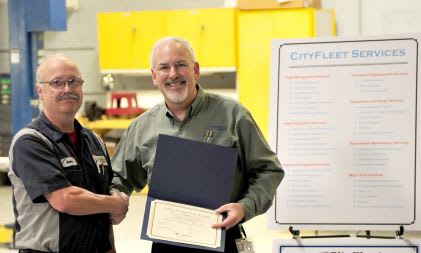
At a fleet meeting, John Hunt, CPFP, the city’s fleet manager, awards Dan Adamson, a vehicle and equipment technician, with a Safety Recognition Award. Photo courtesy of the City of Portland.
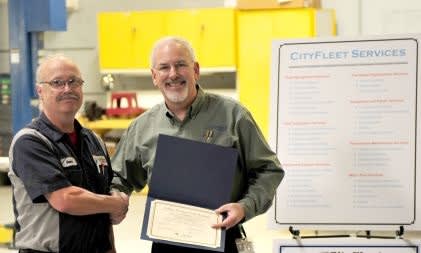
At a fleet meeting, John Hunt, CPFP, the city’s fleet manager, awards Dan Adamson, a vehicle and equipment technician, with a Safety Recognition Award. Photo courtesy of the City of Portland.
The City of Portland, Ore., CityFleet Division was recognized as a Certified Fleet Management Operation (CFMO) by the Government Fleet Management Alliance (GFMA) in June. According to Jim Wright, the associate director of the GFMA, John Hunt, CPFP, the city’s fleet manager, knew right away he wanted to get certified and went after it.
In 2006, Hunt and his staff began making the necessary improvements to each of the 20 individual components that make up the certification.
According to Hunt, industry competitiveness is the name of the game. “Being industry competitive means that the likelihood of an outside agency coming in and taking over our work is reduced because we have all of our ducks lined up, as they say,” he explained. “It really hardens up your organization.”
Taking the Necessary Steps
Staff members started their efforts by reevaluating the fleet’s parts inventory. They decided to move it to a centrally located section of the shop and began using features in the AssetWorks FleetFocus fleet management system to help better track parts information. With the new layout, stock numbers were created and cross referenced, and the process now aligns with industry standards. The changes reduced the steps required to access parts, saving time and improving the inventory process. FleetFocus also allows for highly efficient barcode tracking with hand-held scanners. The result was a negligible 0.007% variance for the end of the year count, compared to the team’s 1% goal.
Next, Hunt and his staff started using a fuel management system with a computer chip on each vehicle that improved customer satisfaction, accountability, and billing. CityFleet also upgraded its fuel tank level and leak detection monitoring system, improving regulatory compliance and daily fuel availability.
A particular challenge Hunt experienced was while trying to educate customers about the value of preventive maintenance. “We had to help our customers understand that the vehicles would actually be available to them more often if they are properly maintained,” Hunt said. As CityFleet worked to provide better service to its customers, this included developing good communication to help those with whom they work. The result is that Portland’s fleet is up to 95% or better for overall preventive maintenance.
What Hunt appreciates about the certification process is that it provides external independent validation and value for governmental fleets. “Of course things happen — there are market fluctuations or the agency’s governing body could change, but the goal is to make it difficult for an outside agency to come in and do things at a greater value than us.” The CFMO certifies CityFleet as “industry competitive,” giving credibility to its fleet operation.
Something Hunt finds extremely valuable about the certification is the leg-up it provides for the fleet. When hiring mechanics, he said, “Often they mention they’ve heard about how well the organization is run and they’d like to be a part of that. I’m very proud we’re both a service provider of choice and an employer of choice.”
Related:
More Operations
Is Keeping Older Fleet Vehicles Really Saving Money?
Is keeping vehicles longer saving money, and what happens when a diagnostic test points to the wrong fix?
Read More →
How Smart Fleet Strategy Can Help Local Government Agencies Do More with Less
Keeping a vehicle longer may ease this year’s budget, but what does it cost the next one? A closer look at fleet decisions can reveal opportunities to reduce spending while protecting essential services.
Read More →
Connect with Government Fleet on LinkedIn
From industry news and fleet management strategies to conversations with peers, Government Fleet's LinkedIn page offers public-sector fleet professionals another way to stay informed and connected.
Read More →
Town of Queen Creek Named Most Successful Fleet Award Winner of Inaugural RTA Fleet Success Awards
Five fleets were honored at RTA Connect 2026 in Chicago for excellence across resource efficiency, intentional culture, risk management, and stakeholder satisfaction.
Read More →
A buyer's guide to fleet management software in 2027
Buying fleet management software in 2027 means looking beyond features and price. As fleet operations, technology and expectations evolve, this guide explores what today’s fleet professionals should consider when choosing a system that can deliver value now and adapt to what comes next.
Read More →
Hazard Alerts, Fleet Car Sales Rise and a New Shuttle Concept
Fleet car sales doubled, but the bigger picture tells a different story in this week’s roundup.
Read More →
How St. Johns County Turned Fleet Data Into Better Replacement Decisions
St. Johns County, Florida, had fleet data, but turning it into reliable decision guidance was another matter. Instead of starting over with a new fleet management system, the county connected existing tools and built a scoring system that gives managers an objective look at fleet health.
Read More →
Fleet Forward Conference Introduces One-Day Passes for 2026
New one-day registration lets fleet professionals attend Tuesday, Wednesday, or Thursday, with passes available for $249.
Read More →
ENC Unveils its ZAVIR Medium-Duty Shuttle
Two variants of the concept shuttles were revealed: a low-floor configuration and a high-floor configuration.
Read More →
Could Your Next Fleet Technician Start as an Intern?
What if your next technician hasn’t worked in a fleet shop yet? What fleets are doing to free up time.
Read More →