Whether constructing a new facility, retrofitting a parts department, or initiating a vehicle replacement cycle, completing major, capital-intensive ventures involves three critical phases: planning, execution, and evaluation.
by Steve Riley
May 3, 2012
8 min to read
Accurate and effective management of a major capital project from start to finish can make the difference between success and failure. The process involves three phases: comprehensive planning, carefully directed execution, and diligent evaluation. The following tips can help build a successful project management plan.
At a glance:
Elements of successful project management include:
Careful, methodical planning
Involvement of all stakeholders, staff, customers, and relevant jurisdictional departments
Clear, accurate, and consistent communication with all participants
Use of such tools as cost tracking programs and project management charts.
PHASE 1 - PLANNING
Every successfully completed large-scale project requires deliberate, methodical planning with input from stakeholders, staff, and customers. This multifaceted process begins with a project description.
Ad Loading...
Define the Project
Describe in detail its ultimate function and intent, potential users and visitors, and benefits to the fleet operation. Identify project stakeholders — all those with “skin in the game,” including elected officials, executives and managers, joint-project partners, regulators, customers, etc.
Determine a timeline and the point at which the project will be considered a success.
Perform a realistic cost-benefit analysis. Avoid committing to grandiose programs or initiatives that are clearly out of reach or don’t make good business sense.
Analyze Funding
When all costs are determined, review funding sources. Will available funding cover all expenses? What are the accessibility, reporting, and accounting requirements? What are the options if costs exceed budgets?
If a portion of the funding involves federal or state grants, review and understand every element of the grant and plan accordingly. Most grant documents contain a multitude of small details with restrictions and requirements. Consider the following:
Ad Loading...
What is the amount of matching funds?
Will the grant payment schedule impact project completion? If so, does the fleet’s agency have funds to support the project spending schedule while waiting for grant reimbursement?
What specific reporting and performance benchmarks are specified in the grant? If certain benchmarks are not met, will funding be reduced? Federal grants are particularly sensitive to stated project deadlines since the government payment schedule is based on project cost at the time the grant is issued.
Is grant funding restricted to specific project elements, e.g., materials, but not salaries?
Determine Required Resources
What resources will be needed to plan and execute the project?
If project construction is contracted out, determine what tasks may remain the fleet operation’s responsibility. For example, will the project site require clearing and preparation? Which party will provide work-site security?
Equipment. Specify the kind of equipment required,when each piece of equipment is needed, and for how long.
Materials. Determine each type of material, quantity, and cost.
Personnel. List the individuals who must be involved in the project planning and execution as active players and contributors. These can be from the fleet organization, stakeholders, partner agencies, and representatives from such departments as legal, risk/safety management, etc.
Consider the impact of external contributors, such as federal, state, and local regulators, energy resources, building and code inspectors, permit-issuers, etc. For example, will these parties have the manpower to meet the project needs and timeline? Are their activities restricted by regulatory requirements? Will other government entities require reimbursement for services they provide?
Ad Loading...
Define team member responsibilities and include specific skill-set requirements.
Review each contributor’s significance to the project. If a primary contributor leaves, particularly in a multi-agency project, how will this impact the project timeline? Can a replacement be brought on board easily?
Develop Plans & Designs
Review the project to confirm the final product will fit its ultimate purpose. Take a look at all the options. Plan not only for immediate needs, but also for the future, e.g., will the design accommodate expansion?
Does the location fit the needs of agency partners, customers, and the fleet organization?
Anticipate unexpected delays, process obstacles, resource shortages, etc., and prepare contingency plans.
Ad Loading...
Heed Multi-Year Project Concerns
A multi-year undertaking raises particular concerns:
Account for potential future increases in required funding.
Link the project timeline to the fleet organization’s long-term strategic plan.
List interim progress reports that must be completed each fiscal year.
Design a Communications Plan
Clear, consistent, and accurate communication is critical to successful project management, particularly complex multi-year, multi-agency undertakings.
Develop an organizational flow chart to define the reporting structure and outline each individual’s or agency’s area of responsibility, for example, permits, grants, site requirements, etc. Note which responsibilities are based internally and externally.
List contact information for each individual or agency, including their communication preferences — phone, e-mail, times, etc. Distribute this to all project participants.
Ad Loading...
Determine a communications method, timing, and format to inform participants of new developments, deadline notices, questions, etc.
Create Forms & Reports
Standardized forms and reports facilitate knowledge-sharing and accuracy.
In drafting forms and reports, determine what details are relevant to each document’s purpose. Be specific, brief, and focused. Create samples of forms and reports to “pilot test” their ease of use among participants.
Specify the timeframe and distribution requirements for reports and forms. For example, status/progress reports can be distributed every 15 or 30 days to keep all parties informed and up-to-date.
Assemble project workbooks for each relevant participant. Include in these binders organization flow charts, contact information list, forms and reports, and templates for each. Encourage participants to maintain up-to-date workbooks, using the binder as a central document file not only for general project information, but also their particular areas of responsibility.
Ad Loading...
Review Permits & Licenses
Record all permits and licenses required by internal and external parties. Review and note the specifications and deadlines for each.
Assess Risk/Safety
With the help of the risk/safety department, develop an assessment of liabilities the fleet organization and its jurisdiction could face in the event of accident or legal issues.
If working with a contractor, review the company’s insurance policy for non-covered risks.
Don’t Forget the Weather
Consider seasonal weather conditions when developing a project timeline. How will a winter blizzard or extreme summer heat impact progress? How many weather delays will cause a change in overall deadlines?
Negotiate Smart Contracts
Build performance bonds into contracts and clearly define opt-out parameters. Include non-performance and poor workmanship clauses.
Ad Loading...
Prepare to Track Costs
Choose one of the available expense-reporting software programs — e.g., Excel, Access — to record and track for costs. Once set up for the project, accounting tasks are simple.
With a tracking program, cost overruns can be easily spotted early. Determine in advance when and how over-budget costs will be announced and resolved.
Use a Project Management Chart
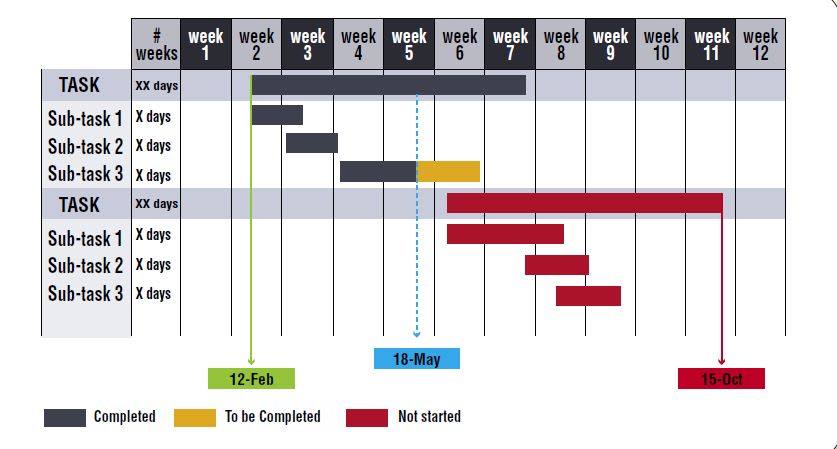
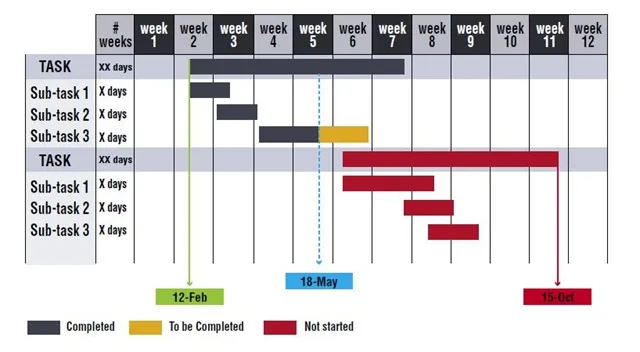
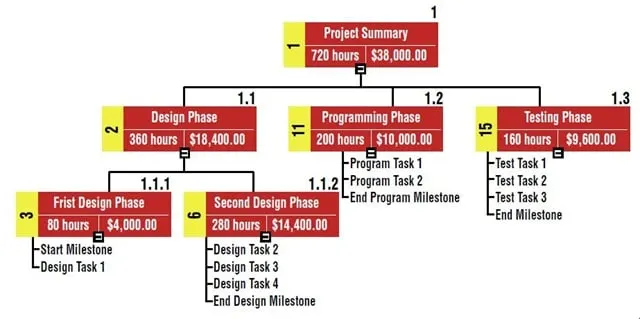
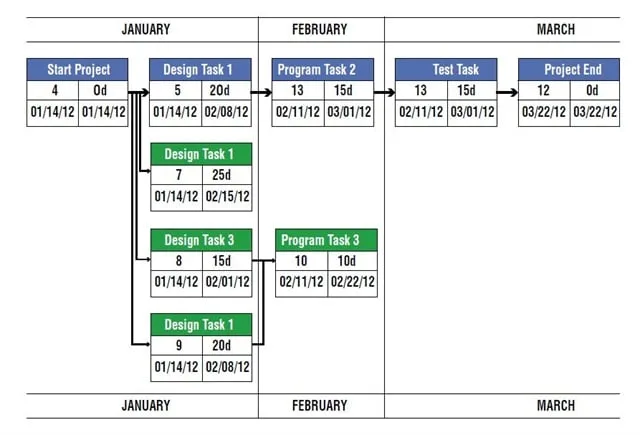
Project management charts are valuable tools in bringing large-scale undertakings to successful conclusions. Charts such as the Gantt, PERT, and Work Breakdown Structure (WBS) models depict the length of time project tasks should take, measured against real time, and reveal task dependencies. The charts provide a visual frame of reference for everyone on the project team. These tools help project managers to plan activities, work out a critical path, and communicate activities with team members. (See examples below.)
Typically, these charts are printed and posted in the project meeting room.
Elements to detail on a project management chart include:
Ad Loading...
Project participants.
Specific activity timeframes and responsible parties.
Points of contact, including alternates.
Those listed are expected to attend all meetings.
Specific and measureable milestones.
Equipment/resource requirements.
Project timeline expenditures and payment schedules.
Report deadlines and recipients.
Project Management Tools
Several project management charts or visual process-tracking tools are available, and most can be integrated with common software programs, such as Microsoft Office. Popular models include:
Gantt. A type of bar chart, the Gantt model illustrates a project schedule from the start-to-finish dates of the project's terminal and summary elements, comprising the work breakdown structure. Gantt charts can be used to show current schedule status using percent0complete shadings and a vertical "Today" line. The rows in the basic Gantt charts represent various activities or tasks and the columns represent time.
PERT. The PERT chart, also known as a network diagram, depicts more complex projects and the relationships between activities. A PERT chart reveals parallel activities, tasks that must follow one another, and complex task dependencies. This chart can help a team to visualize not only the whole project, but also particularly complex project sections.
Work Breakdown Structure (WBS). The WBS depicts the hierarchy of tasks that comprise a project. A project is decomposed into component tasks. Each item of the next level will be the tasks involved in the project (or milestones). The levels under that will contain subtasks and work items, the smallest, executable actions that move the project toward completion. WBS allows a project team to visualize the component parts and their relationships before entering them into a project management software program.
Ad Loading...
PHASE 2 - EXECUTION
When project planning has been careful and comprehensive, the execution phase involves communication, tracking, and managing changes, obstacles, and problem areas. Important elements of this phase include:
Meetings. Conduct routine meetings to provide status updates and confirm project contributors are meeting deadlines and requirements. Draft meeting agendas and distribute well in advance. Review the project management chart with all participants to spotlight changes. Discuss the next steps in the process and project.
Costs and Budgeting. Process and track all expenditures to ensure they meet budgetary guidelines. Determine if timeline adjustments are necessary and if those adjustments impact current or forecasted budgets.
Project management chart. Use as a “Project Central” device and update with new developments, staff and contributor changes, altered deadlines, etc.
Delays and obstacles. The important response to a significant delay is reviewing its impact on the entire project going forward. For example, if an environmental permit is not issued when anticipated, determine which corresponding tasks will be affected and necessary compensating steps. Unexpected obstacles or bottlenecks should prompt the same project review. What elements are related to or dependent upon the hindrance? Consult immediately with all relevant parties to resolve the difficulty or devise alternative options.
PHASE 3 - EVALUATION
Lessons learned during any project will help promote the success of future initiatives. Hold an evaluation meeting for all participants, encouraging candid and constructive input. Consider such questions as:
Were the timelines realistic?
What unforeseen circumstances arose?
Did issues arise with any project contributors?
Were there any unforeseen regulatory requirements/restrictions?
Was the project budget exceeded and if so, why?
Following the meeting, document the outcomes and draft a “lessons learned” summary for project participants.
Ad Loading...
A well-defined project management plan will save much anxiety and heartache — and possibly the fleet manager’s job. Take the time to do it right the first time.
About the Author: Steve Riley is automotive director for the City of Coral Gables, Fla.
Keeping a vehicle longer may ease this year’s budget, but what does it cost the next one? A closer look at fleet decisions can reveal opportunities to reduce spending while protecting essential services.
From industry news and fleet management strategies to conversations with peers, Government Fleet's LinkedIn page offers public-sector fleet professionals another way to stay informed and connected.
Five fleets were honored at RTA Connect 2026 in Chicago for excellence across resource efficiency, intentional culture, risk management, and stakeholder satisfaction.
Buying fleet management software in 2027 means looking beyond features and price. As fleet operations, technology and expectations evolve, this guide explores what today’s fleet professionals should consider when choosing a system that can deliver value now and adapt to what comes next.
St. Johns County, Florida, had fleet data, but turning it into reliable decision guidance was another matter. Instead of starting over with a new fleet management system, the county connected existing tools and built a scoring system that gives managers an objective look at fleet health.