As more baby boomers reach retirement, fleets must prepare the next generation of leaders. Fleet managers share initiatives that have worked for their teams and explain which have not.
Roselynne Reyes・Senior Editor
June 1, 2017
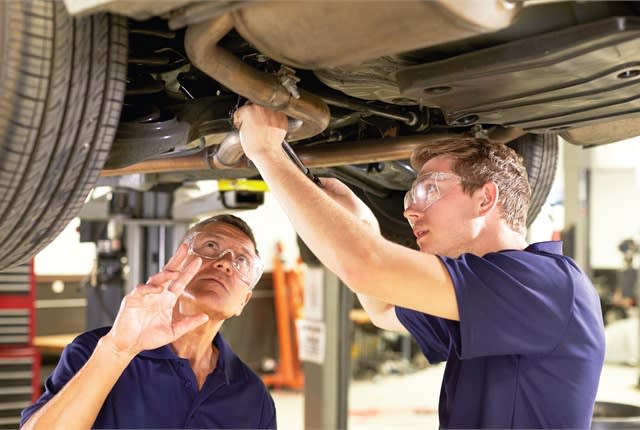
As more baby boomers reach retirement, fleets must prepare the next generation of leaders. Photo: Getty Images
7 min to read
As more baby boomers reach retirement, fleets must prepare the next generation of leaders. Photo: Getty Images
As more and more baby boomers prepare for retirement, the fleet management industry is losing managers with decades of experience and a vast amount of knowledge at a growing rate. In response, many public agencies are preparing the next generation of leaders.
A succession plan is about more than the transition to management; it may also mean building up a qualified pool of candidates when needed. This can require additional training and certification requirements, mentorship programs to ensure crucial knowledge is passed on to the next generation of technicians, and new positions or classifications to ease the transition process once someone leaves. The key to a successful plan is finding the right balance for the fleet.
Ad Loading...
Start Early, and Make a Game Plan
When Doug Weichman, CAFM, the fleet management director for Palm Beach County, Fla., announced his plans to leave the fleet, he gave the county five years to find his replacement. Three years in, the county created an assistant director position and began a nationwide search for a successor. It recruited Sara Burnam, CAFM, who started in the fall of 2015. This gave her a year and a half to work under Weichman and learn about the position.
Burnam said a notable part of her training was when she was put in charge of a remote shop and was able to learn how things ran on a daily basis, from creating a work order to obtaining parts and supplies. At one point, the director sat her down and went over the budget process line by line. She also created a calendar and wrote down the tasks that needed to get done month by month.
Now that she has taken over as fleet management director, Burnam has no immediate need for a succession plan. But when the time does come, she already has a few changes in mind. To start, she wants to create a set of objectives and a formal timeline for training so the successor has time to ask as many questions as possible while the fleet director is still around.
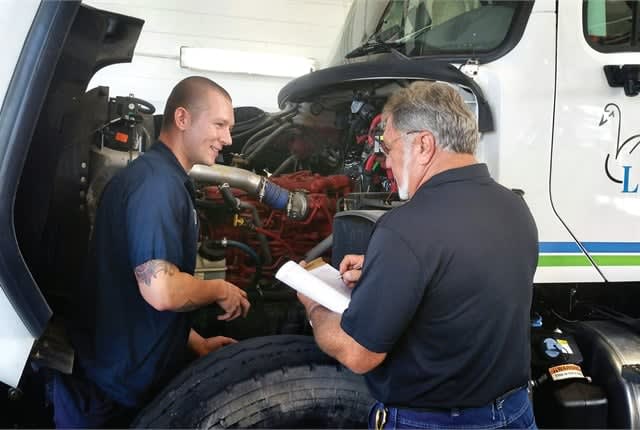
City of Lakeland, Fla., Fleet Maintenance Supervisor Phil Chaffin (right) performs a task certification on Anthony Majkiewicz (left) as part of his assessment to be promoted to mechanic 3. Photo courtesy of City of Lakeland
Review Your Fleet’s Organization
When the time comes to find a successor, recruiting an outside candidate may work for some. But for others, one major part of a succession plan is determining how to train your staff and promote from within. Unlike at Palm Beach County, many fleet professionals don’t give five years notice or help with training, so adding a position is not enough.
When Gary McLean, fleet manager, started working at the City of Lakeland, Fla., he said the city’s succession plan included adding assistant directors and assistant managers but not much else.
Ad Loading...
“That’s not succession, that’s extra bodies,” he said. “What we wanted to do was build a ladder from the mechanic helper all the way to the fleet maintenance supervisor.”
Although the fleet had classifications for mechanics 1, 2, and 3, the city would generally hire a mechanic 3 whenever a spot opened up. McLean said this method did not work for his team because the experience brought in from dealerships did not translate well when working on the city’s diverse fleet. This also made it difficult to measure when a mechanic was qualified enough to move to a higher classification, since everyone entered the fleet at a different skill level.
McLean drew inspiration from his military background and adopted task certification forms, which list specific skills technicians must meet before they move up a classification.
With task certification, technicians can work at their own pace, instead of being expected to perform certain tasks by a deadline. The fleet also started hiring at the entry level, as either a mechanic helper or mechanic 1.
“Everybody comes into the military as a private or airman basic, and they have to learn their craft as they go through the ranks,” McLean said. “I don’t need to keep hiring super-qualified mechanic 3s. I need to hire inexperienced people who we can mold into our philosophy. We have plenty of technicians to help grow those folks, and we throw a lot of training at them.”
Ad Loading...
The City of Greenville, S.C., uses a similar method of measuring skill level. Scott McIver, CPFP, fleet manager, said all new technicians are given a placement test and classified as a technician 1, 2, or 3 based on test results instead of years of experience.
McIver
“Look at training and succession as a way of keeping the best of the best.”
— Scott McIver, CPFP, fleet manager, City of Greenville, S.C., on why succession planning matters even if the fleet manager doesn’t plan on leaving
Build Up Your Team
When finding a training program that works, fleets should think about the skills needed in the shop. Does your fleet offer any programs to help technicians learn those skills?
OEMs and vendors often offer free education, and many fleet associations and industry events offer training opportunities.
Darryl Syler, fleet manager for the City of Dublin, Ohio, chooses a different group of staff members every year and sends them to training classes. Last month, the fleet hosted a Public Fleet Summit in Dublin and three staff members attended.
Ad Loading...
McIver said new supervisors attend training through the fleet’s vendors. In addition, the fleet offers technicians an additional $0.25 per hour for every Automotive Service Excellence (ASE) certification they obtain (up to 20), which helps motivate them to pursue these skills.
“Look at training and succession as a way of keeping the best of the best,” McIver said.
Don’t Forget the Soft Skills
Of course, moving up to a management role requires more than being a good technician. It is also important to consider the skills employees will need in the transition from the shop floor to the office.
A few years ago, the City of Beverly Hills, Calif., began an initiative to promote internally. Craig Crowder was the fleet supervisor at the time, and he applied to participate in the new succession plan. Members of the program were required to attend training sessions, find a mentor, and reach specific benchmarks in career development.
After the first year of the program, the city cut back on its plans, as the rigid deadlines and time requirements were difficult for employees to adhere to. But Crowder, now fleet manager, found some important takeaways about the importance of leadership training.
Ad Loading...
All the mechanics in his shop already have ASE certifications, but Crowder wanted them to learn soft skills as well. He has brought guests in to teach technicians how to build resumes, prepare for job interviews, and promote themselves and their skills.
McIver said the City of Greenville also offers a leadership program for city employees and, like Crowder, he was part of the program’s first class. Technicians attend the training when making the transition to fleet supervisor, and attend again when making the transition to fleet manager. Within the fleet, McIver said technicians are also trained in customer service.
The best way a fleet manager can ensure his or her fleet will be left in good hands is to take a hands-on approach and build up the skills of the fleet team now. Photo: Getty Images
Make It a Team Effort
For many fleets, succession may not be a priority. Fleet managers with no plans for retirement, for example, may not see the point.
For others, a succession plan is about more than preparing the next person in line — it’s about building up the team so all employees are ready to step up when needed.
The City of Dublin uses a “one up, one down” method of training in which everyone knows the duties of the position directly above them and the position directly below them. This not only prepares them for the future, but it also comes in handy when someone can’t come into work. Syler noted that fleets should also discuss these succession plans with whoever is in charge of emergency planning, when shops may need to operate with limited staff.
Ad Loading...
Although creating a plan may often fall to management, executing the plan can incorporate all members of the team.
Because the City of Lakeland allows technicians to train at their own pace, there are employees ready to step up and help others who are struggling to complete their work.
“When we get them up to the senior mechanic level, they are basically foremen in waiting,” McLean said. “That way, when a foreman position does become open, we’ve already got a pool of folks who can compete for that position, and we’re always internally promoting.”
St. Johns County, Florida, had fleet data, but turning it into reliable decision guidance was another matter. Instead of starting over with a new fleet management system, the county connected existing tools and built a scoring system that gives managers an objective look at fleet health.
With more than 8,000 vehicles and pieces of equipment to maintain, the City of Phoenix could not afford to wait for fully trained technicians to walk through the door. Instead, they revamped their entire workforce strategy and showed how public fleets can create their own talent pipeline while preparing existing employees for increasingly complex vehicles.
Public fleets have more data than ever, but inconsistent records and missing information can still undermine maintenance, replacement, and cost decisions.
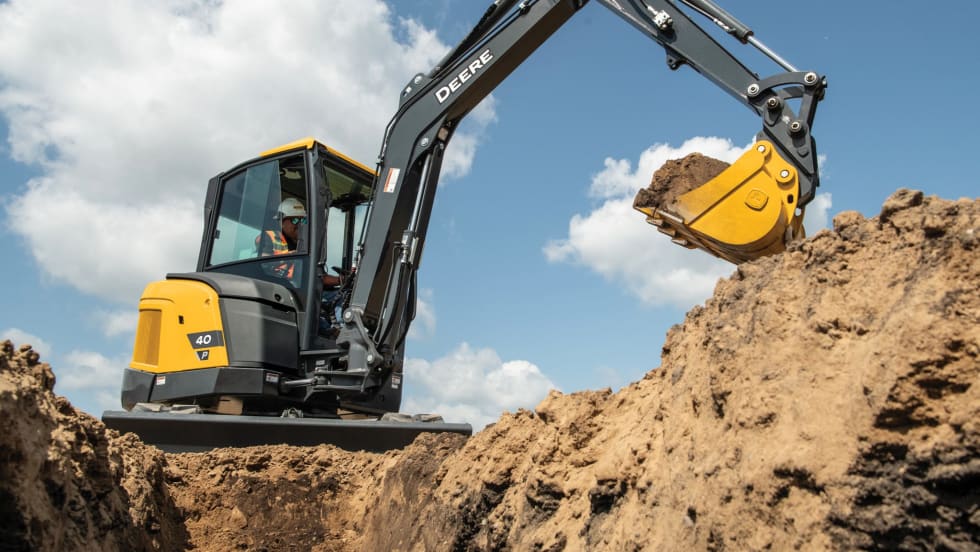
John Deere is adding a compact excavator designed for crews that need to move equipment between jobsites and handle multiple types of work with one machine. The 40 P-Tier weighs less than 10,000 pounds and offers configurable hydraulics, attachment options, and connected fleet-management capabilities.
This week, we look at what past Leading Fleet winners can teach us about making progress, plus how to build a business plan your fleet will actually use.