




2012 Michigan Vehicle Tests: Motorcycles
Michigan State Police tested new cruisers from Victory Motorcycles -- the Commander I and Vision -- among the six police motorcycles to be offered in the 2012 model year.

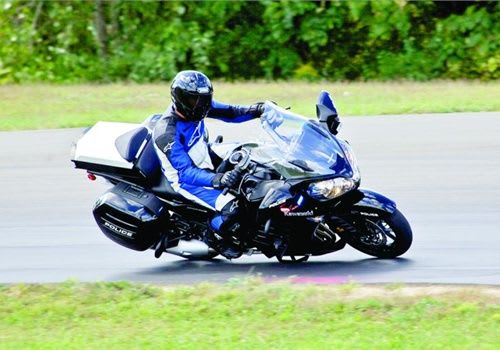
The Kawasaki Concourse 14P was one of six police bikes tested in Michigan. Photo: Michigan State Police
The Kawasaki Concourse 14P was one of six police bikes tested in Michigan. Photo: Michigan State Police
Michigan State Police tested new cruisers from Victory Motorcycles -- the Commander I and Vision -- among the six police motorcycles to be offered in the 2012 model year.
The state police also tested BMW's R1200-RTP, Harley-Davidson's Road King, Harley's Electra Glide, and Kawasaki's Concours 14P. Honda preferred to submit its ST1300 for testing by the Los Angeles County Sheriff's Department in November.
A year ago, the new-kid-on-the-block, the Kawasaki Concours 14P, turned heads at the tests, earning top honors in speed, acceleration from 0-60 mph, and 60-0 mph braking. This year, the Concours 14P-powered by a four-stroke DOHC multi-valve engine that generates 150 hp-was the quickest bike off the line.
Top speed honors went to the BMW R1200, which reached 131 mph. The Concours 14P reached 126 mph, followed by Victory's Vision (120 mph) and Commander I (117 mph). The Road King and Electra Glide reached 117 mph and 104 mph, respectively.
The Concours 14P recorded the fastest 0-60 mph increment (4.08 seconds). The BMW followed at 4.41 seconds. The Commander I and Vision reached the mark in 5.86 and 5.93 seconds, while the Road King and Electra Glide recorded times of 5.66 and 6.1 seconds.
Quick acceleration and rapid braking present hazards for motor officers who chase speeders and other traffic violators, and the new police bikes offer ABS to provide smoother braking for two-wheel riders.
This year, Harley's Electra Glide (with the batwing faring) recorded the top braking performance, needing 139 feet to reach a dead stop from 60 mph. The BMW with ABS needed 140 feet, while the Kawasaki needed 143.7 feet. Victory's Commander I and Vision needed 156.9 feet and 149.2 feet, respectively.
Harley initially introduced its Brembo braking system with the 2008 model-year bikes, and company officials were pleasantly surprised by the results.
"There are so many factors that affect braking performance with rider skill and consistency being key factors that affect how the vehicle's weight transfers to the suspension and brakes in their test," says Steven St. Thomas, Harley-Davidson's worldwide police and fleet sales director. "It appears the test riders were able to manage all these factors to get the vehicle to perform closer to its highest potential."
Tucson, Ariz.,-based Victory, a company that's new to the police motorcycle market, is pitching its bikes as purpose-built for officers. At the tests, Victory reps touted the cruisers' officer-safety features.
The Victory Commander is designed with what the company calls "integrated tip-over protection." The bike is constructed to help keep it from falling on its side. The bike will fall no further than 34 degrees and keeps its wheels on the roadway. The cycle also offers a heel-to-toe shifter with an easier path to neutral, a helmet lock, and saddle bags that can accommodate an M-4 rifle and two additional magazines.
Police departments in Pasadena, Calif., and Lenexa, Kan., have purchased the Commander I.
The Victory bikes face tough competition in a market where approximately 2,700 police motorcycles were sold in 2010. Currently, Harley sells about 80 percent of law enforcement motorcycles.
You can view a photo gallery of the vehicles tested during the 2011 Michigan State Police tests here.
Related Articles:
More Operations
How Phoenix Is Building Its Next Generation of Fleet Technicians
With more than 8,000 vehicles and pieces of equipment to maintain, the City of Phoenix could not afford to wait for fully trained technicians to walk through the door. Instead, they revamped their entire workforce strategy and showed how public fleets can create their own talent pipeline while preparing existing employees for increasingly complex vehicles.
Read More →
John Deere Introduces 40 P-Tier Compact Excavator
John Deere is adding a compact excavator designed for crews that need to move equipment between jobsites and handle multiple types of work with one machine. The 40 P-Tier weighs less than 10,000 pounds and offers configurable hydraulics, attachment options, and connected fleet-management capabilities.
Read More →
How Leading Fleets Improve and Why Business Plans Matter
This week, we look at what past Leading Fleet winners can teach us about making progress, plus how to build a business plan your fleet will actually use.
Read More →
Nominate a Fleet Leader for the 2027 Public Fleet Hall of Fame
Do you know a fleet leader who has made a lasting impact on the industry? Nominate this fleet professional for the 2027 Public Fleet Hall of Fame.
Read More →
Why Fleet Business Plans Need Three Perspectives
A fleet business plan should help agency leaders understand the fleet’s value, give the organization a clear direction, and establish shared expectations with customer departments.
Read More →
How Oil Analysis, Safety Technology, and Fleet Awards Drive Improvement
What happens when fleets let measured results guide their next decision?
Read More →
Emergency Response, Fleet Sales and New Technology
This week’s fleet news covers emergency preparedness, shifting vehicle sales, electric truck investments, and new tools for monitoring road conditions.
Read More →
NCDOT Adds Dash Cam Imagery to Statewide Traffic Monitoring
North Carolina transportation officials are adding another set of eyes to roads that aren't covered by fixed traffic cameras. A statewide deployment gives NCDOT access to on-vehicle imagery to verify conditions during work zones, severe weather, emergencies, and other traffic events.
Read More →
Turning a Bottleneck Into a Blueprint: How Tallahassee Rethought Police Fleet Readiness
For Tallahassee, finally receiving 87 delayed police cruisers created a new problem: how to get them on the road without creating a massive backlog. The solution would change more than the upfit process.
Read More →
AI, Police Fleet Readiness and Fire Apparatus News
See how AI, a reworked police-vehicle upfitting process, and a fire apparatus acquisition could affect public fleet operations.
Read More →