





Related: Fleet Vehicles Go Higher Tech
How Effective Are Your Trucks’ Backup Cameras?
Fleets are already installing backup cameras on work trucks to improve safety. But with no guidelines to follow, do they actually provide the optimal field of view? One Oregon utility set out to fix this problem.
October 3, 2017
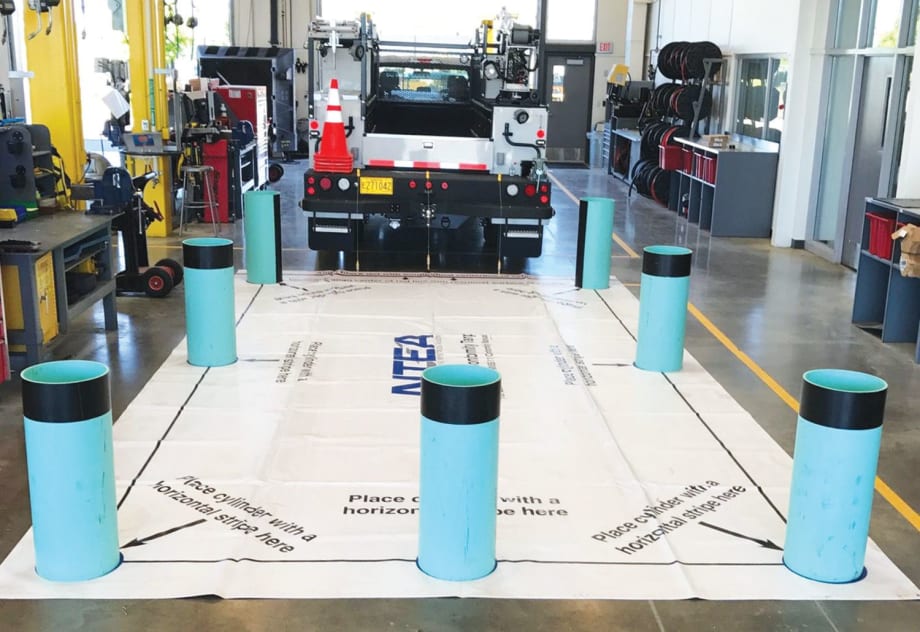
The Eugene Water & Electric Board tested the visibility of two dozen of its work trucks with backup cameras. Photo courtesy of EWEB
4 min to read
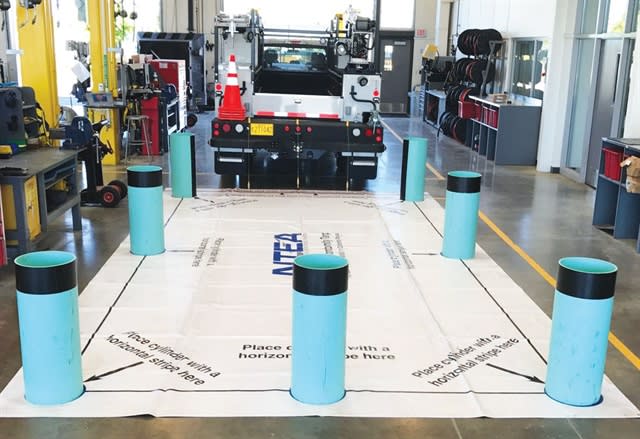
The Eugene Water & Electric Board tested the visibility of two dozen of its work trucks with backup cameras. Photo courtesy of EWEB
Backup cameras will be mandatory in new light-duty vehicles as of May 2018, a law that the National Highway Traffic Safety Administration (NHTSA) hopes will reduce injury and death among children in backover accidents.
Fleets nationwide have been installing them in their mid to heavier vehicles to improve safety, but cameras are placed and adjusted based on the discretion of the installer, with no conformity or guidelines, said Gary Lentsch, CAFM, fleet manager for the Eugene Water & Electric Board (EWEB) in Oregon. That means they can be found toward the side of a vehicle, over the license plate, over the hitch plate, or near the roof.
After learning about the topic at a trade show, Lentsch wanted to know if his trucks’ cameras were effective.
“We’ve been lucky in that we haven’t had somebody get hurt, but we do have backing accidents,” he said. “Our thoughts were that if the fleet is putting cameras on anyway, we might as well make sure the cameras conform to an established standard and that the driver has optimum visibility.”
He soon found out the task was more challenging than he had anticipated.
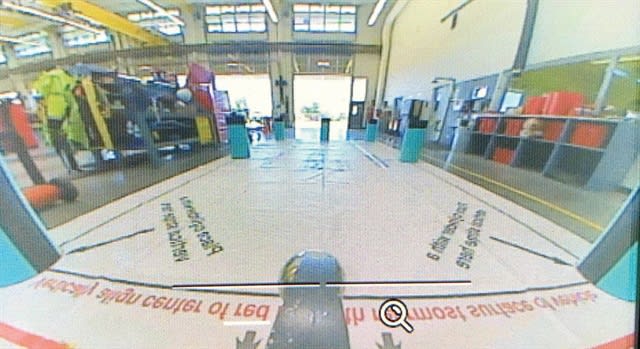
This camera view shows conformity with the standards — the five back cylinders are fully visible, and the front two are partially visible. Photo courtesy of EWEB
Setting Up Testing
Following NHTSA’s final rule on Federal Motor Vehicle Safety Standard for Rear Visibility (FMVSS 111) and a kit from NTEA - The Association for the Work Truck Industry, Lentsch and fleet staff began field of view tests on its vehicles.
Staff prepared a layout grid and used seven cylinders placed behind the vehicle as visual targets to test and adjust its cameras. The goal is to be able to completely see all the five mid and rear cylinders and at least 6 by 6 inches of the two front cylinders through the monitor. In many of the initial tests, the cameras failed to see the front cylinders.
Fleet staff quickly identified that these were the vehicles’ rear blind spots, and that’s where most drivers’ rear backing incidents were occurring. Staff determined the vehicles needed at least a 170-degree-view camera. The vast majority of cameras available online did not fulfill this requirement — they provided around 130 to 150 degrees.
Lentsch hasn’t been able to identify a camera that works for all his trucks, but technicians have adjusted or modified the existing cameras in a couple dozen vehicles to improve visibility. In the meantime, EWEB is looking for camera manufacturers to provide a solution before it replaces its remaining cameras.
The best camera the fleet has tested and installed so far actually came from the automaker, when EWEB ordered a Ford F-550 with the rearview camera option, which was shipped loose.
“We had to put that camera way back on the vehicle to be able to clear the bumpers and everything else back on the vehicle,” Lentsch said.
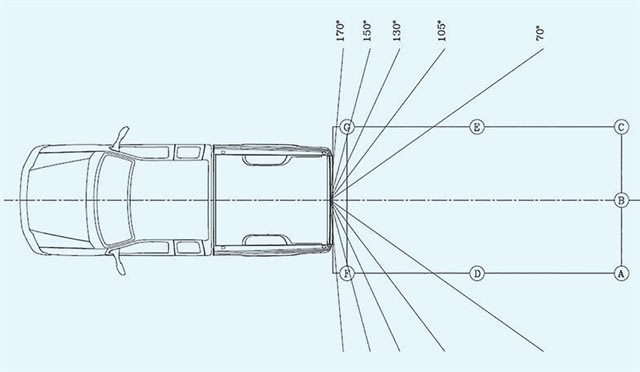
The Eugene Water & Electric Board found that it needed a wide-view camera, at least 170 degrees, to capture all the marked cylinders in its grid. Drawing courtesy of EWEB
A Preventive Measure
When Lentsch explains this process and reasoning to other fleet managers, they almost wish they didn’t know — it’s a costly and time-consuming project. Since the regulations don’t apply to vehicles above 10,000 lbs. GVWR, he knows it’s a preemptive measure more than anything else and that it might be more than some fleet managers are ready to tackle.
“But you might be saving some little kid’s life,” Lentsch said.
8 Steps for Checking Your Cameras |
|
Subscribe to Our Newsletter
More Safety
New Partnership Aims to Expand Public Digital Hazard Alert System Statewide
The Hawai’i Department of Transportation (HDOT) is expanding advance digital hazard alerts for the public statewide.
Read More →
New York City Expands Safety Technologies Across Municipal Fleet
Executive Order 19 moves intelligent speed assistance and pedestrian alerts from pilot programs toward standard fleet equipment, offering other public fleets a look at how safety technology can be tested, measured, and scaled.
Read More →
Sponsored•August 10, 2026
Hidden in Plain Sight: Fleet Compliance Risks
Fleet compliance isn't just about having policies — it's about consistently enforcing them. This practical guide reveals six hidden compliance risks common in public sector and shared fleet operations and outlines proven strategies to improve visibility, accountability, and audit readiness.
Read More →
5 Days Left to Submit Your 2026 Fleet Safety Award Nomination
Know a government fleet, safety, or risk manager who deserves recognition for making fleet operations safer? Nominations are open through Aug. 15.
Read More →
How the First 24 Hours Can Shape a Fleet Crash Response
How a strong accident response process helps government fleets move from the initial report to recovery while building a clearer record for what needs to change next.
Read More →
Sponsored•July 17, 2026
How Better Visibility Cut Speeding Violations by 48%
Fleet leaders don't need more data, they need clearer visibility into what the data is saying. This case study explores how one utility replaced speeding-event counts with a single metric — miles driven in violation — to strengthen safety and significantly reduce speeding violations.
Read More →
e-con Systems Expands AI Camera Tools for Traffic Monitoring
The systems support license plate recognition, traffic analytics, and video management for transportation agencies.
Read More →
King Township Pilot Links Driver Feedback to Reduced Speeding
How King Township, a best-in-class municipal fleet, reduced speeding by 10.9% and demonstrated a projected 349% ROI by putting safety ownership directly in drivers' hands.
Read More →
Beyond the Fireline: The Critical Role of Public Fleets in Wildfire Response
Behind every wildfire response is a complex network of vehicles, data, and decisions that must work in sync under extreme pressure. Global heating trends require strong fleet coordination and reliable communications to keep crews safe and operations running smoothly.
Read More →
How AI Is Transforming Public Fleet Safety - Part 1
AI-powered safety systems are helping public fleets tackle distracted driving by delivering real-time coaching and measurable behavior change behind the wheel. In part one of our Q&A, Nauto CEO Stefan Heck explains how agencies can improve safety, reduce costs, and navigate implementation challenges with AI-driven technology.
Read More →