




AWD Police Vehicles Gain Traction
Traditionally, police vehicles have arrived for duty with rear-wheel or front-wheel drive. Starting with the 2015 model year, Chrysler, Ford, and General Motors will offer at least one police vehicle in an all-wheel or four-wheel-drive configuration.

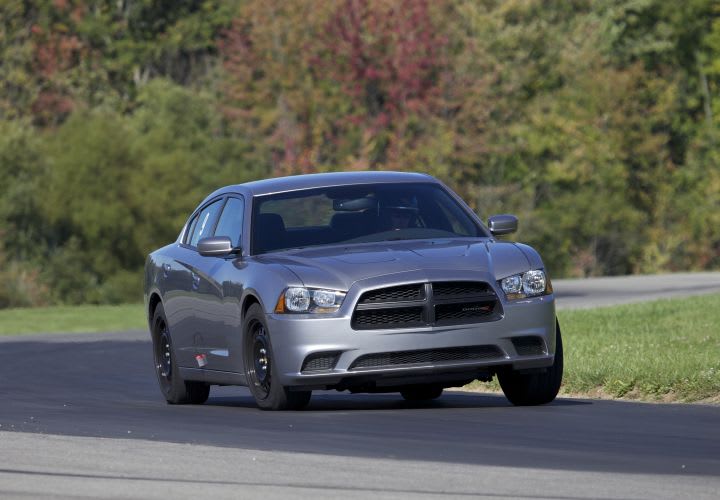
Photo courtesy of Raymond Holt/MSP.
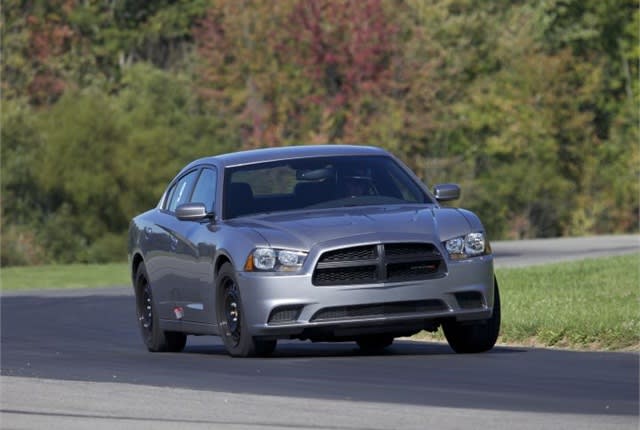
Photo courtesy of Raymond Holt/MSP.
Officers pursuing suspects in earlier decades often had to fight to keep their hurtling police cars on the road as they accelerated from a standing start. The big-block torque of many early patrol cars could be a wild beast that needed harnessing when an officer had to floor it to catch a scofflaw or felon.
Thankfully such fishtailing thrill rides have become a relic of the past, as automotive technology has advanced and law enforcement agencies have demanded both power and control from their pursuit vehicles. The latest police vehicles now available from the Detroit automakers offer precision-tuned engineering that is generationally advanced not just from that found in the cars of the '70s, '80s, and '90s but even from the Ford Crown Vic, which was retired in 2011. Officers conducting emergency maneuvers can now do so with much more confidence in the performance of the engine, drivetrain, and suspension, as well as stability and traction control that keeps the patrol vehicle on course.
AWD Rising
Traditionally, police vehicles have arrived for duty with rear-wheel or front-wheel drive. Police have generally believed a rear-wheel-drive vehicle provides greater stability during higher-speed maneuvers, while front-wheel-drive vehicles offer greater traction for inclement environments. Experts say that's not necessarily true.
"Historically, the majority of the police cars were RWD," says Brian Tolan, General Motors' vehicle performance engineer for police vehicles. "To say a RWD conventionally is better performing or safer than a FWD, I disagree with that."
Police automotive engineers have been rethinking these parameters, and starting with the 2015 model year, Chrysler, Ford, and General Motors will offer at least one police vehicle in an all-wheel or four-wheel-drive configuration. In early November, GM introduced a pursuit-rated version of its four-wheel-drive Chevrolet Tahoe PPV to go with the pursuit-rated RWD Tahoe. In June, Chrysler announced it would produce an AWD Dodge Charger Pursuit.
The trend toward AWD patrol vehicles is partly market driven, as Chrysler and GM/Chevrolet have offered their vehicles following the initial introduction of the Ford Police Interceptor sedan and P.I. Utility in a standard AWD package. Ford initially offered a discount to agencies seeking FWD, but has since eliminated that option. The vehicles are now only offered with AWD.
"Customers were buying the AWD version at a little over 97 percent," says Randy Freiburger, a lead police vehicle engineer with Ford. "Only a little over 2% were buying the FWD version."
Market competition isn't the only factor behind the popularity of AWD police vehicles. Police advisors of the automakers have asked for the feature to provide additional safety to officer drivers, because providing power to all wheels allows a vehicle to better manage varied terrains and weather conditions. As a result, law enforcement agencies are seeking AWD systems for sedans that no longer require a trade-off in performance, according to the automakers.
"We're seeing a larger acceptance for non SUVs in climates that wouldn't have ordered an all-wheel drive before," says Jiyan Cadiz, a Chrysler spokesman.
In September testing of 2014 model-year police vehicles by the Michigan State Police, AWD models performed nearly as well as their rear-wheel or front-wheel counterparts.
"Given the latest MSP tests, our Charger Pursuit AWD delivered essentially the same performance as the RWD," Cadiz says. "We want to offer our law enforcement agencies overall at-limit performance. We've engineered the pursuit AWD to take on the same demands as our RWD Charger Pursuit."
AWD vs. RWD vs. FWD
AWD patrol vehicles have been gaining in popularity since 2012 when Ford first introduced the option on its Crown-Vic replacement Police Interceptor sedan and P.I. Utility.
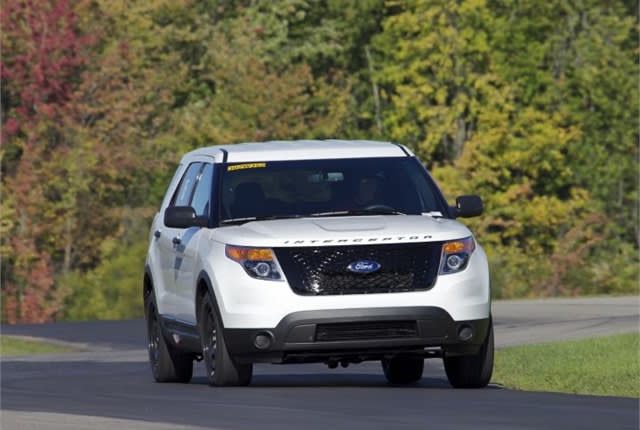
Photo courtesy of Raymond Holt/MSP.
An AWD pursuit vehicle offers a few key advantages to patrol officers. Typically an AWD vehicle provides better torque management than a two-wheel-drive system, giving a vehicle better traction by more equally distributing power to four tires. AWD systems also provide better traction on adverse surfaces such as dirt, sand, ice, and rain-slicked pavement.
The automakers each say their AWD vehicles provide greater safety and vehicle control for officers who need to make sudden emergency maneuvers that require a strong steering input coupled with fast acceleration. An ideal example would involve an officer stopped on a gravelly highway shoulder who must make a quick U-turn to catch a speeder heading in the opposite direction.
Ford employs an AWD system on the Police Interceptor sedan and P.I. Utility known as a "continuously variable" system that's always anticipating wheel slip, aggressive accelleration, or handling. Ford's AWD system favors FWD, then shifts torque to rear wheels when needed.
"It's an active AWD system," Freiburger says. "It's continuously monitoring vehicle conditions to determine when to apply torque to the appropriate axle."
An AWD vehicle can also provide greater resale value, which would be a boon to fleet managers considering the lifecycle cost of a vehicle when choosing which car to buy.
Vehicles with AWD systems also have their drawbacks. The cost of an AWD system can exceed that of a RWD vehicle. Maintenance costs can be higher. Differential fluid must be changed, which creates an additional maintenance item. If something goes wrong with the differential, it tends to cost more to repair.
Typically AWD vehicles have worse fuel efficiency than FWD or RWD vehicles. However, a Chrysler engineer disputes that claim. The Dodge Charger Pursuit's AWD system works with a rear-wheel bias. In other words, the vehicle operates as a rear-wheel car until certain triggers activate AWD. The triggers are set for environment and weather, speed, state of the stability control system, road surface, and driving style.
"In our case, if you were driving down the highway and cruising on a nice warm dry day, the torque to propel you at 70 mph is from the rear wheels," says Neil Young, Jr., Chrysler's lead engineer for law enforcement vehicles. "We disconnect torque from the front wheels so you don't have negative effects on fuel economy."
Ford's Freiburger says next-gen engine technology is also eliminating any loss in fuel economy between AWD and two-wheel-drive vehicles. The Ford P.I. sedan's base 3.7-liter V-6 engine offers a 35% increase in fuel economy compared to the RWD Ford Crown Vic during idling. The P.I. Utility is 32% more efficient than the Crown Vic, Freiburger says. Ford's smaller-displacement engines also offer better performance than the Crown Vic due to their greater efficiency.
AWD Pursuit Vehicles
Ford was the first of the automakers to bring an AWD system to the new crop of pursuit-rated police vehicles when it introduced its Police Interceptors for the 2013 model year. The automaker also added other driving management systems to increase safety. Under certain high-speed conditions, the vehicle will apply braking to selective wheels in an understeer condition to help prevent a vehicle rollover.
Ford vehicles also come with electronic stability control that makes the vehicle more forgiving to drive when cornering. Special tuning of the system for emergency driving and more rugged suspensions with upgraded springs and shocks also improve safety.
In June, Chrysler announced it would produce an AWD Dodge Charger Pursuit that will be available later this year as a mid-model-year vehicle for 2014. Chrysler also added larger, 14.5-inch high-performance brakes for 2014 and made a camber link change to the rear suspension for improved performance during high-speed driving and aggressive braking maneuvers.
Earlier this month, GM announced it will produce a revamped Chevrolet Tahoe for the 2015 model year available in a four-wheel-drive pursuit version for the first time. The vehicle will use the platform from the 2014 Chevy Silverado 1500 truck, which was redesigned for that model year.
In addition to the four-wheel-drive system, the 2015 Tahoe will include the StabiliTrak with traction control that limits wheel spin and assists with directional control of the vehicle. The 2015 Tahoe will get the 5.3-liter, V-8 EcoTech3 engine on the Silverado that generates 355 hp (a 35 hp increase from the existing police Tahoe) and 383 foot-pounds of torque, an increase of 48 foot-pounds of torque. The EcoTech3 delivers "enhanced fuel economy," says Dana Hammer, GM's manager of law enforcement vehicles. MPG ratings will be released at a later date.
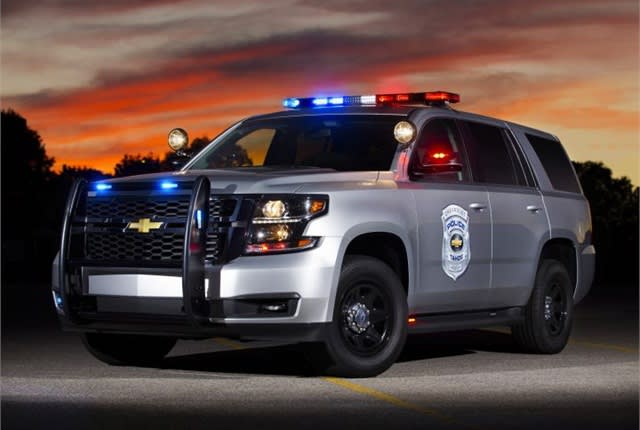
Photo courtesy of GM.
The vehicle will also include new safety features such as rear park assist, backup cameras, and available lane departure warning. Hammer says GM was asked to produce a four-wheel-drive pursuit vehicle by its law enforcement customers.
"We do feel there is demand for that in the market," he says. "A full-sized SUV, a truck-based product with durability and a tried-and-true four-wheel-drive system for when they really need it for those really heavy snows, inclement weather, off-road conditions."
Entrenched law enforcement drivers may prefer a RWD or FWD vehicle due to familiarity with those drivetrains, but AWD systems are catching on among police vehicle purchasers. Members of the automakers' police advisory boards have been asking for it, because these advanced AWD systems help keep police vehicles on the road when a chase is at its hairiest.
"Once you lose traction on the back end, you don't have any other wheels trying to get you back on track or driving you forward," adds Freiburger. "You're just taking power away from those wheels, which means if you don't have power you're not moving as fast. We can balance that need between the four wheels."
Paul Clinton is the web editor for Government Fleet.
More Police

Ford Pro Introduces Full-Size 2028 Expedition Police Responder
Ford Pro gave law enforcement customers a first look at the pursuit-rated utility during Police Fleet Expo.
Read More →
Paterson Police Expand Drone Fleet, Launch Real-Time Operations Center
The Paterson Police Department has expanded its drone program and opened a new Real-Time Operations Center designed to support emergency response and incident management. The initiative integrates multiple technologies to provide officers with real-time information during investigations and public safety operations.
Read More →
Why Public Fleet Success Depends on More Than the Vehicles
Tim Coxwell of the Leon County Sheriff’s Office discusses the projects shaping his fleet operation, including long-term work around vehicle selection, greenhouse gas emissions, and cost per mile.
Read More →
Havis Acquires Pro-gard Products
The acquisition brings together two manufacturers of public safety vehicle equipment under one company. Havis says the move expands its portfolio of products for outfitting law enforcement vehicles and other public safety fleets.
Read More →
RTA Fleet Introduces AI Assistant for Fleet360 Platform
As artificial intelligence continues to gain traction across public-sector operations, fleet software providers are finding new ways to incorporate the technology into everyday workflows. RTA's latest addition aims to simplify how users interact with fleet data.
Read More →
2026 Police Fleet Innovators Named
Meet the professionals finding new ways to solve some of law enforcement's toughest fleet challenges.
Read More →
Rynse Expands Nationwide Fleet Wash Access for Law Enforcement
The North Carolina Sheriff’s Association Contract Cooperative purchasing contract aims to streamline procurement process for law enforcement agencies across the U.S.
Read More →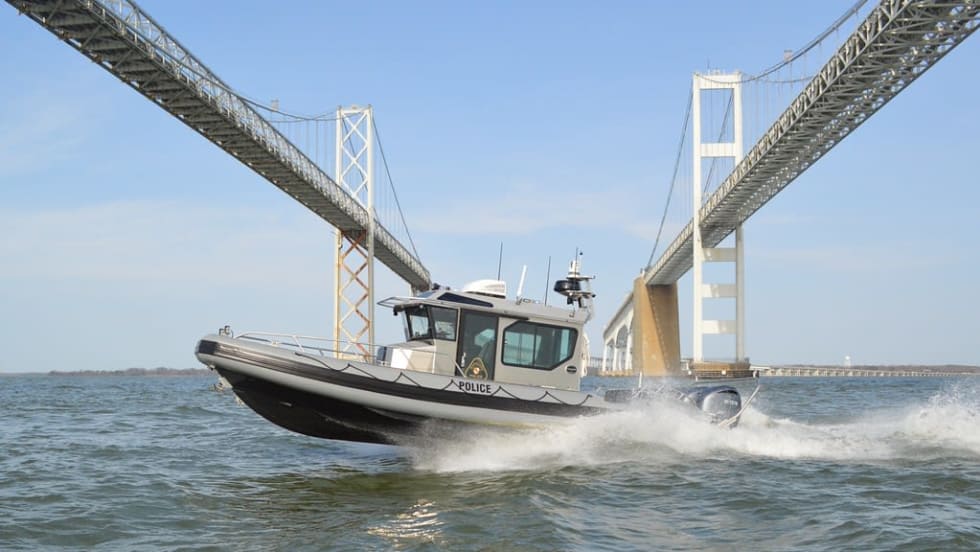
Maryland Natural Resources Police Adds 31-Foot Patrol Boat to Enforcement Fleet
A new addition to Maryland’s marine enforcement fleet is bringing expanded capabilities to Chesapeake Bay operations while honoring a legacy within the agency. The high-performance patrol vessel reflects how law enforcement fleets are adapting to growing demands on the water.
Read More →
LEHR Expands Florida Presence With Enforcement One Acquisition
LEHR has acquired Florida-based emergency vehicle upfitter Enforcement One, marking its eighth add-on acquisition.
Read More →
Maryland’s Wicomico County Sheriff Adds Mustang GT Patrol Vehicles
The agency is also working with the Maryland Police Training Commission on a specialized high-performance driving course for deputies assigned to the vehicles.
Read More →