




Related: Refurbishing Equipment: The Ultimate Recycling Program
Cranes Help Lifeguards Reduce Rescue Times
Workers in the trauma world operate in what they call the “golden hour.” If they can get a patient to a trauma center in an hour from the moment of the accident, then there is an 89% chance that patient will live.
by Eric Gandarilla
August 31, 2015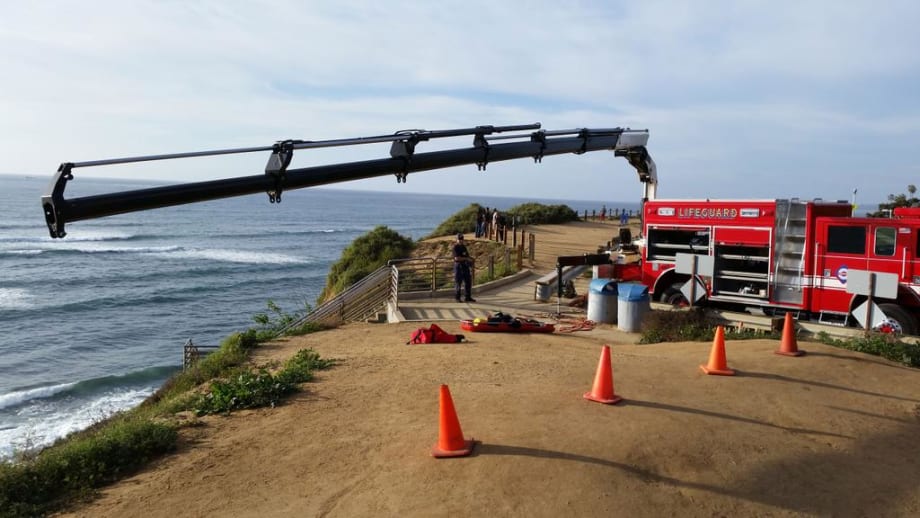
Photo courtesy of Two Rivers Marketing.
3 min to read
Photo courtesy of Two Rivers Marketing.
Workers in the trauma world operate in what they call the “golden hour.” If they can get a patient to a trauma center in an hour from the moment of the accident, then there is an 89% chance that patient will live.
Lifeguards in the San Diego Fire Department (SDFD) know this hour all too well as they get around 9,500 medical calls and perform about 5,000 water rescues every year. Apart from that they perform about 50 to 75 cliff rescues. And while that number may seem small in comparison, it’s actually an exorbitantly high number of cliff rescues compared to other agencies who see about one cliff rescue a year, said John Bahl, lifeguard III, who has been with the agency for 29 years.
Cranes have become an indispensable tool for SDFD lifeguards in their pursuit of that golden hour.
Whenever someone is stuck on a cliff, especially if the person is injured, SDFD lifeguards use their crane to send down a lifeguard, stretcher, and paramedic to the patient. Once the patient is loaded onto the stretcher, the response team hoists the patient, along with the paramedic, up the hill and provides immediate assistance or sends them to a nearby hospital, depending on the severity of the situation.
San Diego Lifeguards are able to perform a cliff rescue in around 30 minutes, it’s a number that’s already below the hour mark, but with the acquisition of a new IMT knuckleboom crane, that number should soon be dropping down to 10.
The new IMT crane, which will be outfitted onto a Pierce Saber-HDR firetruck, will be replacing the department’s current crane, which it first acquired in 1994. Bahl had some input into the design of that crane back when it was first purchased, and 21 years later, he’s been a driving force in the acquisition of the IMT crane.
Not only has preliminary training shown that this crane can cut the department’s cliff rescue time by 66%, it’s also going to be its also going to be improving safety. Its safety restrictions won’t allow an operator to lift something it’s incapable of lifting, won’t allow for overextension, and it’ll be easy to use.
It also won’t be prohibited by certain Occupational Safety and Health Administration (OSHA) or American National Standards Institute (ANSI) crane standards that restrict what a crane can be used for.
The way their old crane was certified, it could only lift people. It might have been rated at 7,000 pounds but it was restricted to 7,000 pounds worth of people. If the department used it to lift a car off of a person, it would have to take it out of service and get the whole thing tested and have its cable replaced.
The department’s new knuckleboom crane won’t have this problem. Pierce’s legal department has given the crane a rescue rating, so the department will be able to use the crane to lift a person, car, and concrete in the same day without having to worry about taking the crane out of service.
The SDFD has often been criticized for their use of cranes in rescues. Its critics have argued that it’s violating OSHA by using a powered lift and that there’s too much risk of injury when pulling people up if the equipment malfunctions or not enough attention is paid to it, Bahl said.
However, he disputes that and says the advancements in crane technology, built-in safety precautions, and constant surveillance on equipment has nearly eliminated any risk if causing any injury to a patient due to equipment.
Given the crane’s versatility, it should be seeing a lot of use outside of cliff water rescues, Bahl said. He hopes it isn’t restricted to only coastal cliff rescues and is used in all kinds of different scenarious.
Subscribe to Our Newsletter
More Operations

Who Deserves Fleet Recognition and What Could You Teach at GFX?
Who helped shape your fleet career, and what have you learned that could help someone else?
Read More →
What’s Haunting Public Sector Fleets?
Public sector fleet challenges rarely happen in isolation, and addressing one often means understanding how it connects to another.
Read More →
Is Keeping Older Fleet Vehicles Really Saving Money?
Is keeping vehicles longer saving money, and what happens when a diagnostic test points to the wrong fix?
Read More →
How Smart Fleet Strategy Can Help Local Government Agencies Do More with Less
Keeping a vehicle longer may ease this year’s budget, but what does it cost the next one? A closer look at fleet decisions can reveal opportunities to reduce spending while protecting essential services.
Read More →
Connect with Government Fleet on LinkedIn
From industry news and fleet management strategies to conversations with peers, Government Fleet's LinkedIn page offers public-sector fleet professionals another way to stay informed and connected.
Read More →
Town of Queen Creek Named Most Successful Fleet Award Winner of Inaugural RTA Fleet Success Awards
Five fleets were honored at RTA Connect 2026 in Chicago for excellence across resource efficiency, intentional culture, risk management, and stakeholder satisfaction.
Read More →
Sponsored•October 14, 2026
A buyer's guide to fleet management software in 2027
Buying fleet management software in 2027 means looking beyond features and price. As fleet operations, technology and expectations evolve, this guide explores what today’s fleet professionals should consider when choosing a system that can deliver value now and adapt to what comes next.
Read More →
Hazard Alerts, Fleet Car Sales Rise and a New Shuttle Concept
Fleet car sales doubled, but the bigger picture tells a different story in this week’s roundup.
Read More →
How St. Johns County Turned Fleet Data Into Better Replacement Decisions
St. Johns County, Florida, had fleet data, but turning it into reliable decision guidance was another matter. Instead of starting over with a new fleet management system, the county connected existing tools and built a scoring system that gives managers an objective look at fleet health.
Read More →
Fleet Forward Conference Introduces One-Day Passes for 2026
New one-day registration lets fleet professionals attend Tuesday, Wednesday, or Thursday, with passes available for $249.
Read More →