A Closer Look at San Bernardino County’s Leading Fleet
America’s largest county is the home of 2017’s No. 1 Leading Fleet. Learn more about the planning, technology, and training initiatives that pushed this fleet to the top spot.
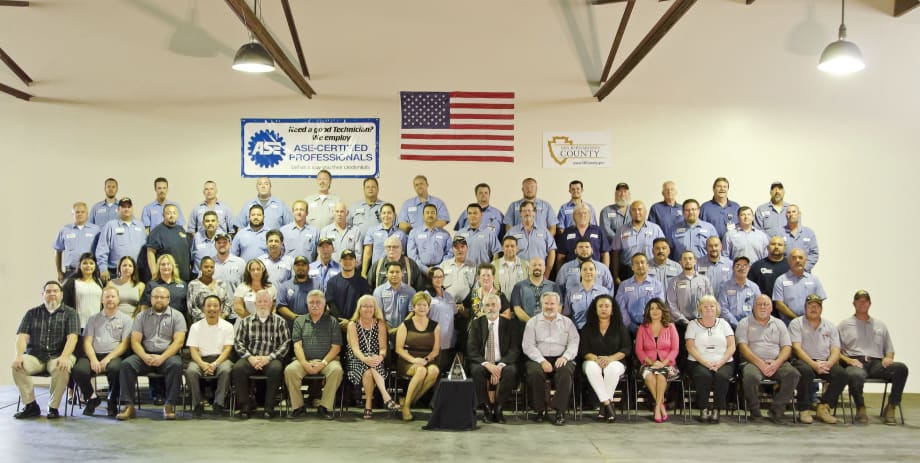
San Bernardino County, Calif., fleet’s No. 1 Leading Fleet award represents the hard work of its entire operation. Photo courtesy of San Bernardino County
7 min to read
San Bernardino County, Calif., fleet’s No. 1 Leading Fleet award represents the hard work of its entire operation. Photo courtesy of San Bernardino County
With more than 20,000 square miles to cover, San Bernardino County’s Fleet Management Department in California faces a unique set of challenges. Staff maintains or supports nearly 6,000 vehicles, about 300 fixed and portable generators, 100 fuel tanks, and six service centers, five of which are located up to hundreds of miles from their headquarters in the City of San Bernardino. The territory includes snowy mountains and vast stretches of sandy desert. It is the single largest county in the contiguous United States, bigger than the four smallest states combined, all managed on a $51 million fleet operational budget.
At a glance
San Bernardino County, Calif., earned recognition as the No. 1 Leading Fleet by:
Playing a key role in disaster preparedness and response
Improving efficiency and accountability through the integration of new technology, including a GPS tracking network
Participating in a welfare-to-work program that teaches basic mechanical skills to a select group of young adults and high school students.
As if that weren’t enough, the fleet also takes an active role in emergency preparedness and response. In addition to maintaining, deploying, and refueling generators, staff members move people and vehicles, assist in erecting and operating temporary operational centers, and support first responders.
Ad Loading...
For these reasons and more — including leadership, efficiency, and a clear vision for operational success — on June 13, at the Government Fleet Expo and Conference (GFX), San Bernardino earned recognition as the No. 1 fleet among this year’s Leading Fleets honorees. Sponsored by Ford, the award recognizes those that are excelling in the industry.
Battling the Conflagration
In August 2016, San Bernardino County first responders and the fleet team’s resolve was tested by the Blue Cut Fire, a weeklong event that resulted in widespread evacuations, 37,000 scorched acres, and the loss of 105 homes.
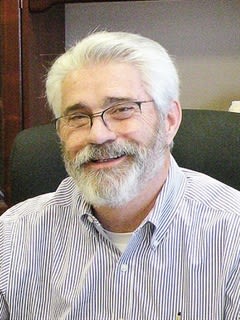
“Like most disasters, we didn’t start out knowing it would become a conflagration,” said Roger Weaver, CAFM, CPFP, CPM, fleet management director for the county. “It started out as a small brush fire near the freeway, and before you knew it, the freeway had to be shut down.”
As the incident evolved and demand for support grew, the fleet department jumped into action, mobilizing emergency generators, organizing transportation, and maintaining communications with San Bernardino’s Office of Emergency Services. Wildfires on the scale of Blue Cut are rare, Weaver said, but weather-related events are not. Some parts of the county get more annual snowfall than Denver. Desert areas are prone to severe windstorms and flash floods.
“Every kind of weather, calamity, you name it, we get it. We run the gamut because of the size, geography, and placement,” he explained.
Ad Loading...
The extent of the response surprised Dennis Tormey, a county staff analyst who joined the fleet team shortly after the fire.
“I would not have known all that fleet does to support the county’s first responders,” Tormey said. “When you think about disasters, you immediately think of the sheriff and fire departments and perhaps hospitals, but you don’t normally think about where their support comes from when they exceed their emergency support resources during a sustained demand.”
In December 2015, a disaster of another kind unfolded when 14 people (including 13 county employees) were killed in a mass shooting at San Bernardino’s Inland Regional Center. True to form, the fleet team rose to the occasion, supporting first responders and transporting people, vehicles, generators, and emergency lights throughout the weeklong investigation that followed the attack.
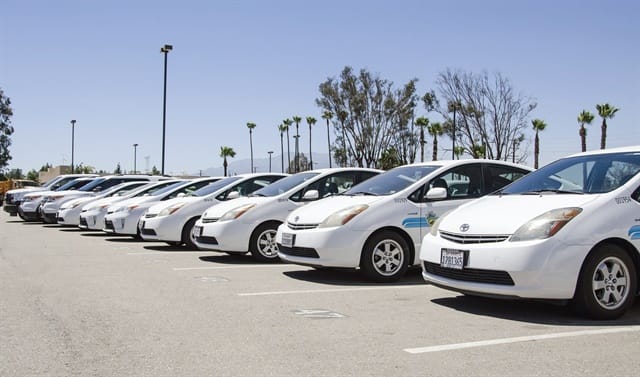
The San Bernardino County fleet consists of more than 5,000 on-road vehicles, including about 1,800 vehicles in the motor pool. Photo courtesy of San Bernardino County
Size and Scope
The fleet department is responsible for records for all vehicles and equipment, maintenance, and repairs for about 4,000 units. The sheriff’s department owns another 2,000 vehicles for which service is primarily performed at local retail shops. Motor Shop Supervisor Michael Jabaay manages about 1,800 vehicles and supervises the procurement process for numerous county departments.
“The county’s vehicles operate in two air-quality zones — South Coast Basin and Mojave — and public fleets aren’t allowed to purchase diesel vehicles in South Coast,” Jabaay said. There are a few exceptions for specialized heavy-duty vehicles and light-duty emergency vehicles.
Ad Loading...
All county-owned vehicles are tracked in a central database powered by FASTER Asset Solutions. Installed in 2002, the system offers web-based access to work orders, technician assignments, diagnosis of problems, scheduled maintenance, repairs, and service calls.
“One of the things that stand out for a county of our size is ‘windshield time’ for the technicians, supervisors, and leads,” Weaver said. “It can take you an entire day to get from my office to our most distant service center in Needles. And if you expect to accomplish anything while you’re there, you’ll more often than not have to spend the night.”
The county provides services for the many unincorporated communities, and Weaver maintains a network among the other public-sector fleets scattered throughout the county. “We call each other often and meet occasionally to talk about regionwide issues, fuel shortages, and alternative-fuel strategies. But for the most part, we all operate independently,” he said.
All county departments, including fleet, operate in support of the “Countywide Vision,” a framework developed in concert with all the cities in the county, residents, and investors. Weaver says his department’s role boils down to one major component: “Create a county in which those who reside and invest can prosper and achieve well-being.”
“Fleet people are hardworking, responsive, reactive people. San Bernardino just happens to have more than our fair share of the best ones.”
-Roger Weaver, fleet management director, San Bernardino County, Calif.
Ad Loading...
Benefiting from Community Outreach
Of all the countywide initiatives in which fleet plays a role, Weaver pointed to workforce development as one of which his team is particularly proud. Operated in conjunction with local adult education centers, the program includes a basic mechanic training class for young adults and high school students. They get on-site training in a field for which qualified workers are in short supply.
“The program has a small student-to-instructor ratio, with five hours per day of classroom training and three hours on our shop floor, turning wrenches, checking brakes, and changing oil,” Weaver said.
It’s a tough program to get into, and as many as half of the enrollees will not complete it. But for those who do, the rewards are invaluable: They are provided with coveralls, safety glasses, work boots, and all the tools an entry-level mechanic would need — all theirs to keep. Fleet takes an active role in evaluating the students’ progress and has hired two recent graduates.
“One is a single mother of three and now a mechanic,” Weaver said. “She was also No. 1 in her class. She excelled in the program and [is] doing the same as a full-time employee for the county.”
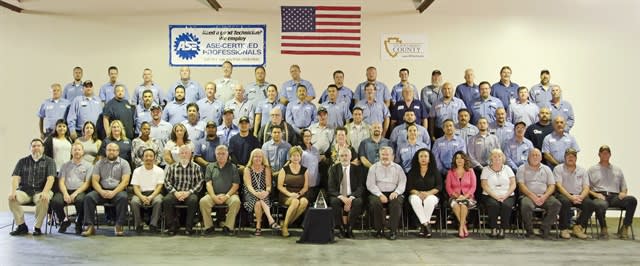
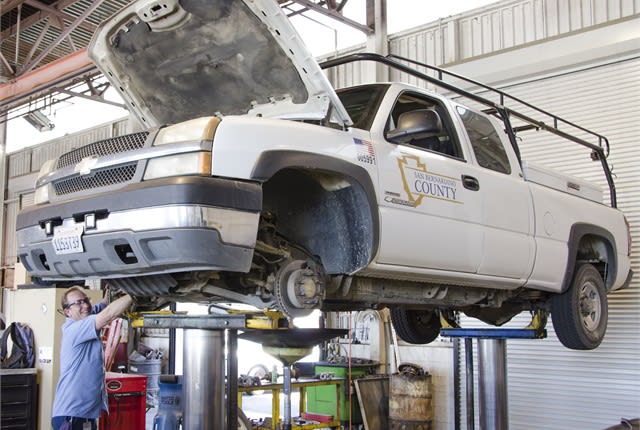
Technicians maintain and repair more than 6,000 vehicles in six fleet facilities. Photo courtesy of San Bernardino County
Implementing Technology
In addition to updating the county’s fleet management information system (FMIS), the department has invested in upgrades to its facilities; a brand-new remote service center is in the planning stages. The department has also implemented new technologies including GPS, smartphones, and tablets to help drive efficiency and accountability.
Ad Loading...
“We have roughly 2,000 GPS units deployed in county vehicles,” Weaver noted. “We are trying to tie the information gathered from GPS into our primary FMIS. The industry just hasn’t gone that far yet in this area. It sure would be helpful.”
One of the GPS’s functions is to help other departments and divisions handle complaints from the general public. When a complaint is made about a driver, fleet staff members prepare a report with all the relevant data and relay it to the appropriate department.
“If someone complains a driver was speeding down a street, we forward that complaint and supporting GPS data. GPS confirms whether the vehicle was or was not in that area and whether it was doing 20 miles per hour, not 90, as reported,” Weaver said, noting that the system also monitors vehicle error codes. The moment a red warning light appears on the vehicle’s dashboard, the fleet team receives an e-mail.
Fleet also uses GPS to monitor, track, and activate or shut down emergency generators. In addition to the monitoring and service aspects, the GPS units are providing real-time data needed to report usage to the air-quality zones and avoid penalties for overuse.
Whether it is routine maintenance of the large, highly dispersed fleet, responding to disasters, or community involvement, Weaver said, effective planning and a great team set the county’s fleet apart.
Ad Loading...
“Fleet guys by nature are very reactive to demand,” said Weaver. “If your car breaks down on the freeway, they are going to come get you. I think that’s the attitude of most fleet employees, not just here but anywhere. Fleet people are hardworking, responsive, reactive people. San Bernardino just happens to have more than our fair share of the best ones.”
A Message From the Sponsor
Congratulations to the No. 1 Leading Fleets in all size categories, as well as those operations recognized with this award. Ford Motor Company values recognition programs, and it’s an honor to sponsor an award that recognizes those organizations that have shown leadership in the industry.
In addition to ensuring competitiveness, these fleets are at the forefront of the industry with their ideas, actions, and leadership among the industry, with local communities, and with their customers.
We thank public fleets for the service they provide to their communities. If the public only knew how much effort, hard work, and pride these fleets put into their operations, they would be overwhelmed. We are happy to support these leading fleets and wish them continued success.
Tony Gratson Government Sales Manager Ford Motor Company
Keeping a vehicle longer may ease this year’s budget, but what does it cost the next one? A closer look at fleet decisions can reveal opportunities to reduce spending while protecting essential services.
From industry news and fleet management strategies to conversations with peers, Government Fleet's LinkedIn page offers public-sector fleet professionals another way to stay informed and connected.
Five fleets were honored at RTA Connect 2026 in Chicago for excellence across resource efficiency, intentional culture, risk management, and stakeholder satisfaction.
Buying fleet management software in 2027 means looking beyond features and price. As fleet operations, technology and expectations evolve, this guide explores what today’s fleet professionals should consider when choosing a system that can deliver value now and adapt to what comes next.
St. Johns County, Florida, had fleet data, but turning it into reliable decision guidance was another matter. Instead of starting over with a new fleet management system, the county connected existing tools and built a scoring system that gives managers an objective look at fleet health.