




What Happens When Your CNG Tanks Expire?
While the benefits of CNG vehicles are well documented, one issue looms over the industry that must be addressed: What happens when a dedicated CNG vehicle fuel tank reaches its expiration date?

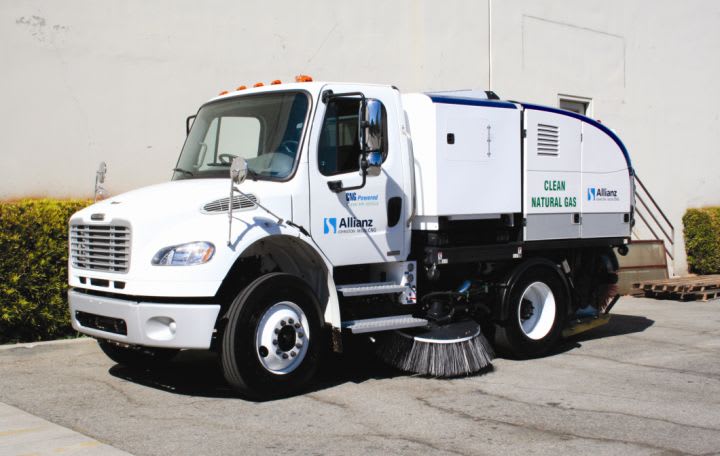
Battersby believes the demand is there to support additional OEM offerings in CNG light-duty trucks and vans, but is frustrated the industry is not seeing them brought to the U.S. market ... yet.
Photo: NGVAmerica
Utilizing compressed natural gas (CNG) in vehicles has benefited fleets around the world for decades. Compared to vehicles fueled with conventional diesel and gasoline, natural gas vehicles (NGVs) can produce greatly lower amounts emissions and reduce operating costs up to 50%, while helping wean the nation from dependence on foreign oil, according to NGVAmerica, the industry trade association.
NGVAmerica estimates about 110,000 NGVs are in use in the United States today, displacing about 360 million gasoline-gallon equivalents (GGE) per year. More than 11 million NGVs are operated worldwide, with the numbers growing quickly throughout Europe, South America, and Asia.
According to NGVAmerica, replacing an older vehicle with an NGV reduces:
Carbon monoxide (CO) by 70-90%
Nitrogen oxides (NOx) by 75-95 percent
Particulate matter (soot) by up to 90 percent
Greenhouse gases by 20-30 percent compared to diesel or gasoline vehicles, respectively.
While the benefits of CNG vehicles are well documented, one issue looms over the industry that must be addressed: What happens when a dedicated CNG vehicle fuel tank reaches its expiration date?
Standards Pre-Determine CNG Cylinder Life
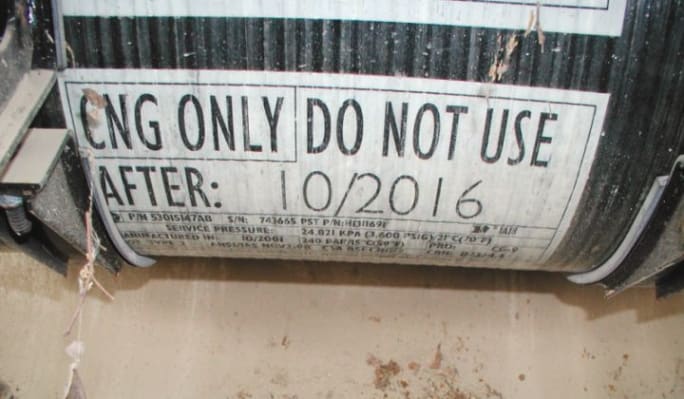
In the 1990s, the NGV industry created CNG cylinder certification standards. Cylinders built to meet the original (1992) version of Standard NGV2 were designed for a service life of 15 years, with labeling requirements setting a "Do not use after" date. A 1998 revision extended allowable cylinder life certification to 20 years. The 2007 revision raised that figure to allow a 25-year lifespan.
Most countries have adopted similar CNG cylinder standards. Tanks cannot be recertified after reaching the expiration date set at time of manufacture and must be taken out of service. That leaves vehicle owners two options: retire the vehicle or replace the cylinders.
"Most NGVs are retired well before their cylinders expire," says Stephe Yborra, director of market analysis, education, and communications for the Clean Vehicle Education Foundation (CVEF), a nonprofit working on NGV industry technology research, development, and design, and codes and standards. He acknowledges a small, but growing number of vehicles built in the mid-to-late 1990s "still have life in them," but their CNG tanks don't. "Like any other major item that needs replacement, you have to decide whether it makes economic sense to make the investment," said Yborra.
"With the 1998 and 2007 cylinder-life certification extensions, we expect this problem to diminish or go away completely through attrition of older vehicles," said Yborra."
The dilemma has surfaced primarily in California, where early adoption of NGVs in the 1990s was strongest and a mild climate has prompted a growing number of school buses, municipal trucks, and some light-duty vehicles outlasting their CNG cylinder's 15-year lifespan.
Armed with a more complete and accurate CNG vehicle registration database, he feels the industry could be more proactive, educating NGV owners about proper cylinder safety practices and issuing notices for older vehicles equipped with soon-to-expire cylinders.
Photo: NGVAmerica
"The challenge before us right now is how can we help fleets that have well-maintained 15-year-old CNG vehicles keep them on the road," said Yborra."
What alternatives do these higher-mileage fleets have? According to Yborra, current options are limited. Although NGV standards officials initially considered a process for recertifying older tanks, liability and technical challenges scuttled the idea.
"Our organization's number one priority is safety," Yborra said. For CNG cylinders, it starts with certification standards, he added.
"Next is in-use inspections of cylinders," said Yborra. The National Highway Traffic Safety Administration (NHTSA) mandated notices be affixed to all CNG cylinders for vehicles produced after Dec. 2, 1996. The notices state the cylinders should be inspected for damage or deterioration every 36 months or 36,000 miles, whichever comes first, or after a fire or accident. A CNG cylinder safety inspection protocol and inspector certification program is in place, and a variety of community colleges and other organizations provide training.
"Last is the timely removal and proper disposal of a cylinder when it reaches its full useful life or if it's damaged," Yborra explained.
He believes some owners may keep CNG cylinders in service after expiration because either they don't realize tank life has expired or the tank may appear safe.
"Appearances can be deceiving," Yborra noted. "Certified cylinder inspectors are trained to look for bracket wear, gouges from road debris, and — less obvious to the naked eye — corrosion that could compromise a cylinder's integrity." He cited examples of battery acid, industrial solvents, and other chemicals that may have been stored in the vehicle or splashed from a road spill.
Yborra also pointed out no official tracking systems are available to ensure all CNG cylinders undergo proper periodic safety inspections or are retired at set expiration dates.
"We feel the mechanisms the industry has in place are good — we have the right steps in place — but we don't have a way to make sure everyone follows those steps," Yborra said.
One challenge is the lack of a national database of all CNG vehicles, whether OEM-built or converted. "Each state has its own vehicle registration requirements and only a few record fuel type," said Yborra.
Armed with a more complete and accurate CNG vehicle registration database, he feels the industry could be more proactive, educating NGV owners about proper cylinder safety practices and issuing notices for older vehicles equipped with soon-to-expire cylinders.
The NGV industry is also addressing whether retired NGV cylinders are properly defueled and rendered unusable, according to Yborra.
"CNG cylinders are fairly expensive. We suspect that some expired cylinders are being resold by unscrupulous shops, which could result in a dangerous situation," said Yborra. He added that the resale of unexpired cylinders removed from a vehicle, while legal, should always include a thorough inspection by a certified inspector.
CVEF Task Force to Address Expiration & Other Issues
CVEF is currently assembling a task force of cylinder manufacturers, fleet operators, state motor vehicle agencies (MVA), and other government agencies to address cylinder expiration, replacement, and related issues.
"The task force is an extension of our current role managing cylinder incident investigations," said CVEF president Doug Horne. The task force hopes to assemble NGV inventory data — and through extrapolation, CNG cylinder data — from state motor vehicle registration databases, OEM sales data, and conversion company records. With this information, Horne's organization will contact fleets with vehicles in which cylinders are nearing the end of useful life to determine fleets' needs.
Horne suggested the task force will review potential business models to offer funding and/or leasing options for CNG tanks as well as consult grant agencies about adding CNG tank replacement to their grants.
"We'll also be looking at how to effectively move forward," Horne explained. Future plans may include discussion of a potential national NGV registration database capturing CNG cylinder information, if state MVAs cooperate.
California University Faces Wave of Tank Expirations
Richard Battersby, director of fleet services for the University of California, Davis, operates a fleet of about 1,000 vehicles and trailers; 63 are dedicated CNG on-campus vehicles, including 51 transit busses operated by the campus UNITRANS program. The campus also operates 31 bi-fuel vehicles, capable of running on either CNG or gasoline.
The University's dedicated CNG vehicles are used for general transportation, full-scale transit bus operations, utility vehicles, and on-campus maintenance vehicles.
"We have a CNG-powered refuse vehicle on order and are exploring a CNG-powered disabled access transportation vehicle as well," Battersby said.
265,000 gallon equivalents of CNG, which eliminates about 475 tons of greenhouse gas emissions each year versus operating on gasoline. "CNG provides substantial reductions in pollutants and greenhouse gases, and typically offers a substantial cost savings as well, although this can vary based upon market fluctuations," Battersby said.
The University currently pays less than $1.50 per GGE of CNG, a substantial cost savings. The University is also eligible to take a federal credit of 50 cents per GGE.
Most of the University's CNG vehicles are 1997 or newer models, but some of these vehicles will hit CNG cylinder expiration in 2011 or 2012. While the University has disposed of CNG vehicles prior to expiration date, it is now considering replacing CNG tanks on existing vehicles if proven cost effective to retain vehicles up to or beyond expiration dates.
"If we keep them beyond the cylinder's service life, we will buy replacement tanks and install them," said Battersby. "One reason for considering keeping them is that we don't have a competitively priced option to buy another CNG vehicle. The manufacturers stopped making them in the late '90s, and our only option is an aftermarket retro kit, which can double the cost of the new vehicle."
Battersby believes the demand is there to support additional OEM offerings in CNG light-duty trucks and vans, but is frustrated the industry is not seeing them brought to the U.S. market ... yet.
However, General Motors Co. and Ford have hinted at plans to offer CNG-ready vehicles in the near future. Industry sources expect GM will once again offer a gaseous fuel-prepped engine for its full-sized CNG van, pickup, and chassis cab models in about two years, and Ford, which already offers two gaseous fuel-prepped engines for its full-sized pickups, vans, and cutaways, may add the option to additional models.
The University prefers not disposing an NGV vehicle without buying an NGV replacement, not only because of environmental benefits, but also because customers are conditioned to the NGV vehicle.
Battersby and his staff will also soon explore a drop-in electric-vehicle conversion, called ElectraDrive in a low mileage, of formerly CNG-powered chassis. The California-based ElectraDrive company offers to repower existing truck/van chassis with a complete electric-vehicle drivetrain. The County of Alameda General Services Administration is conducting a pilot project with the ElectraDrive conversion.
"We dispose of our CNG vehicles the same way as we do our regular vehicles, through the State of California auction site. Plus, we have a property disposal unit on campus, and they sell campus vehicles on occasion," Battersby said. "We are considering selling some of our equipment using an online service called Public Surplus.com."
Develop Options for CNG Tank Expiration in Advance
Battersby has found while guidance is given about tank safety and expiration, noncompliance is not subject to regulatory punishment.
"There is no 'enforcement' of these rules, but if you continue to use a tank that is past its expiration, then the liability is all on you. The tank manufacturer, tank installer, and the tank inspector are all cleared of any liability," he stated.
Expiration dates for all CNG fuel tanks are displayed on labels located on the tanks, as well as on warning labels in the engine compartment.
"The tank should be destroyed upon its expiration because there is no re-hydrotesting of CNG tanks and returning them back into service," Battersby said. "Have a qualified technician replace the fuel tank. Do not reuse the old fuel tank!"
He emphasized the importance of being aware of each individual vehicle's CNG tank expiration so a plan can be implemented before the expiration date. For instance, when the tanks near expiration, will the vehicle be retained? If so, have re-tanking options, costs, and benefits been researched?
"Keeping these vehicles in service could mean avoiding a big expenditure, as well as not losing out on the environmental benefits associated with them," Battersby added.
He also pointed out that because some CNG vehicles have specific tank size limitations, managers should make sure if they replace the tank, the new tank purchase is compatible with the vehicle.
"Also, make sure if you purchase a replacement tank that it has not been sitting on the shelf for five years. If it has, it's already lost five years of its lifecycle," he said.
The University is considering applying for grant applications to re-tank its existing NGVs. "This way, we wouldn't lose some of our throughput," Battersby added.
According to Lucintel, a leading global management consulting and market research firm, the CNG tank market witnessed double-digit growth during the last decade and is expected to grow at a similar rate for the next five years (2010-15). Lucintel also said the global composite CNG tank market for the automotive industry is forecast to reach $368.8 million by 2015.
Will the market keep up with demand, as well as implement new tank safety standards, tracking systems, and disposal methods? With people such as Yborra and Battersby furthering the discussion about CNG practices and roadblocks, progress may indeed be made.
More Green Fleet
Sustainability Partners, Energy Systems Group Help Albuquerque Close the Gap on its 100% Renewable Energy Goal
The eight-site, 6 MW solar project has advanced the city toward 100% renewable energy for municipal operations.
Read More →
Port Authority and CALSTART Launch $45 Million Electric Truck and Charging Programs
The programs aim to boost sustainable operations across the East Coast's busiest seaport.
Read More →
Moving Government Fleets Beyond the Vehicle Purchase: EV as a Service
A discussion on how EVaaS is moving beyond pilot programs and what fleets should consider before beginning a larger deployment.
Read More →
Moving Government Fleets Beyond the Vehicle Purchase: EV as a Service
As fleets move beyond small EV pilots, Sustainability Partners CEO Adam Cain explains how EVaaS can address the infrastructure and long-term planning required for larger deployments.
Read More →
Peterbilt Expands Sourcewell Partnership with Electric Vehicle Lineup
The agreement aims to provide streamlined procurement of Peterbilt trucks for government, education, nonprofit and tribal organizations across the United States and Canada.
Read More →

EV Adoption & Charging Challenges
Where is your fleet in the journey of vehicle electrification? If you're still looking for answers to fleet electrification you've come to the right place.
Read More →
Hawaii Passes Clean Fuel Policy
Hawaii lawmakers passed clean fuel legislation that could support renewable natural gas production, biogas-powered transportation, and lower-carbon fueling options for public and commercial fleets.
Read More →
Are You Tracking Your Fleet's True Total Cost of Ownership?
Bobit Business Media surveyed 190 fleet professionals and found that while most fleets are tracking costs, fragmented systems and data gaps are keeping true TCO visibility out of reach. With rising pressure to control spend in an increasingly volatile environment, the gap between what fleets think they know and what the data actually shows is wider than you might expect. See how your peers are managing costs today and where the industry still has room to improve.
Read More →
Stanislaus County Deploys Ten Beam Global EV ARC Systems to Support County Fleet Electrification
Stanislaus County deployed 10 off-grid solar-powered EV charging systems and a mobile charging trailer from Beam Global to support its electric fleet operations and emergency response flexibility.
Read More →