




Carbon Motors Appeals To Obama Administration for Loan
CONNERSVILLE, IN - Carbon Motors Corp. has turned to President Obama's cabinet for help moving forward its stalled police cruiser concept more than two years after submitting a federal loan application.
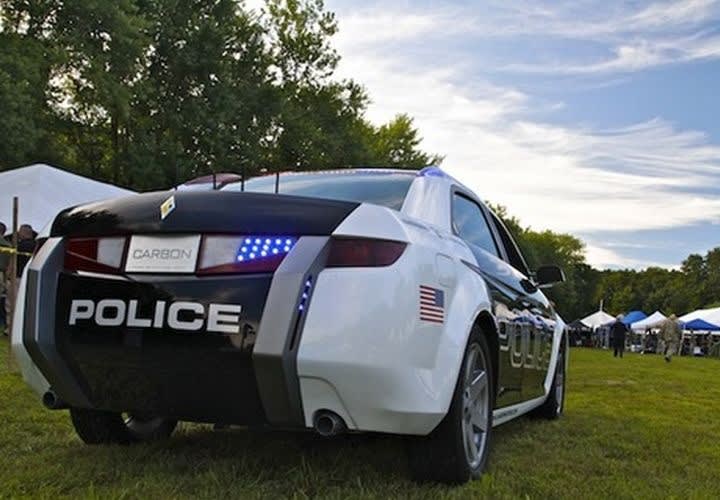
Carbon Motors' E7. Photo Credit: Carbon Motors.
Carbon Motors.
CONNERSVILLE, IN - Carbon Motors Corp. has turned to President Obama's cabinet for help moving forward its stalled police cruiser concept more than two years after submitting a federal loan application.
In an open letter to eight federal department heads and Vice President Joe Biden, the company's chairman and chief executive asked "for your help in making this happen" with the "timely approval of our ATVM loan." Approving the loan would be in the country's national security and socioeconomic interests, William Li wrote in the letter.
Carbon Motors submitted an application in late 2009 to the U.S. Department of Energy for a $310 million loan under an incentive program called the ATVM (Advanced Technology Vehicles Manufacturing) Loan Program. The program was established by Section 136 of the Energy Independence and Security Act of 2007 to stimulate more green jobs in the automotive industry.
Vehicles developed through the program must meet a higher fuel-efficiency standard—125% of the 2005 base-year CAFE fuel efficiency standards—than similar conventional vehicles.
In his letter, Li addresses each cabinet member in an attempt to make a wide-ranging case for the vehicle. The letter was sent to Attorney General Eric Holder, Commerce Secretary John Bryson, Labor Secretary Hilda Solis, Transportation Secretary Ray LaHood, Energy Secretary Steven Chu, Homeland Security Secretary Janet Napolitano, Environmental Protection Agency Administrator Lisa Jackson, and Office of Management and Budget Director Jacob Lew.
After unveiling its E7 patrol car in 2008, Carbon Motors brought the vehicle to numerous law enforcement trade shows. In late July of 2009, the company announced it would take over a former Ford factory in Connorsville, Ind., where it would produce the vehicle.
In late November of that year, the company announced that it had secured $100 million in private financing for the vehicle that allowed it to hire associates and open the factory.
At the same time, the company submitted its federal loan application. In January 2010, Department of Energy officials notified the company that it's application was "substantially complete." The company hired HOK Architects to redevelop the campus into an environmentally sustainable facility.
By June of 2010, high-grade supplier partners such as BMW, Bosch, and Inteva agreed to provide the vehicle's engine, electrical architecture, and cockpit.
The E7 patrol vehicle, which had been scheduled to be produced in 2012, is the brainchild of Stacy Dean Stephens, a former patrol officer in the Dallas suburb of Coppell, Texas.
By Paul Clinton
More Operations
Who Deserves Fleet Recognition and What Could You Teach at GFX?
Who helped shape your fleet career, and what have you learned that could help someone else?
Read More →
What’s Haunting Public Sector Fleets?
Public sector fleet challenges rarely happen in isolation, and addressing one often means understanding how it connects to another.
Read More →
Is Keeping Older Fleet Vehicles Really Saving Money?
Is keeping vehicles longer saving money, and what happens when a diagnostic test points to the wrong fix?
Read More →
How Smart Fleet Strategy Can Help Local Government Agencies Do More with Less
Keeping a vehicle longer may ease this year’s budget, but what does it cost the next one? A closer look at fleet decisions can reveal opportunities to reduce spending while protecting essential services.
Read More →
Connect with Government Fleet on LinkedIn
From industry news and fleet management strategies to conversations with peers, Government Fleet's LinkedIn page offers public-sector fleet professionals another way to stay informed and connected.
Read More →
Town of Queen Creek Named Most Successful Fleet Award Winner of Inaugural RTA Fleet Success Awards
Five fleets were honored at RTA Connect 2026 in Chicago for excellence across resource efficiency, intentional culture, risk management, and stakeholder satisfaction.
Read More →
A buyer's guide to fleet management software in 2027
Buying fleet management software in 2027 means looking beyond features and price. As fleet operations, technology and expectations evolve, this guide explores what today’s fleet professionals should consider when choosing a system that can deliver value now and adapt to what comes next.
Read More →
Hazard Alerts, Fleet Car Sales Rise and a New Shuttle Concept
Fleet car sales doubled, but the bigger picture tells a different story in this week’s roundup.
Read More →
How St. Johns County Turned Fleet Data Into Better Replacement Decisions
St. Johns County, Florida, had fleet data, but turning it into reliable decision guidance was another matter. Instead of starting over with a new fleet management system, the county connected existing tools and built a scoring system that gives managers an objective look at fleet health.
Read More →
Fleet Forward Conference Introduces One-Day Passes for 2026
New one-day registration lets fleet professionals attend Tuesday, Wednesday, or Thursday, with passes available for $249.
Read More →