




2012 Michigan Vehicle Tests: Motorcycles
Michigan State Police tested new cruisers from Victory Motorcycles -- the Commander I and Vision -- among the six police motorcycles to be offered in the 2012 model year.

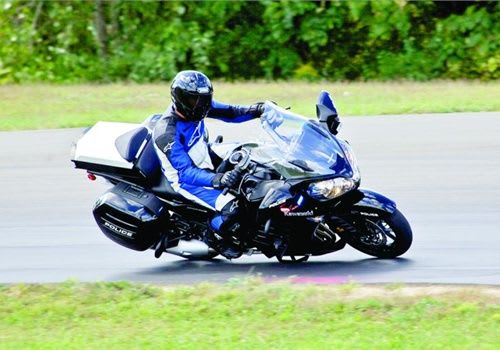
The Kawasaki Concourse 14P was one of six police bikes tested in Michigan. Photo: Michigan State Police
The Kawasaki Concourse 14P was one of six police bikes tested in Michigan. Photo: Michigan State Police
Michigan State Police tested new cruisers from Victory Motorcycles -- the Commander I and Vision -- among the six police motorcycles to be offered in the 2012 model year.
The state police also tested BMW's R1200-RTP, Harley-Davidson's Road King, Harley's Electra Glide, and Kawasaki's Concours 14P. Honda preferred to submit its ST1300 for testing by the Los Angeles County Sheriff's Department in November.
A year ago, the new-kid-on-the-block, the Kawasaki Concours 14P, turned heads at the tests, earning top honors in speed, acceleration from 0-60 mph, and 60-0 mph braking. This year, the Concours 14P-powered by a four-stroke DOHC multi-valve engine that generates 150 hp-was the quickest bike off the line.
Top speed honors went to the BMW R1200, which reached 131 mph. The Concours 14P reached 126 mph, followed by Victory's Vision (120 mph) and Commander I (117 mph). The Road King and Electra Glide reached 117 mph and 104 mph, respectively.
The Concours 14P recorded the fastest 0-60 mph increment (4.08 seconds). The BMW followed at 4.41 seconds. The Commander I and Vision reached the mark in 5.86 and 5.93 seconds, while the Road King and Electra Glide recorded times of 5.66 and 6.1 seconds.
Quick acceleration and rapid braking present hazards for motor officers who chase speeders and other traffic violators, and the new police bikes offer ABS to provide smoother braking for two-wheel riders.
This year, Harley's Electra Glide (with the batwing faring) recorded the top braking performance, needing 139 feet to reach a dead stop from 60 mph. The BMW with ABS needed 140 feet, while the Kawasaki needed 143.7 feet. Victory's Commander I and Vision needed 156.9 feet and 149.2 feet, respectively.
Harley initially introduced its Brembo braking system with the 2008 model-year bikes, and company officials were pleasantly surprised by the results.
"There are so many factors that affect braking performance with rider skill and consistency being key factors that affect how the vehicle's weight transfers to the suspension and brakes in their test," says Steven St. Thomas, Harley-Davidson's worldwide police and fleet sales director. "It appears the test riders were able to manage all these factors to get the vehicle to perform closer to its highest potential."
Tucson, Ariz.,-based Victory, a company that's new to the police motorcycle market, is pitching its bikes as purpose-built for officers. At the tests, Victory reps touted the cruisers' officer-safety features.
The Victory Commander is designed with what the company calls "integrated tip-over protection." The bike is constructed to help keep it from falling on its side. The bike will fall no further than 34 degrees and keeps its wheels on the roadway. The cycle also offers a heel-to-toe shifter with an easier path to neutral, a helmet lock, and saddle bags that can accommodate an M-4 rifle and two additional magazines.
Police departments in Pasadena, Calif., and Lenexa, Kan., have purchased the Commander I.
The Victory bikes face tough competition in a market where approximately 2,700 police motorcycles were sold in 2010. Currently, Harley sells about 80 percent of law enforcement motorcycles.
You can view a photo gallery of the vehicles tested during the 2011 Michigan State Police tests here.
Related Articles:
More Operations
Is Keeping Older Fleet Vehicles Really Saving Money?
Is keeping vehicles longer saving money, and what happens when a diagnostic test points to the wrong fix?
Read More →
How Smart Fleet Strategy Can Help Local Government Agencies Do More with Less
Keeping a vehicle longer may ease this year’s budget, but what does it cost the next one? A closer look at fleet decisions can reveal opportunities to reduce spending while protecting essential services.
Read More →
Connect with Government Fleet on LinkedIn
From industry news and fleet management strategies to conversations with peers, Government Fleet's LinkedIn page offers public-sector fleet professionals another way to stay informed and connected.
Read More →
Town of Queen Creek Named Most Successful Fleet Award Winner of Inaugural RTA Fleet Success Awards
Five fleets were honored at RTA Connect 2026 in Chicago for excellence across resource efficiency, intentional culture, risk management, and stakeholder satisfaction.
Read More →
A buyer's guide to fleet management software in 2027
Buying fleet management software in 2027 means looking beyond features and price. As fleet operations, technology and expectations evolve, this guide explores what today’s fleet professionals should consider when choosing a system that can deliver value now and adapt to what comes next.
Read More →
Hazard Alerts, Fleet Car Sales Rise and a New Shuttle Concept
Fleet car sales doubled, but the bigger picture tells a different story in this week’s roundup.
Read More →
How St. Johns County Turned Fleet Data Into Better Replacement Decisions
St. Johns County, Florida, had fleet data, but turning it into reliable decision guidance was another matter. Instead of starting over with a new fleet management system, the county connected existing tools and built a scoring system that gives managers an objective look at fleet health.
Read More →
Fleet Forward Conference Introduces One-Day Passes for 2026
New one-day registration lets fleet professionals attend Tuesday, Wednesday, or Thursday, with passes available for $249.
Read More →
ENC Unveils its ZAVIR Medium-Duty Shuttle
Two variants of the concept shuttles were revealed: a low-floor configuration and a high-floor configuration.
Read More →
Could Your Next Fleet Technician Start as an Intern?
What if your next technician hasn’t worked in a fleet shop yet? What fleets are doing to free up time.
Read More →