




Fueling Public Sector Fleets
Fuel strategies used by private sector fleets may prove useful for public sector fleets as well.
The November/December 2010 issue of Government Fleet described unpredictable fuel costs as a top 10 challenge facing public sector fleets in 2011. In fact, this prognostication has proven true as fuel prices have steadily risen in the new year, and some analysts are now predicting upwards of $4 per gallon before year's end. Fleet owners we've spoken to are concerned they will see a repeat of three years ago when budgets were under severe strain with little relief in sight.
With a rough year ahead, private and public sector fleets are focused on driving down fuel costs and achieving predictable, manageable budgets. Public sector fleets have the added pressure of relying on funding from governmental agencies with significant shortfalls. However, the private sector is no better off, as fuel costs tend to be the second largest expense (after headcount), and lower profit margins from a poor economy are driving deep spending cuts.
With public and private fleets facing similar issues, do fuel management best practices exist in the private fleet world that can benefit public fleets? Private fleets get the biggest bang for their buck by adopting outsourced fuel management - a phenomenon that has not penetrated as much in the public sector. Outsourced fuel management reduces fuel costs and the impact of price volatility by optimizing and directing all fuel management activities - from supplier and distributor selection, demand forecasting and ordering, to dispatching and invoice reconciliation. This article focuses on two key elements that should be of particular interest to public fleets: centralized fuel management and optimized supply decisions.
[PAGEBREAK]
Centralized Fuel Management
Commercial fleet managers charged with overseeing significant supply portfolios and maintaining adequate stock levels (often at multiple sites) gain more with a centralized approach to fuel management. Centralized fuel management enables commercial fleet professionals to:
Mitigate the impact of price volatility.
Implement supply decisions immediately and across the entire network.
Reduce working capital tied to oversupply of fuel.
Gain better control of pricing and the timing of fuel purchases.
Reduce overall costs.
There are many ways to accomplish a centralized fueling approach in the government sector. Some municipalities, for example, use a mix of their own bulk fuel purchases with fleet cards, essentially an "over-the-road" purchase. By increasing the utilization of bulk fuel and employing private sector best practices, such as just-in-time (JIT) inventory management, fleets optimize their control over fuel costs. For smaller municipalities that see bulk purchase as out of reach, many pool their volume with nearby cities or counties to create a bigger purchasing block.
Optimized Supply Decisions
Public fleets do not need deep knowledge of the fuel markets to reduce fuel costs. By taking advantage of available technology and fuel-buying programs, agencies can save money and gain greater predictability in their budgets. With fluctuating prices, outsourced fuel procurement and inventory management can save cents per gallon, which adds up quickly for even the smallest agencies. Large agencies with more unpredictable deployment and national (or even global) fleets can realize even greater annual cost savings.
Supply optimization can have some agencies break their reliance upon delivered pricing to fuel their fleets. Delivered pricing, meaning a fleet manager pays one fee for having fuel delivered to specific sites, reduces purchasing complexity, but a premium is paid for the service. Buying fuel at (FOB) rack means better pricing and fewer taxes due to procurement of fuel and freight separately. The public sector may also be reliant on a high percentage of contracted volumes for fulfillment, often to their disadvantage during fluctuating fuel prices. By including an optimal percentage of supply volume that is non-contracted supply, a government agency can decrease its overall fuel costs by procuring fuel when spot prices offer an advantage. However, the caveat is that in order to procure fuel optimally, managers must have access to the industry expertise and technology automation available through outsourced fuel management.
One company that utilizes outsourced fuel management is YRC Worldwide, a transportation and global logistics services provider. At one location, YRC has seen major strides in terms of inventory position and procurement. According to Laura Rome, senior procurement manager at YRC, outsourcing fuel management has provided her fleet "visibility into our inventory and helps us to make better buying decisions based on the market. Whether we are making the purchase decisions or letting [the fuel management company] make them on our behalf, we feel confident that we bought fuel at the right time and at the right price."
[PAGEBREAK]
Optimized Working Capital
Moving to a JIT inventory strategy will provide significant benefits to the fuel budget of any county, state, or federal agency. A traditional "keep it full" fuel management approach increases costs unnecessarily and ties up needed funds. Without insight into usage patterns, real-time inventory visibility, and demand forecasts, fleet managers err on the side of caution when determining the fuel inventory to keep on hand. With fuel management automation technology and experts watching fuel levels, a fleet manager maintains lower inventory levels while realizing fewer operational issues such as runouts. Adopting JIT inventory positions enables fuel buying when the price is right. In fact, it is possible to save between two to 15 cents per gallon by moving loads a day forward or a day back.
Headquartered in Paris, Veolia Environment employs 313,000 people in 74 countries. Veolia Environmental Services established itself in North America in 1984 and is a provider of solid waste, industrial cleaning, hazardous waste, and integrated waste services categories. For a company with a North American truck fleet the size of Veolia Environmental Services, fuel is a considerable expense. In the past, Veolia maintained a "keep it full" inventory approach and utilized a limited range of local suppliers, which kept fuel costs high.
After reviewing various fuel management options, the company decided an outsourcing strategy would provide the greatest savings and control over their fuel costs. By outsourcing fuel management, site managers leveraged third-party expertise to improve operational, purchasing, pricing, and financial reconciliation activities. They also gained greater visibility and transparency into fuel costs and inventory supply.
Prior to outsourcing, the company relied only on a handful of spot market quotes from local suppliers - falling victim to volatile prices. By adjusting its supply portfolio, Veolia attained the right supply and carrier mix to fit its distinct business model. At the same time, it took advantage of both indexed (primarily OPIS and Platt's) and fixed price models to generate savings wherever possible, including purchases from FOB rack, major oil companies, and distributors.
From waste management to food production, streamlining fuel management allows many organizations to get back to their core business or mission. Murphy Brown, LLC, a division of Smithfield Foods, negotiates contracts based on aggregated volumes and uses load shifting and strategic sourcing as applicable.
"We operate 450 hog farms and partner with other independent farmers and contract growers in the U.S. Our fleet delivers feed and provides quality products to the market," stated Brian Reding, logistics manager at Murphy Brown. "Outsourcing fuel management has allowed us to focus on our core business while leaving our fuel needs to the experts."
Murphy Brown fleet managers gain predictability in their operational plans and budgets by better managing fuel pricing and procurement timing. The company's large fleet with multiple terminal locations utilizes load shifting, moving loads up or back based on intra-day pricing, to help lower fuel costs. In addition, managers move fuel to other locations to optimize the procurement strategy.
[PAGEBREAK]
Cost Savings
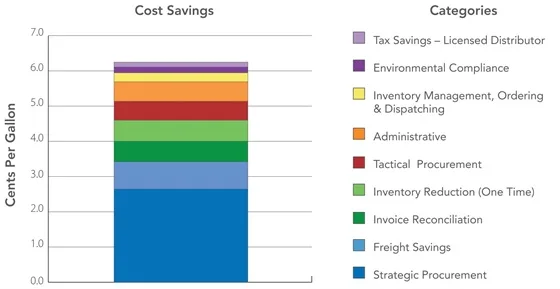
A business can save an average of 4-6 cents per gallon by implementing fuel management outsourcing strategies, and government agencies can expect to achieve the same. The subsequent graphic illustrates the cost savings available:
Can Fuel Management Work?
Good ideas can come from any sector. When it comes to gaining control over fuel costs and operational budgets, private sector fleets have discovered outsourced fuel management as a key operational strategy. Public sector fleets face many of the same issues that the private sector fleets face - and in some ways - have greater pressure to trim due to underfunded budgets. Public fleet managers have the same opportunity to change the way the government procures, manages, and accounts for fuel. By adopting tried and true best practices from the private sector, public fleet managers can drive down fuel costs, gain control in a volatile market, and ultimately keep fleet vehicles on the road in the most efficient manner as possible.
About the Author

MOSSMAN
Ryan Mossman is vice president and general manager of FuelQuest's Fuel Services. He can be reached at rmossman@fuelquest.com.
More Fuel

Clean Energy to Build Hydrogen Station for Orange County Transportation Authority
The new station will support the agency’s growing fleet of zero-emission hydrogen fuel cell buses.
Read More →
How Fleet Managers Reduce Fuel Waste and Protect Budgets
When fuel prices swing, fleet averages don’t tell the whole story. This white paper helps fleet and operations leaders uncover where fuel waste really hides and what data they need to build a smarter, more resilient fuel strategy.
Read More →
Planning for Future Technologies: Hydrogen and Beyond
As public agencies work to cut emissions from off-road operations, fleets are turning to a mix of renewable fuels, hybrid systems, battery-electric equipment and emerging hydrogen technology.
Read More →
RoadFlex Expands Fuel Network with Refuel Partnership
RoadFlex expands its fueling network for public sector fleets through a new partnership with Refuel, adding more than 250 locations across the Southeastern U.S. to improve access, savings, and efficiency.
Read More →
Rislone DEF Treatment Designed to Keep Diesel Exhaust Fluid Crystal-Free
Rislone is rolling out a super-concentrated version of its Diesel DEF Treatment that is designed to stabilize and improve diesel exhaust fluid.
Read More →
Are Bi-Fuel Propane Autogas Vehicles Making Law Enforcement Fleets More Resilient, Cost-Effective?
How a Florida sheriff office’s choice in fuel system led to a healthier budget, increased resiliency, and decreased emissions.
Read More →
Fleets All-In On Fuel Management Tech
Fuel management can become a tricky obstacle, but smart strategies and new tech have turned it into a well-oiled machine where price prediction is art, and cost control is science.
Read More →
Prepare Diesel Trucks for Winter with Diesel Exhaust Fluid
Understand proper DEF purchasing, handling, and storage practices in order to meet regulatory requirements and operates at peak performance.
Read More →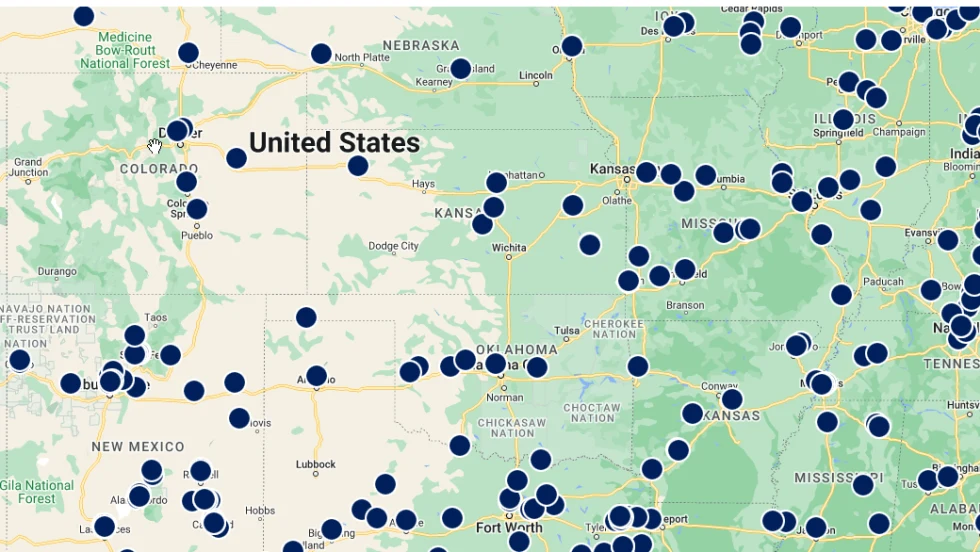
Diesel Exhaust Fluid (DEF) Locator
Yara, a diesel exhaust fluid (DEF) producer, offers a DEF locator website to help get the fluids fleets need.
Read More →
Gas vs. Diesel: The Bad Investment Only Fleet Managers Know About
A major point of debate in fleet management is using diesel vs. gas cars and trucks. Choosing to purchase gasoline engines instead of diesel ones for medium-duty trucks may be an unpopular decision, but is it the right one?
Read More →